
Rhythm of Wave
波のリズム - Nami no Rizumu
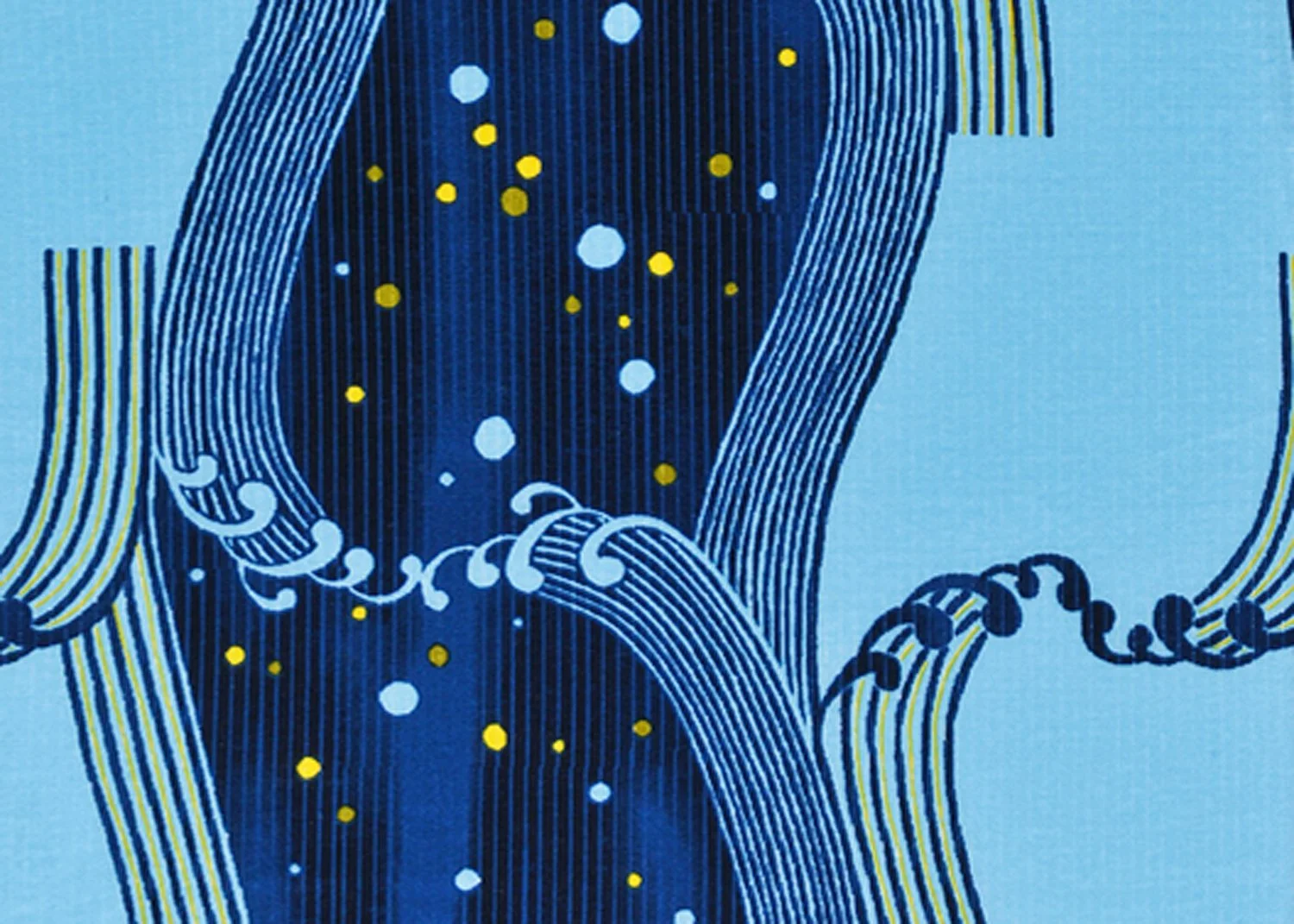
The Story of the Rhythm of Wave Pattern
This pattern originates from a kimono design of the early Shōwa period.
It was created using meisen, a textile technique that reached its peak during this time.
Meisen is produced by applying stencil-dyed patterns to the threads before weaving. Various methods were used in its production. In one approach, the warp and weft threads are arranged on the loom and then printed with a design before being woven into fabric. Another method, known as hogushi-ori (disentangled weaving), involves loosely weaving the threads into a temporary cloth, dyeing the pattern onto it, and then reweaving it while unraveling the initial weave.
Because the pattern emerges through the interweaving of warp and weft, slight misalignments between the threads create a distinctive effect in which colors appear to blur or bleed beyond the outlines. The origins of meisen can be traced back to the Edo period, when finely woven textiles were called “mesen” (or “mesen/mesen-ori”), a term believed to have evolved into “meisen.”
Despite being relatively affordable, meisen kimono featured a wide variety of bold and innovative designs, making them highly popular among women of the time. Department stores—then major trendsetters—commissioned artists and in-house designers to create an array of new patterns. Their free-spirited approach resulted in designs with a striking originality, reminiscent of modern pop art.
The motif used in this pattern is the wave. While waves have long been a traditional design element expressed in many forms, the interpretation seen here offers a fresh and unconventional perspective.
Rendered in a playful, stylized manner, the waves resemble a musical score. The splashes of water appear almost like notes dancing across a staff. As you look at this pattern, you may begin to sense a lively, uplifting rhythm—as if a cheerful melody were gently emerging from the design itself.