
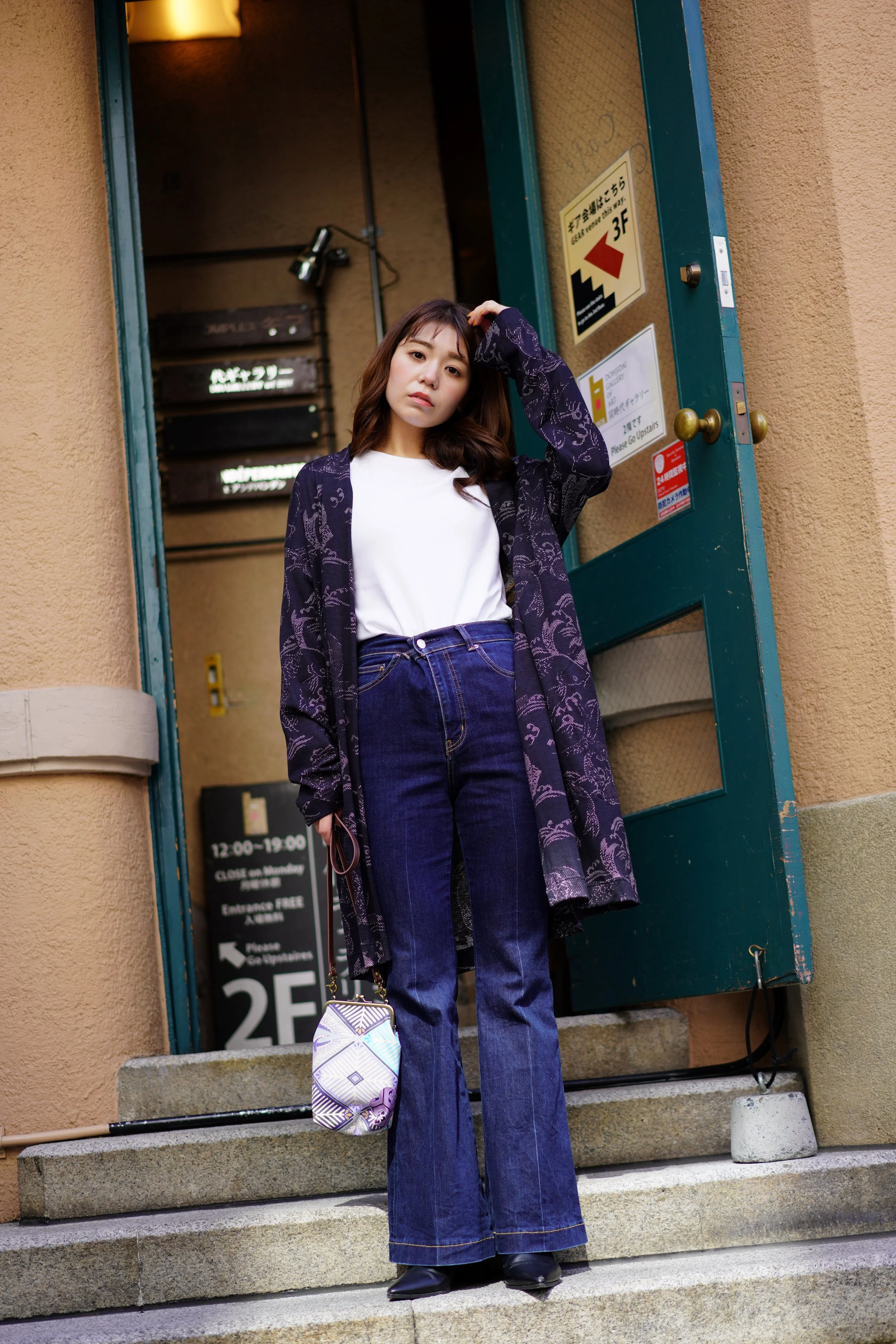


Color / Navy and White Care Instruction
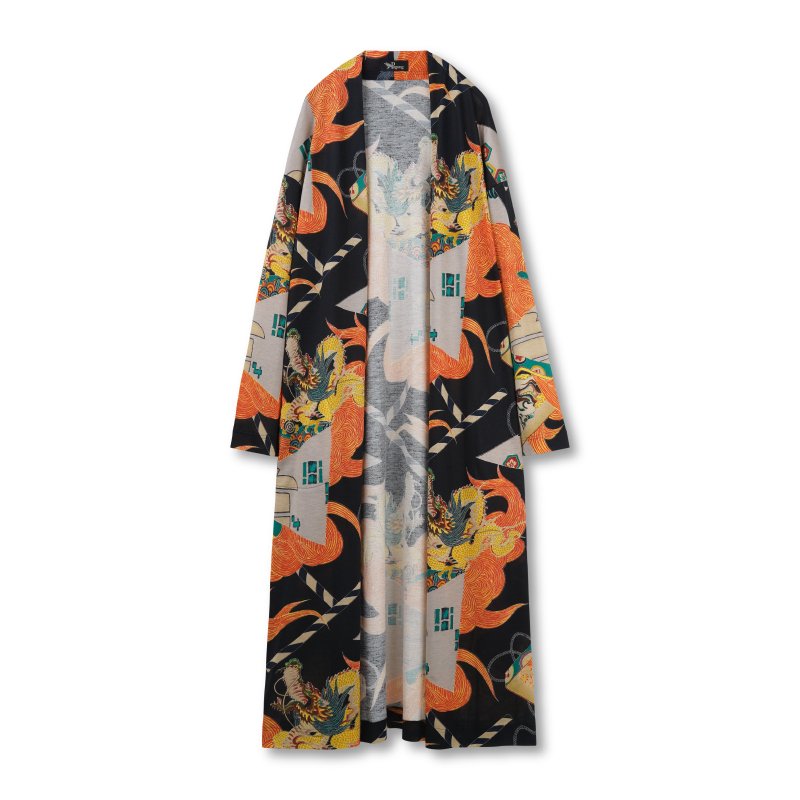
Japanese name/ <波に龍> (Nami ni Ryu)
-About-
Fuyuki Fukaiya (1975~ ) is an artist living in the Okazaki areaof Kyoto. Fukaiya’s paintings reflect his deep appreciation of Japanese traditional beauty and spirituality.
This vigorously drawn figure of a dragon rising between waves represents divine energy in a dramatically fantastic atmosphere. The dragon protects our ambitions and success, giving us power at each important turning point in life.
・Rayon 50% Cotton 50%
・One-Size-Fits-Most
・Made in Japan
・Urban style
・Hand-wash
・Currency : US Dollar (USD)
Color / Blue and Multi-color Care Instruction
Japanese name/ 花と雅楽 (Hana to gagaku)
-About-
Seasonal flowers blooming in full force, the bird helmets worn by gagaku performers, and musical instruments (drums and flutes). It exudes a truly elegant atmosphere.
Gagaku = the image of the dynasty, and this design alone gives off a gorgeous and elegant impression. At that time, the mere idea of a dynasty style was associated with good fortune.
At the beginning of the Showa period, designs of balls, medicine balls, folding fans, and other motifs with elegantly flowing strings were commonly used as patterns for children's kimonos, to the point that a collection of designs was published under the name "Goten moyo."
Originally, this pattern was called the Ouchi Daidairi pattern, which refers to a dynastic style pattern. It is a pattern reminiscent of elegant customs of court life, and has come to be considered an auspicious pattern that represents wealth and elegant harmony.
・Rayon 50% Cotton 50%
・One-Size-Fits-Most
・Made in Japan
・Urban style
・Hand-wash
・Currency : US Dollar (USD)
Color / Navy and White Care Instruction
Japanese name/ 招福だるま (Shofuku Daruma)
-About-
This design was created in collaboration with Gion Daruma, a tattoo studio in Gion, Kyoto. The main motif is the Daruma, a lucky charm that brings good luck and career advancement, with other auspicious motifs including cranes, turtles, spiny lobsters, lucky cats, and magic mallets. Each motif features a skull, which adds a playful touch and also conveys the meaning of the skull's warding off evil and rebirth.
・Rayon 50% Cotton 50%
・One-Size-Fits-Most
・Made in Japan
・Urban style
・Hand-wash
・Currency : US Dollar (USD)
Color / Black and Gray Care Instruction
Japanese name/ <乱菊> (Rangiku)
-About-
The Japanese chrysanthemum is a symbol of longevity and vitality.
Starting from the late Taisho era (1912-1926), more modern and exuberant patterns became fashionable in Japan. This depiction of “dancing” chrysanthemums was made during Japan’s “Art Nouveau Movement”, and became a very popular design for those who wished to represent the fashion style of a new era.
・Rayon 50% Cotton 50%
・One-Size-Fits-Most
・Made in Japan
・Urban style
・Hand-wash
・Currency : US Dollar (USD)
Color / Black and Yellow Care Instruction
Japanese name / 額波 ( Gakunami )
-About-
This is a collaborative design with the tattoo studio "Gion Daruma." Tattoos have been used in ceremonies, as talismans, and as customs around the world since ancient times, and have expanded into a sophisticated culture over time. The powerful wave patterns unique to Japanese tattooists are expressed using Yuzen dyeing.
・Rayon 75% Cotton 25%
・One-Size-Fits-Most
・Made in Japan
・Urban style
・Hand-wash
・Currency : US Dollar (USD)
Color / Black and Golden Yellow Care Instruction
Japanese name / 龍神 (Ryujin)
-About-
A deity of the sea in Japanese mythology, RYUJIN or “Dragon God”, has the powerful capability to transform into a human shape, and is the master of serpents. With his magic jewels he is responsible for the tides, and represents both the perils as well as the bounty of the sea.
Ryujin is one of the eight dragon gods which were originally imported from Indian mythology via China and Korea. His residence is in a palace beneath the sea or in a lake of an extinct volcano. The depths of Lake Biwa, north-east of Kyoto, are often cited as the home of Ryujin.
・Rayon 75% Cotton 25%
・One-Size-Fits-Most
・Made in Japan
・Urban style
・Hand-wash
・Currency : US Dollar (USD)
Color / White,Black and Grey Care Instruction
Japanese name/ けし
-About-
The poppy blooms from April to June, and its beautiful flower and shape of its fruit make it an ideal subject for kimono design. This pattern has a painterly feel, depicting a poppy blowing in the wind with rich expression and careful attention to detail.
・Rayon 75% Cotton 25%
・One-Size-Fits-Most
・Made in Japan
・Urban style
・Hand-wash
・Currency : US Dollar (USD)
Color / White,Blue and Navy Care Instruction
Japanese name/ 猫の歌舞伎 (Neko no Kabuki)
-About-
One of three Museum Collection patterns at Pagong inspired by great ukiyo-e masters of the Edo-era, “Kuniyoshi Loves Cats!”. The composition for this pattern is actually based on two ukiyo-e works by Kuniyoshi Utagawa who lived from 1797 to 1861, in Edo (modern-day Tokyo).
The son of a kimono silk-dyer, Kuniyoshi apprenticed from the age of twelve in the tradition of ukiyo-e woodblock printmaking. As an adult artist, Kuniyoshi became quite well-known for his prints depicting Kabuki actors and beautiful courtesans. However, when the ruling shogunate placed an official ban on the making of prints depicting the popular actors and courtesans, (reflecting his love of felines), Kuniyoshi ingeniously began to use his own charming and beloved cats as his subjects,“cats that have been well-loved”, he liked to say.
Creating hundreds of works of his own cats “playing humans”, Kuniyoshi packed each print with his witty, entertaining style, and often his friends told, while having a cat cozily sleeping in the folds of his kimono as he worked.
Neko no Hyakumensou and Hayarineko no Tawamure are the prints used in the making of Kuniyoshi Loves Cats!
A collaboration with GALLERY BENIYA.
・Rayon 75% Cotton 25%
・One-Size-Fits-Most
・Made in Japan
・Urban style
・Hand-wash
・Currency : US Dollar (USD)
Color / Black and Grey Care Instruction
Japanese name/ 鯉 (Koi)
-About-
In Japan, the carp or koi, represents good luck, prosperity, and good fortune. Also, the word “koi” is pronounced the same as another word meaning love and affection.
The Chinese legend of “The Dragon’s Gate on The Yellow River” is well-known in Japan. The story tells of a carp swimming up a waterfall, evolving into a dragon, which ultimately leads to enlightenment. Based on this legend, Japan has the custom of “Koinobori“, or flying fish banners on Boy’s Day, with the hope that their male child or children become great dragons (strong men) in the future. Being highly respected and closely tied to Japan’s national identity, the carp signifies perseverance (due to the tendency of fish to swim upstream), and steadfastness, for the overcoming of obstacles with ultimate victory, no matter what the odds.
Color is also relevant when it comes to traditional Japanese carp. Black carp symbolize love and the facing of challenges, with red carp indicating energy and vitality. The most highly-prized is the white carp, with a red dot on its forehead which resembles the Japanese flag.
・Rayon 75% Cotton 25%
・One-Size-Fits-Most
・Made in Japan
・Urban style
・Hand-wash
・Currency : US Dollar (USD)
Color / Cream White and Multi-color Care Instruction
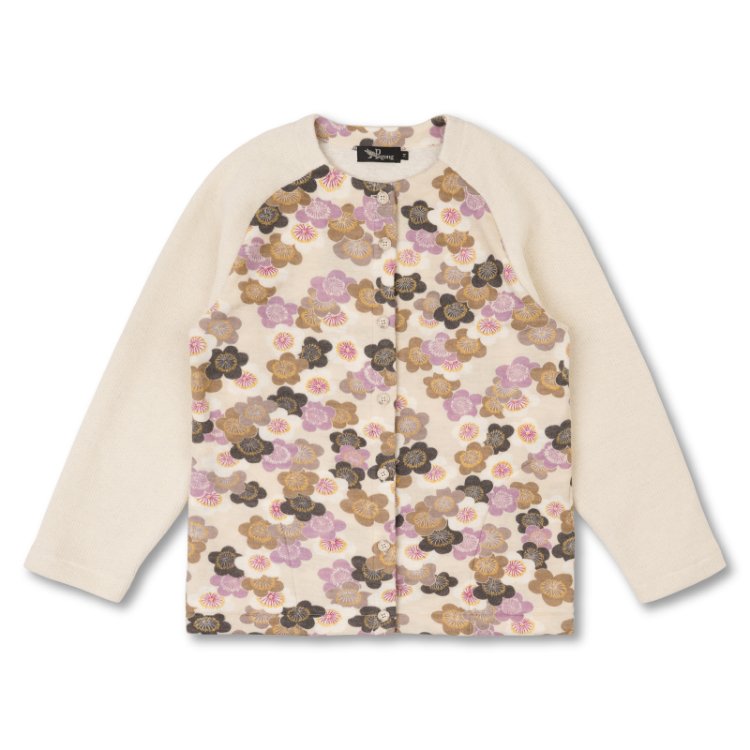
Japanese name/ 梅花ちらし (Baika Chirashi)
-About-
They were introduced to Japan before the Nara period, and it is said that aristocrats competed to plant them in their mansions. Before they were replaced by cherry blossoms, the word "flower" meant "plum," and the Man'yoshu contains many poems about plum blossoms.
Plum blossoms bloom before all other flowers in the harsh winter, and because they give off a fragrant fragrance, they are considered to be a symbol of perseverance and vitality, and are considered to be auspicious flowers.
There is also a legend that plum blossoms beautifully when academics flourish, and they were popular among common people in the Middle Ages due to their connection with Tenjin faith.
・Wool 100% (Plain part)
・38% wool 41% cotton 21 % nylon
・Made in Japan
・Hand-wash
・Currency : US Dollar (USD)
Color / Two - Tone Chest - Coal Black and Black
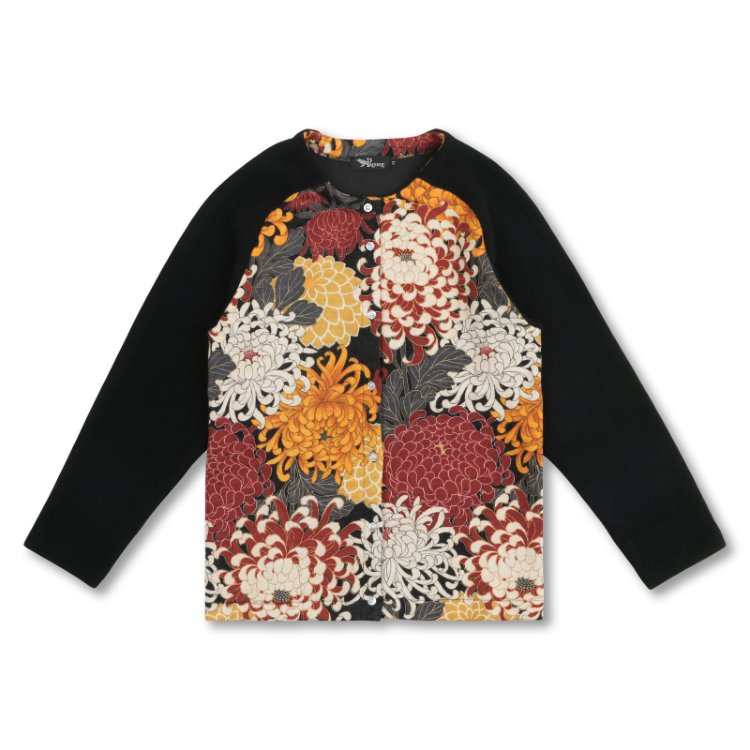
Japanese name/ 乱菊 (Rangiku)
-About-
The Japanesechrysanthemum is a symbol of longevity and vitality.
Starting from the late Taisho era (1912-1926), more modern and exuberant patterns became fashionable in Japan. This depiction of “dancing” chrysanthemums was made during Japan’s “Art Nouveau Movement”, and became a very popular design for those who wished to represent the fashion style of a new era.
・Wool 100% (Plain part)
・38% wool 41% cotton 21 % nylon
・Made in Japan
・Hand-wash
・Currency : US Dollar (USD)
Color / Black and Multi-color Care Instruction
Japanese name/ 百年の鶴 (Momotose no Tsuru)
-About-
In Japanese mythology, tsuru, or the crane, comes from Mount Horai in heaven, and carries happiness and good luck to earth. Since the crane was believed to live 1,000 years, in Japan it has become a symbol for survival, and long life.The matsu, or pine, in reality, can live for up to 1,000 years; therefore it also, is a symbol for long life, as well as strength.The ume, or plum, blooms in the harsh, cold winter; therefore is a symbol for vitality, and life-force.In 2019, in order to celebrate the 100th Anniversary of our founding company Kamedatomi LTD, this exquisite pattern was especially chosen to represent our sincere wish for everyone: “One Hundred Years of Happiness, Continued Good Health, and a Long Prosperous Life“.
・Wool 100% (Plain part)
・38% wool 41% cotton 21 % nylon
・Made in Japan
・Hand-wash
・Currency : US Dollar (USD)
Color / Black and Multi-color Care Instruction
Japanese name/ 大輪菊 ( Dairingiku )
-About-
Kiku, or chrysanthemums, were introduced to Japan from China in the Nara-era ( 710-794 ). In Japan, the chrysanthemum has become a symbol for the emperor and appears on the Japanese imperial seal. In the language of flowers, the chrysanthemum carries the symbolic meaning of devoted love, loyalty, happiness, longevity, and joy.
・Wool 100% (Plain part)
・38% wool 41% cotton 21 % nylon
・Made in Japan
・Hand-wash
・Currency : US Dollar (USD)






Color / Green and Multi-color Care Instruction
Japanese name/ <鷲> (Washi)
-About-
In Japan, court nobles and samurai have used eagles for hunting since ancient times. Their use as design in samurai family crests was due to the heroic image of an eagle flying through the sky.
It was first used as a kimono pattern in the late Edo period, in combination with other auspicious patterns.
In modern times, it can often be seen as a pattern for boys clothing and Shichi-Go-San kimono.
This particular pattern, which depicts a sharp-eyed eagle perched on a large rock floating in the ocean, was used for boy baby clothes.
It symbolizes the wish to "grow up to be strong and become a champion!"
・Rayon 50% Cotton 50%
・One-Size-Fits-Most
・Made in Japan
・Urban style
・Hand-wash
・Currency : US Dollar (USD)