
Bamboo and Various Flowers
竹に花尽くし - Take to Hanatsukushi
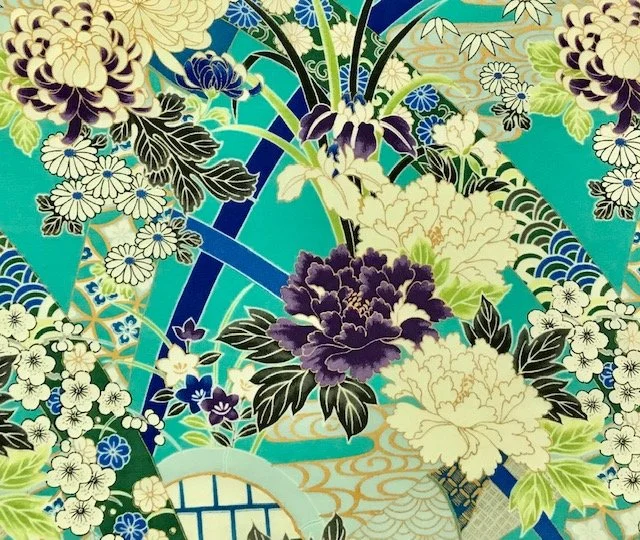
The Story of the Bamboo and Various Flowers Pattern
This pattern, depicting bamboo and flowing water set against a backdrop of seasonal flowers, is a reproduction of a relatively modern furisode design from the 1960s–70s. While contemporary in origin, it draws deeply on traditional motifs, where each flower not only represents its season but also carries auspicious meaning—symbols of good fortune and favorable signs.
Peonies, known as the “flowers of wealth and nobility,” are believed to bring prosperity and abundance. Chrysanthemums, introduced during the Nara period as medicinal plants, are associated with longevity; it is said that drinking chrysanthemum-infused sake on the Double Ninth Festival (September 9) grants long life. Plum blossoms, which bloom in the cold of late winter before other flowers, symbolize resilience and the strength to endure adversity—an ideal long admired in Japanese culture.
In the background, bamboo appears as abstract silhouettes, within which various patterns are subtly arranged. Bamboo has long been revered as a symbol of integrity and noble character: it grows straight, its joints are firm, it bends without breaking under wind or snow, and it remains evergreen throughout the year. It is also a symbol of growth and vitality, as young shoots rise rapidly from the earth in spring.
Its spiritual and mythical significance is reflected in The Tale of the Bamboo Cutter, written during the Heian period, where Princess Kaguya is discovered within a bamboo stalk. The hollow spaces between bamboo nodes were once imagined as liminal realms—points of connection between the human world and the divine.
Water motifs further enrich the design. Patterns such as kanze-sui express the ever-changing, fluid nature of water, while seigaiha—depicted here within the bamboo forms—represents overlapping waves extending endlessly toward the horizon. This sense of infinite motion makes it an auspicious symbol of eternity, continuity, and peaceful living.
Since ancient times, people in Japan have lived in close harmony with nature, finding meaning and good fortune within its forms and rhythms. Even as styles evolve, this enduring desire to embody the auspicious power of nature within design continues to be passed down to the present day.