
Birds and Animals in the Flower Garden
鳥獣花木図屏風 - CHOJUKABOKUZU
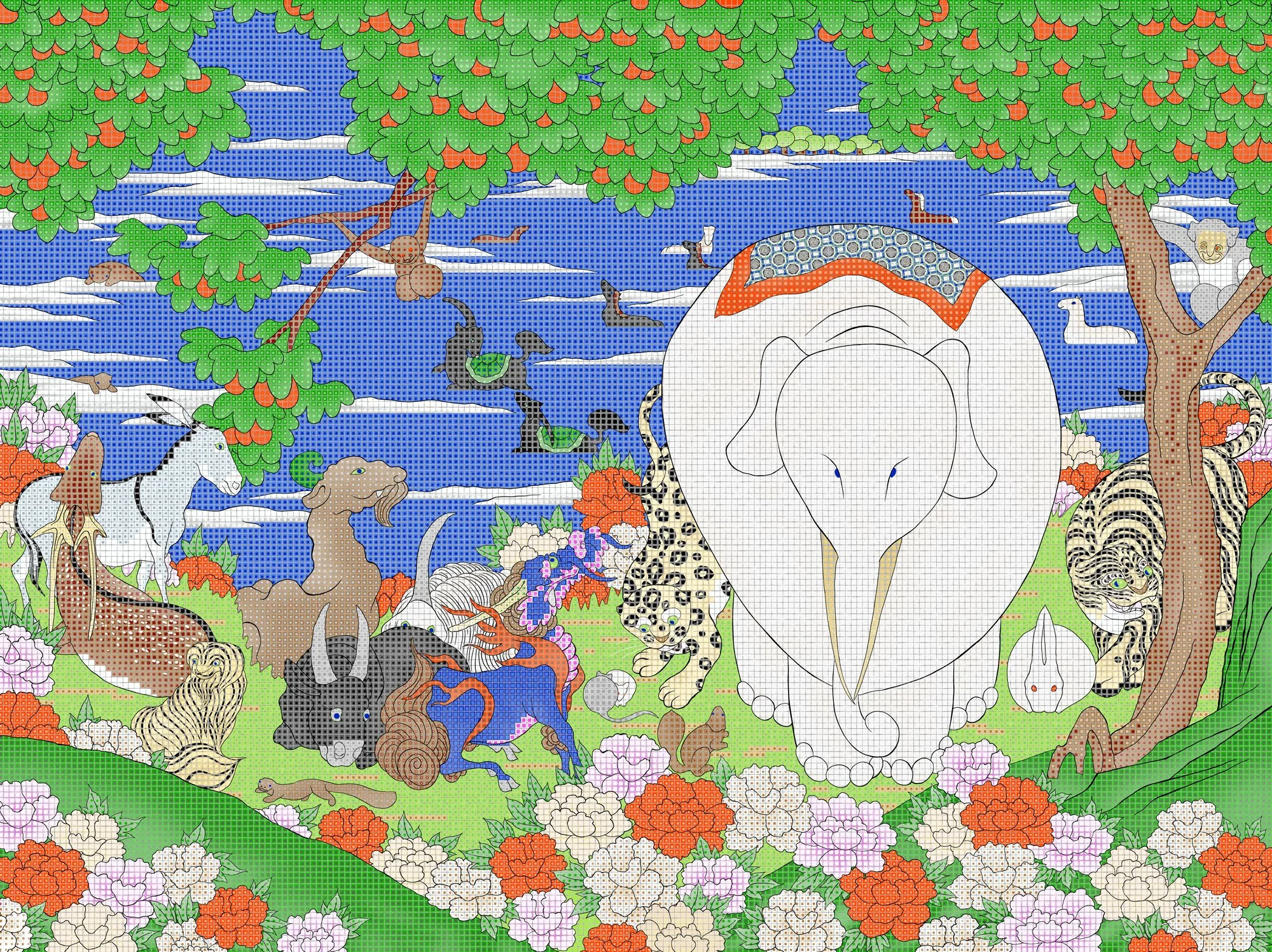
The Story of the Birds and Animals in the Flower Garden Pattern
Ito Jakuchu (1716–1800) was a painter active in Kyoto during the mid-Edo period.
Born as the eldest son of the Masuya greengrocer on Nishikikoji Street in Kyoto, he inherited the family business at the age of 23 and took the name Ito Genzaemon IV. At 40, he passed the business to his younger brother and retired, devoting the rest of his life entirely to painting.
With the cooperation of the Idemitsu Museum of Arts, Pagong has undertaken a Kyoto Yuzen dyeing project to recreate Ito Jakuchu’s “Birds, Animals, Flowers, and Trees Screen,” formerly part of the Price Collection.
This folding screen, featuring charming depictions of animals—including a white elephant—showcases Jakuchu’s highly original artistic vision through his distinctive grid-based composition technique.
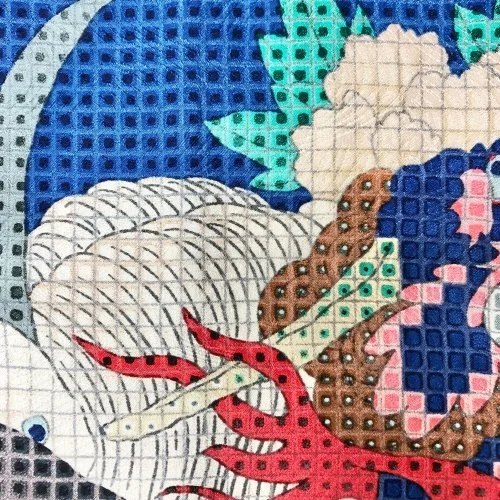
The work is created using a method known as masume-gaki (grid painting), in which the entire surface is divided into a lattice-like structure. A preliminary sketch is placed within this framework, and color is applied square by square to complete the image. This method is believed to have been uniquely developed by Jakuchu, possibly inspired by the grid structures used in Nishijin textile design drafts.
To faithfully reproduce this precise, segmented composition in Kyoto Yuzen dyeing, the design required as many as 24 separate stencils.
The original Birds, Animals, Flowers, and Trees Screen is a pair of six-panel folding screens. Pagong has reproduced the right-hand screen, which features a white elephant surrounded by a multitude of animals, using Yuzen dyeing techniques.
A design formed by repeating multiple motifs of the same type is known as tsukushi. Because it gathers numerous identical elements, it is considered an auspicious pattern, and this composition also carries that celebratory meaning.
In addition, folding screens decorated with birds, animals, flowers, and trees are often associated with a paradisiacal world, evoking a sense of harmony and abundance.
The elephant itself is also a traditional auspicious motif symbolizing strength and wisdom. In particular, the white elephant holds Buddhist significance as the mount of Fugen Bodhisattva, further enhancing the sacred and fortunate nature of the design.