
Bushido
武具の図 - Fugu no zu
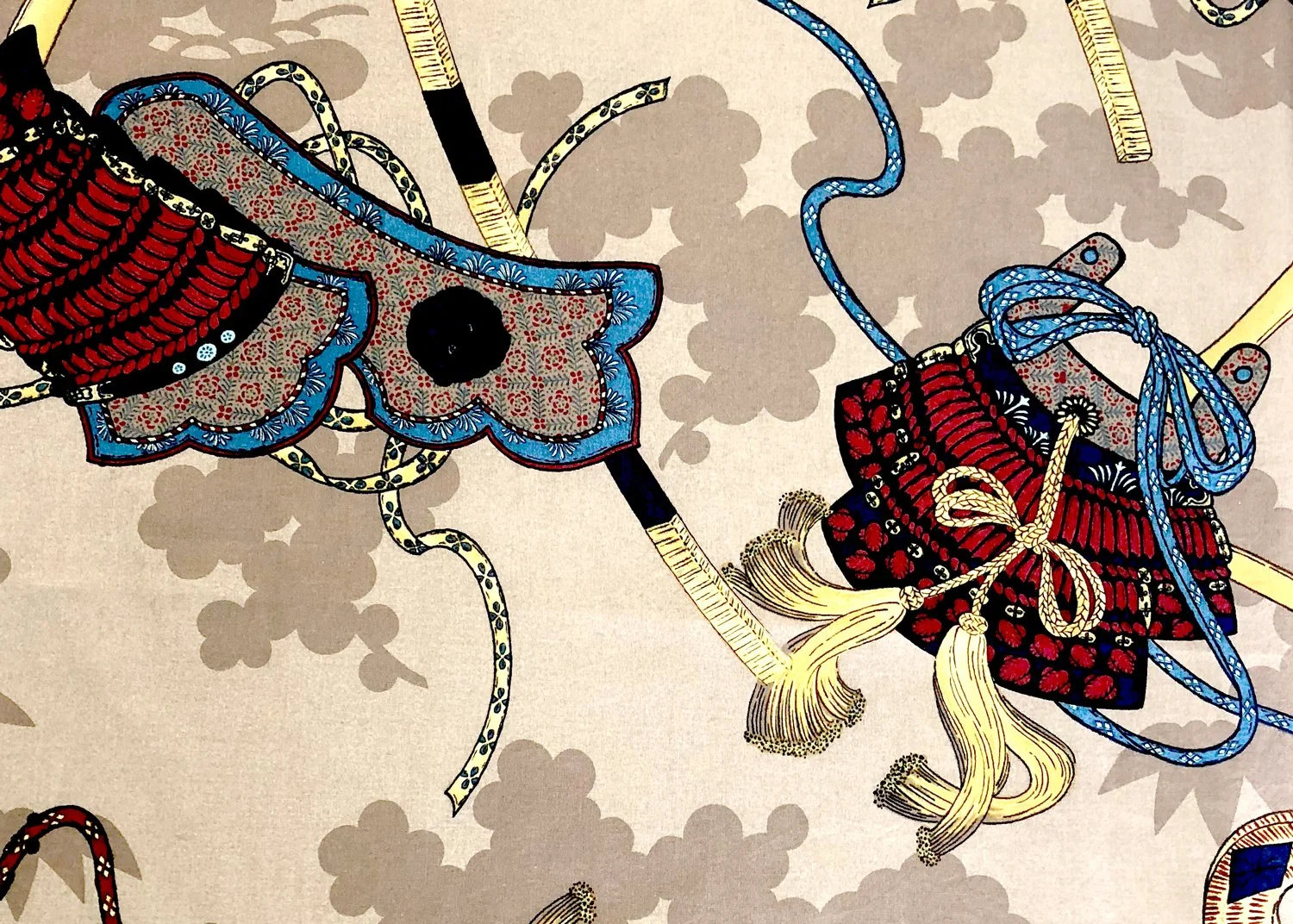
The Story of the Bushido Pattern
This pattern originates from a men’s undergarment of the Taishō period and depicts elements of a magnificent suit of samurai armor.
For the samurai, whose lives were devoted to martial readiness, armor was more than protective gear—it also served as formal attire, expressing authority and prestige on important occasions. Representative types of Japanese armor include the ō-yoroi, used from the Heian to Kamakura periods and designed for mounted archery, and the tōsei-gusoku, developed later for more active, ground-based combat.
With the rise of peace following the establishment of the Tokugawa shogunate under Tokugawa Ieyasu, armor gradually lost its practical necessity. Even so, it continued to be treasured as a symbol of samurai authority and as a reminder of the courage and discipline expected in times of need.
In samurai households, a full set of armor (gusoku) was often displayed in the alcove during the New Year and seasonal festivals, serving to instill the warrior spirit. This custom lives on today in the form of decorative armor displayed for Tango no Sekku. Samurai armor itself represents a culmination of diverse craftsmanship—metalwork, braiding, lacquer, and dyed leather—making it a comprehensive work of both functional and artistic excellence.
From the Meiji to Taishō periods, admiration for this refined craftsmanship, along with the belief that armor motifs symbolized strength and victory, led to their popularity in men’s undergarments and kimono linings.
This design features details such as riding whips used to command troops and control horses, as well as tsurumaki (bowstring winders), crafted by weaving vine bark into rings to hold spare bowstrings. The kuwagata—the horn-like crest mounted on the front of a helmet—is depicted independently, without the helmet itself. Additional elements include the nodowa (neck guard) and the sendanita and kyūbiita, decorative attachments placed on the chest of ō-yoroi armor.
The sendanita shown here is made of dyed leather decorated with iris (shōbu) and hanakatsumi motifs—both associated with victory—making it an especially auspicious design symbolizing triumph.
Since ancient times, the dyed leather used in armor has often featured powerful protective imagery, such as fierce deities and mythical beasts. The cords that bind the small armor plates together are also dyed in auspicious colors, including deep indigo—known as kachi-iro (“victory color”)—and red, believed to ward off evil. Through such elements, armor embodied not only physical protection but also prayers for good fortune and divine protection.