
Camellia
椿 - Tsubaki
The Story of the Camellia Pattern
The Japanese word for camellia, tsubaki, is written with the characters for “tree” and “spring,” literally meaning “the flower that heralds spring.” An evergreen native to Japan, the camellia has long held an important place in traditional belief. In ancient times, it was seen as a sign of renewal—blooming as winter waned, it symbolized the return of sunlight and the revival of the earth’s life force.
During the Heian period, camellia wood was used to craft uzue, ritual staffs employed in New Year ceremonies at shrines to ward off evil spirits. For this reason, the tree was revered as sacred, believed to possess protective and spiritual power.
Camellia motifs also appear in works such as Kamakura-bori carvings on the oi—portable chests carried by Shugendō practitioners—suggesting a close connection to these beliefs. Later, from the time of Sen no Rikyu, camellias became highly valued in the tea ceremony, appreciated for their quiet beauty and often displayed in alcoves or cultivated in tea gardens.
On the other hand, because camellia blossoms fall whole from the branch, they were sometimes avoided by samurai families, as this was thought to resemble a severed head and was considered inauspicious. As a result, the flower was rarely used in family crests. Nevertheless, from the Muromachi period onward, camellia motifs gained popularity in textile design, particularly in the rich and expressive Tsujigahana style.
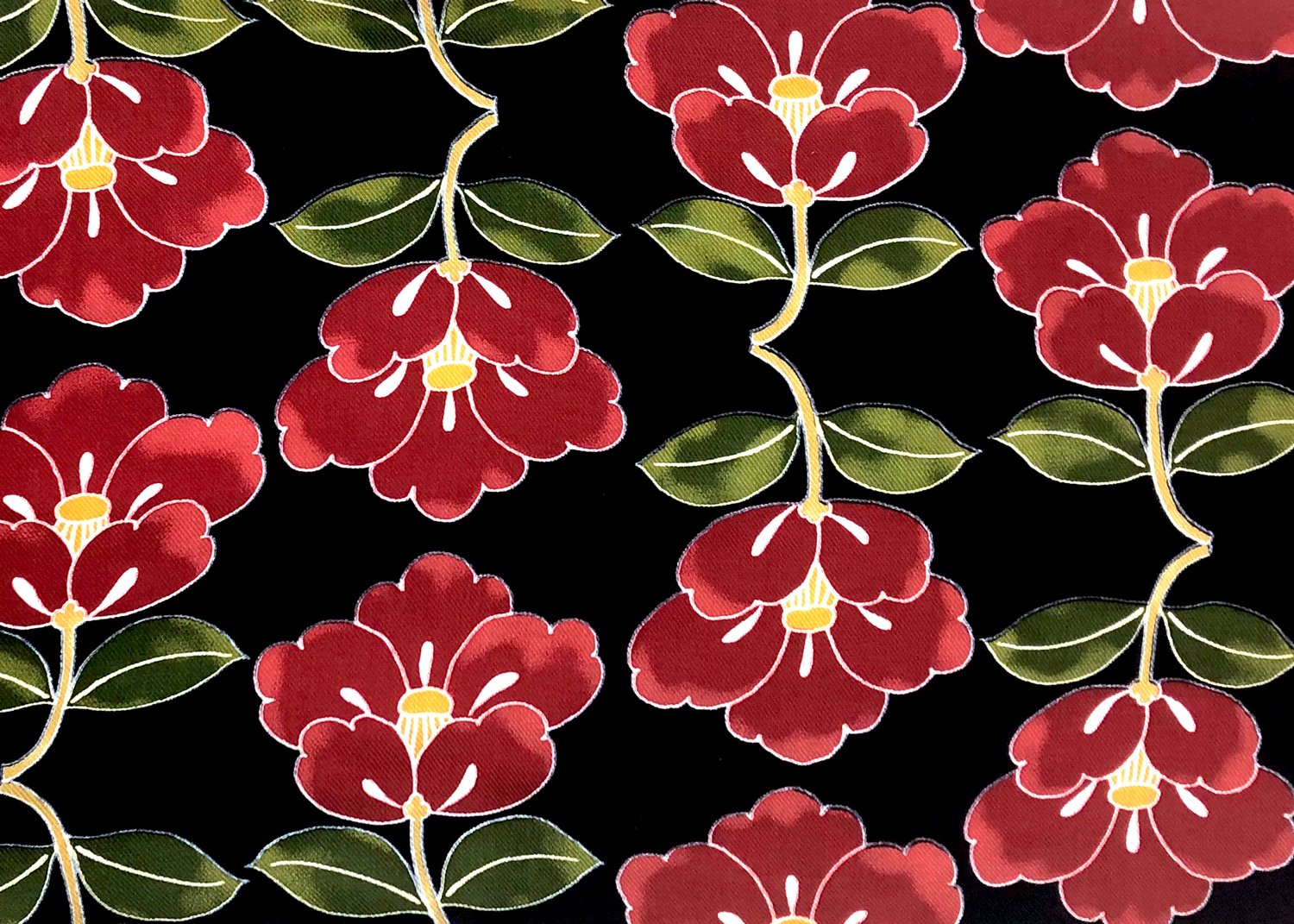
This particular pattern dates to the late Showa period and presents the camellia in a modern interpretation. It appears to draw inspiration from the stylized “Enshū camellia” associated with Kobori Enshu, giving the design a slightly Western-influenced aesthetic compared to more traditional kimono patterns.
A defining feature of this design is its symmetrical composition: a single camellia is mirrored along the axis of its branching stems, creating a repeating pattern. This sense of continuity lends not only visual harmony but also conveys the idea of unbroken flow—an enduring wish for permanence that has long resonated with people.
Wearing this pattern evokes both protection and blessing, as if inviting good fortune while gently warding off misfortune—perhaps even suggesting a happiness that continues without end.