
Cat and Paperball
猫と紙風船 - Neko to Kamifusen
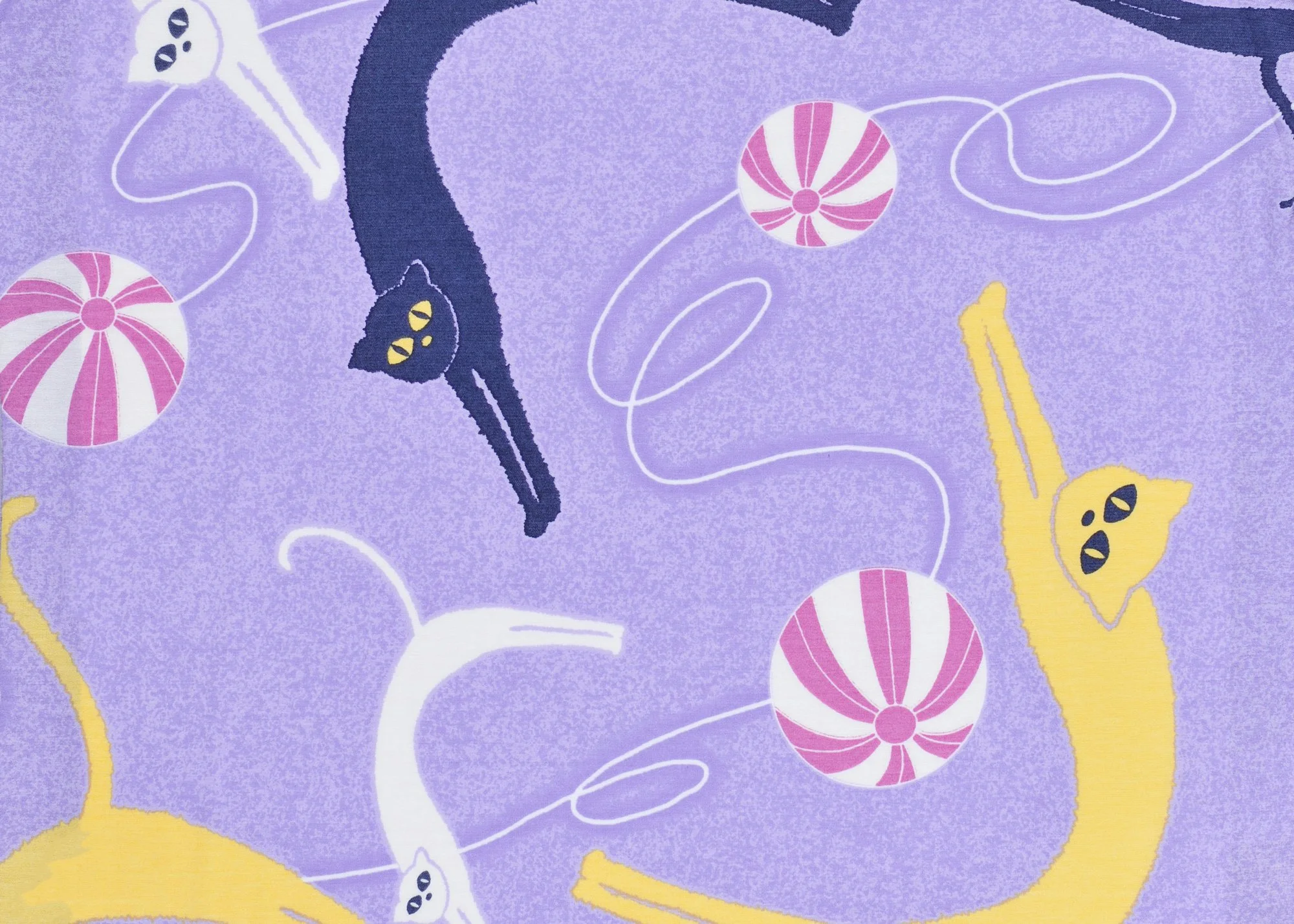
The Story of the Cat and Paperball Pattern
Cats are believed to have first been domesticated by humans for practical purposes, such as controlling pests like mice and snakes. In Japan, they were introduced from the Asian continent during the Nara period to protect Buddhist scriptures from rodent damage.
It is thought that cats began to be kept as companion animals around the Heian period. In The Pillow Book, the episode “The Cat Who Serves at Court” describes how Emperor Ichijō and Empress Teishi were devoted cat lovers. Unlike today, cats were relatively rare at the time, and it was common to keep them indoors with collars.
During the Edo period, when real cats were still considered valuable, images of cats were sold as talismans to ward off mice. For sericulture farmers, who needed to protect silkworms from rodents, cats may have been regarded almost as guardian figures.
In earlier periods, cat motifs were rarely seen on kimono. It was only from the Taishō and Shōwa periods onward that such designs gradually became more common. Although uncommon in textile patterns, cats frequently appeared in ukiyo-e prints—most notably in the works of Utagawa Kuniyoshi, who was known for his deep affection for them—showing that cats have long been cherished companions.
In East Asian traditions, the word for “cat” shares its pronunciation with a character associated with longevity, and thus cats came to be regarded as auspicious symbols of long life. This may also reflect the image of cats as gentle companions that stay close to people and quietly witness the passage of their lives. Cats were also carried aboard merchant ships along major trade routes to control rodents, and their charming presence is said to have comforted sailors far from home.
In this way, cats have lived alongside humans across cultures and centuries, quietly observing the course of life.
When depicted as a motif, cats are often paired with round objects—such as balls, bells, or yarn—playfully interacting with them. In this design, the cat is combined with a paper balloon. Rendered in a rhythmic, modern style reminiscent of the Taishō and Shōwa eras, the pattern vividly captures the endearing and lively spirit of cats, long beloved as companions close to everyday life.