
Chicken
にわとり - Niwatori

The Story of the Chicken Pattern
Since ancient times, the rooster has been believed to ward off evil spirits.
In ancient Persia, the crowing of a rooster was thought to drive away darkness and the air of night, and it was revered as a sacred bird that protected life from the demons of the night.
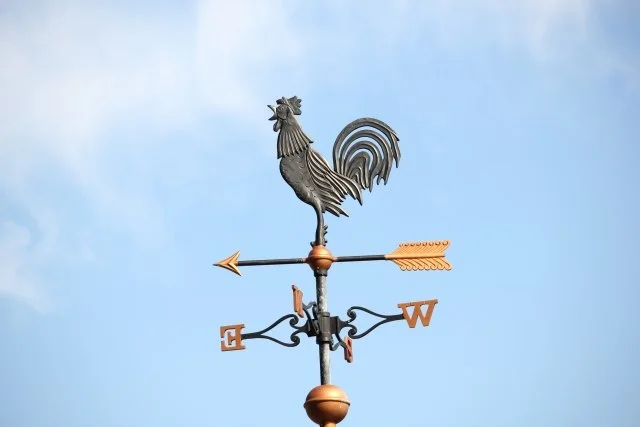
In the West, the rooster—announcing the end of the night ruled by evil—came to be honored as a messenger of the divine. This symbolism lives on in the form of weathercocks, which are still seen today atop churches and houses across Europe. While they serve as wind vanes, they are often said to have originally been placed as talismans to ward off evil.
According to Greek and Roman mythology, when Mars spent a night with Venus, he assigned a servant named Alectryon to stand guard. However, Alectryon fell asleep, causing a great commotion. As punishment, he was transformed into a rooster, and since then, the rooster has been said to announce the coming of dawn.

The earliest appearance of the rooster in Japanese literature can be found in the Kojiki. When Amaterasu hid herself inside the Heavenly Rock Cave, plunging the world into darkness, the myriad deities gathered and caused the Tokoyo no Naganaki-dori—a long-crowing bird, believed to be a rooster—to cry out. Together with the dance of Ame-no-Uzume, this drew Amaterasu out and restored light to the world. In this myth, the rooster appears as a being that calls forth the sun itself.
There is even a theory that the torii gates found at Shinto shrines originated from perches placed for these sacred birds before the gods, reflecting how highly revered the rooster once was.
Beyond mythology, roosters were also valued in everyday life as timekeepers up until the Edo period. Their crowing marked the hours of the night: the first crow (ichiban-dori) was said to sound during the Hour of the Ox (around 2 a.m.), and the second (niban-dori) during the Hour of the Tiger (around 4 a.m.). Since ancient times, the rooster has been a familiar and essential presence, announcing the passage of time.
This pattern, which depicts roosters in a playful and stylized manner, may evoke a more Western impression than the traditional Japanese image. Yet across cultures, the rooster as a herald of time carries a shared message—perhaps reminding us that time is precious.