
Cranes
鶴 - Tsuru
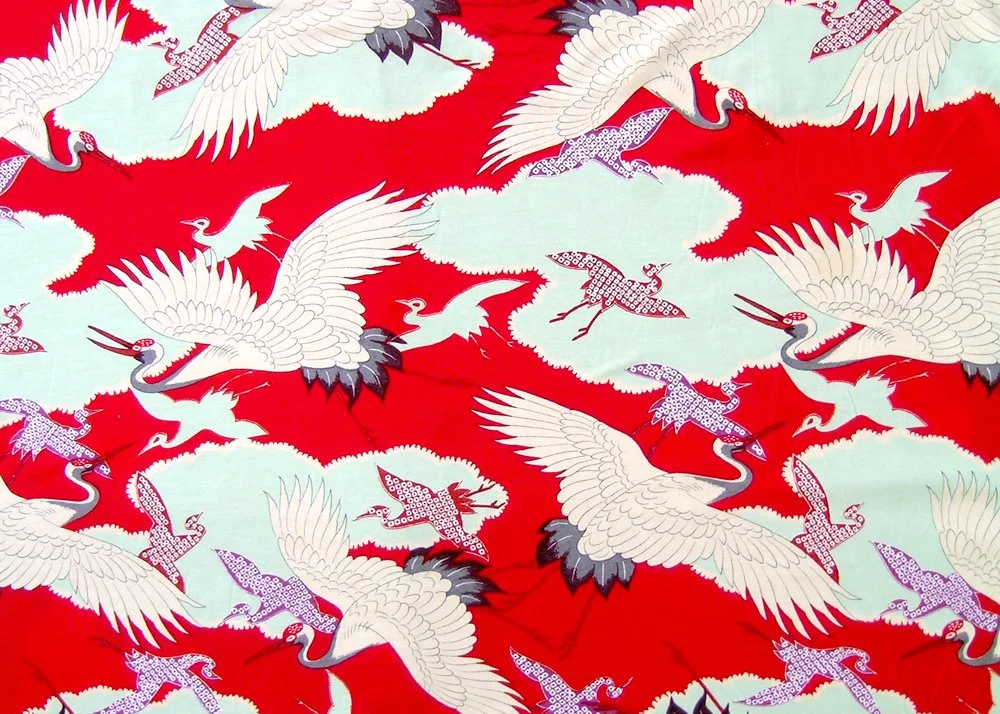
The Story of the Cranes Pattern
As the saying goes, “Cranes live for a thousand years, turtles for ten thousand,” cranes have long been regarded as auspicious symbols of longevity in Japan.
Graceful both in flight and at rest, cranes have been widely used as decorative motifs since ancient times, appearing on kimonos, crafts, and family crests. With their striking black-and-white plumage, red crowns, and elegant, slender forms—often imagined standing in snowy landscapes—the red-crowned crane can be seen as one of the most iconic birds of Japan. Their deep connection to Japanese culture is also reflected in well-known folktales such as “The Crane’s Return of a Favor.”
This pattern, known as “Crane in the Clouds,” depicts cranes soaring high above the clouds, symbolizing individuals of exceptional character who rise above the ordinary. The crane’s call is said to reach the heavens, serving as a metaphor for how the virtue and greatness of a person can become known far and wide.
Within the design, some cranes are shown with their beaks closed, while others are open. This expresses the concept of “A” and “Un,” representing the beginning and end of all things. As reflected in the phrase Aun no kokyū—perfect harmony—this pairing suggests balance, unity, and the idea that harmony between two beings gives rise to prosperity and happiness.
Cranes are also associated with sacred, otherworldly realms—places of peace and abundance where nature flourishes in perfect harmony. They are imagined as birds that move freely between such realms and the heavens, carrying blessings with them. Because of this, cranes have long been seen as messengers of good fortune, bringing happiness from beyond into the human world.