
Dairingiku
大輪菊
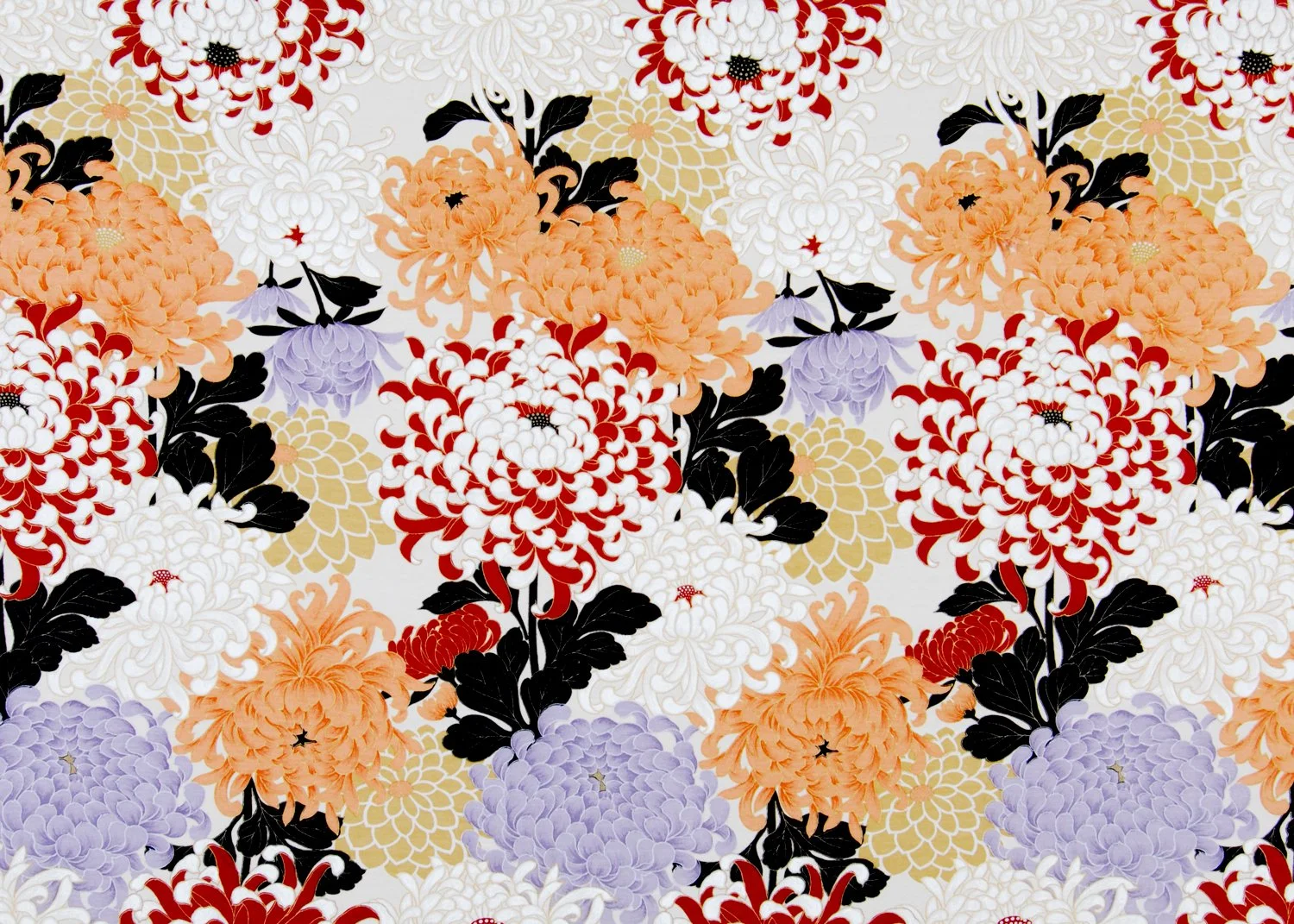
The Story of the Dairingiku Pattern
uring the Meiji era, a Nishijin-ori maru-obi featuring a large chrysanthemum motif was exhibited at a European exposition and received the grand prize. This reflects the high regard in which Japanese chrysanthemums—renowned for their diverse varieties and large, refined blossoms—were held in Europe. Alongside the rise of Japonism, chrysanthemum motifs also became widely adopted in Western women’s fashion and interior textiles.
The chrysanthemum was introduced to Japan during the Nara period, originally valued for its medicinal properties. Perhaps because of this practical origin, chrysanthemums do not appear in the Manyoshu, the ancient anthology that celebrates flowers through poetry. It was not until the Heian period that chrysanthemum cultivation and appreciation began to take root within court culture, where the flower came to symbolize refinement and aristocratic elegance. References in The Pillow Book and The Tale of Genji suggest that chrysanthemums were already being cultivated and admired in elite circles at the time.
The chrysanthemum also became associated with imperial authority during this period. Although the paulownia crest had been used earlier as a formal emblem, the chrysanthemum crest gained prominence, particularly during the Kamakura period under Emperor Go-Toba, who was known for his deep admiration of the flower. It was used across garments and furnishings, gradually becoming a symbol of the imperial household. By the Meiji era, it was formally established as the imperial crest, and its use was restricted exclusively to the imperial family.
Meanwhile, chrysanthemums became widely popular among the general population during the Edo period. Under the influence of Tokugawa Ieyasu and successive shoguns, flower appreciation and gardening culture flourished among daimyo, samurai residences, temples, wealthy merchants, and even rural communities. In Edo, chrysanthemum doll displays were even created as popular seasonal attractions.
Today, in Kyoto’s narrow streets, the chrysanthemum season still transforms the city into something like an open-air exhibition. Carefully cultivated potted chrysanthemums line the pathways, blooming in vibrant abundance and continuing a centuries-old tradition of seasonal beauty and refined cultivation