
Divine Beasts
狛犬と源氏車 - Komainu to Genjiguruma
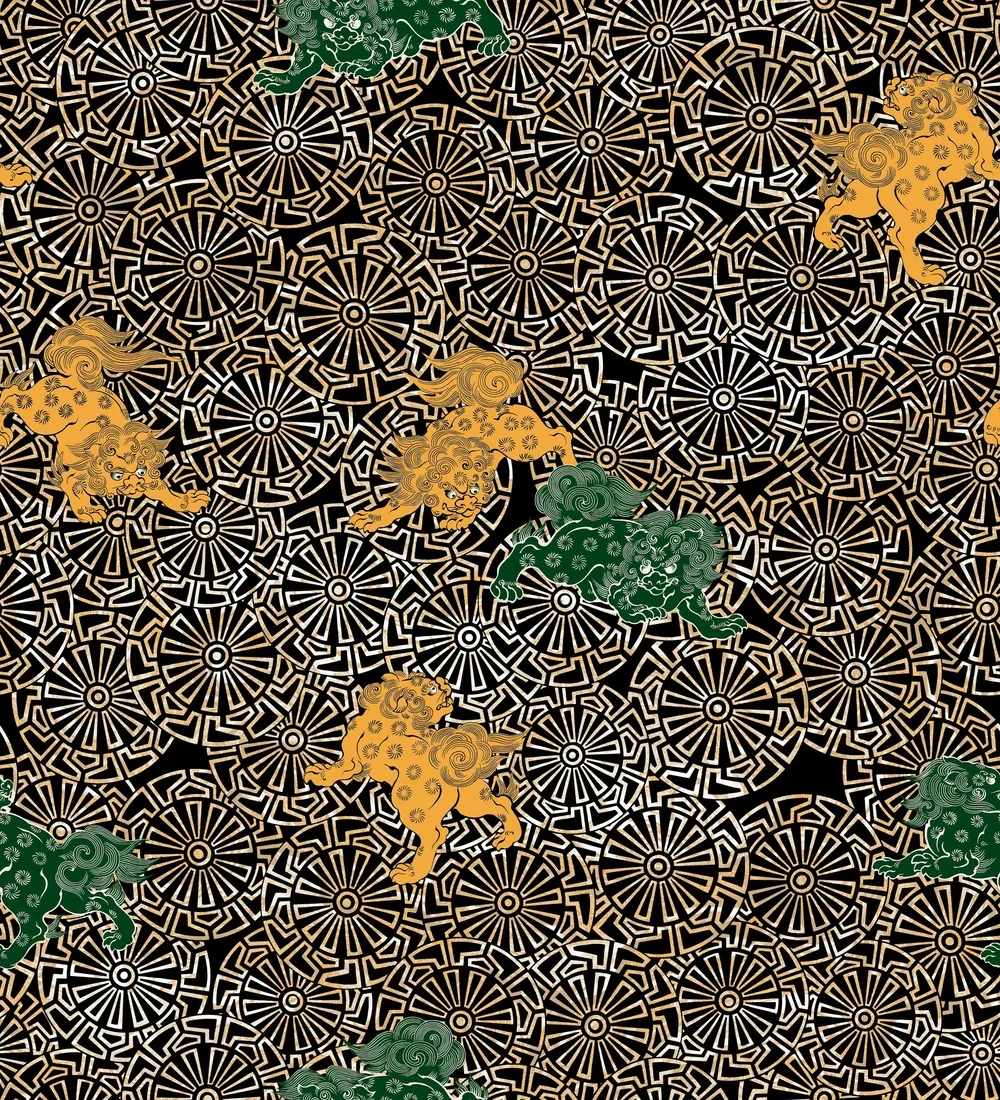
The Story of the Divine Beasts Pattern
Divine beast statues placed at the entrances of shrines and temples are today commonly known as komainu. These figures are based on a mythical creature whose origin traces back to the lion.
Their roots can be found in the ancient Near Eastern world, where lions were widely used as symbols of divine power and royal authority. Imaginary creatures such as the Sphinx—with a lion’s body and a human face—emerged from this tradition and were regarded as sacred representations of kingship.
The concept of the lion as a symbolic creature traveled across cultures, passing through India and becoming associated with religious traditions before reaching East Asia. There, it evolved into a mythical guardian figure and was eventually introduced to Japan during the Asuka period.
At that time, it was known simply as a lion figure. Over time, however, it developed into a uniquely Japanese form through cultural adaptation.
These guardian figures are typically placed in pairs at shrine or temple entrances. Originally, symmetry was emphasized, and both figures appeared nearly identical.
However, Japanese aesthetics gradually came to favor natural variation over strict symmetry. This shift led to the creation of paired figures with distinct differences—one with its mouth open, the other closed.
The open-mouthed figure is said to represent the beginning of sound, while the closed-mouthed one signifies its end, symbolizing completeness and harmony.
The term komainu is thought to relate to the idea of a creature introduced via the Korean peninsula, though it does not refer to an actual breed of dog. Instead, it reflects how people in Japan interpreted this mythical being as a dog-like Divine distinct from the lion.
By the Heian period, distinctions between lion-like and dog-like forms were more clearly recognized, and together they spread across the country as protective guardians of sacred spaces.
Today, many variations can be found—some resembling rabbits, foxes, or even tigers—making the distinction between lion and komainu less clear. As a result, all such guardian figures are now commonly referred to collectively as komainu.
They are widely understood as protective beings, believed to ward off evil and safeguard sacred places.
In this design, the komainu are paired with the Genji wheel motif—stylized ox-cart wheels once associated with courtly culture. Because wheels turn continuously, they symbolize continuity and the enduring flow of time.
Together, the protective presence of the komainu and the symbolism of the wheel express a powerful wish: to guard the wearer from misfortune and to ensure a life of lasting peace and stability.