
Dragon flying over Mount Fuji
富士越龍 - Fuji koshi Ryu
Katsushika Hokusai, a ukiyo-e artist of the late Edo period
Katsushika Hokusai was one of Japan’s most celebrated ukiyo-e artists, creating an extraordinary body of work over his 90-year life, including masterpieces such as Thirty-Six Views of Mount Fuji and Hokusai Manga. His art had a profound influence on European painters, and in 1998 he was the only Japanese individual selected by Life magazine as one of the “100 Greatest People of the Millennium.”
Hokusai was also known for his many eccentricities. Over the course of his life, he changed his name more than 30 times, using names such as Shunrō, Sōri, Hokusai, Tatsusai, Hyakurin, Raito, Gakyōjin, Raishin, Gakyō Rōjin, and Manji. The name “Hokusai,” by which he is best known today, is derived from “Hokusai Tatsumasa” and is believed to be connected to the Hokushin Myoken faith, which venerates the North Star and the Big Dipper.
Another well-known aspect of his life is his frequent relocations—said to have moved as many as 93 times. One theory suggests that Hokusai, together with his daughter Katsushika Oei, lived entirely devoted to painting, moving whenever their living space became too cluttered.
In 1842, at the age of 83, Hokusai traveled to Obuse in Shinshu (modern Nagano). The reasons for this journey remain debated: some suggest it was due to the restrictions of the Tenpo Reforms, while others believe he was invited by the wealthy merchant Takai Kozan. In Obuse, under Kozan’s patronage, Hokusai was provided with a studio known as Hekiiken. Their relationship was close, with each addressing the other respectfully as “sensei” and “danna-sama.”
In this supportive environment, Hokusai devoted himself to large-scale works in his later years. At age 86, he was commissioned by Takai Kozan to create four ceiling paintings for a festival float—Dragon, Phoenix, Male Wave, and Female Wave. He also painted Phoenix Gazing in All Directions on the ceiling of the main hall of Iwamatsu-in Temple, completing it at the age of 89.
After accomplishing these monumental works, Hokusai returned to Edo and, at the remarkable age of 90, created Dragon Crossing Mount Fuji, continuing his lifelong pursuit of artistic mastery until the very end.

#/media/%E3%83%95%E3%82%A1%E3%82%A4%E3%83%AB:Hugaku100kei_batsubun.jpg)
Story of the Dragon flying over Mount Fuji pattern
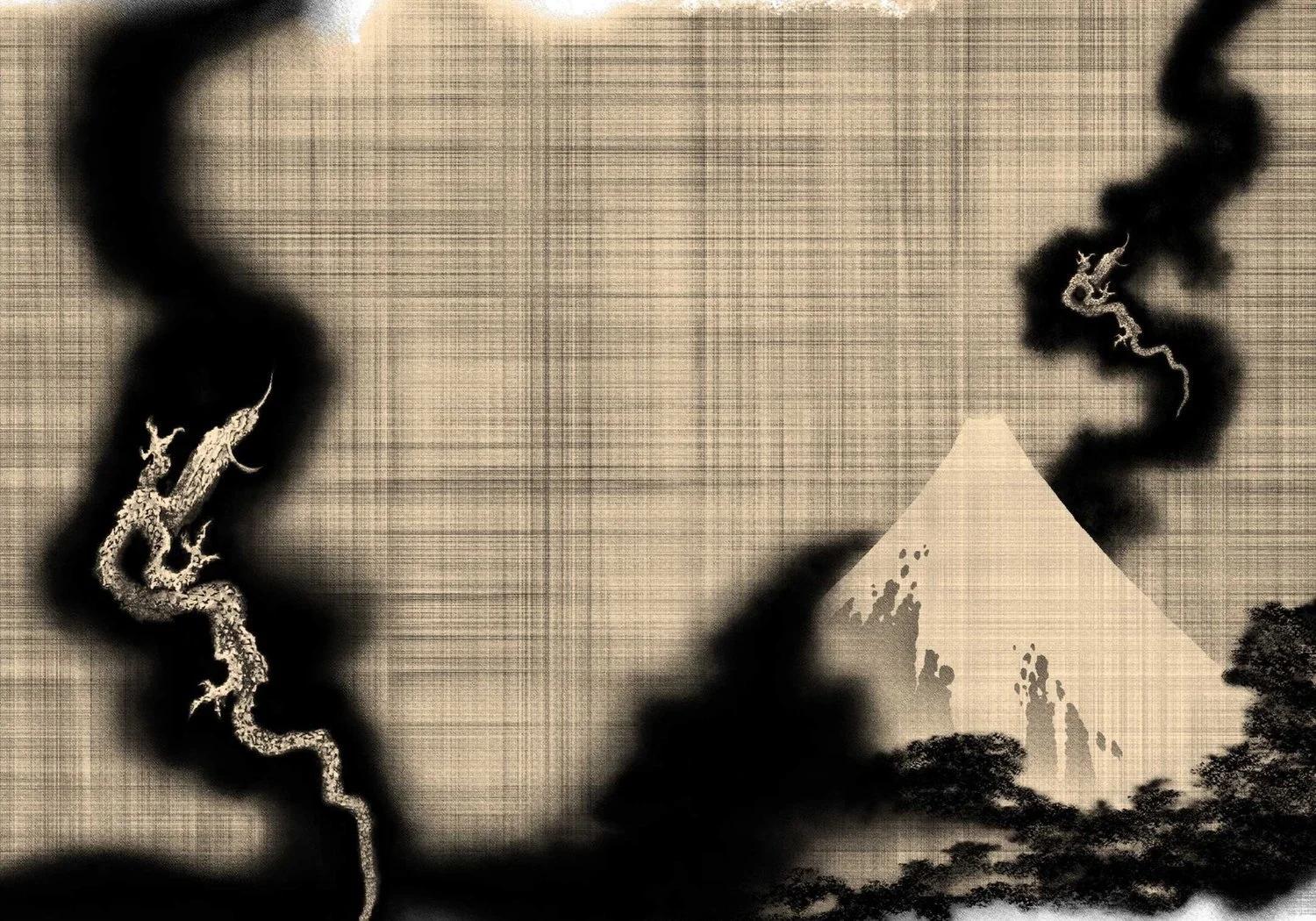
Katsushika Hokusai’s Dragon flying over Mount Fuji is one of the defining works of his final years, painted in January 1849—the very year of his death. The inscription on the painting reads: “January, 2nd year of Kaei (1849)… painted by a 90-year-old man.” Created just three months before he passed away, it is often regarded as either his last work or one very close to it, making it essential for understanding the culmination of his life and artistic journey.
The composition portrays a dragon ascending into the heavens, carried by swirling clouds resembling black smoke, beyond the snow-covered peak of Mount Fuji. Hokusai’s characteristic use of bold, geometric composition is evident in the striking placement of Mount Fuji’s triangular form in the foreground. Behind it, the dragon—though relatively small—is rendered with extraordinary precision, emerging dynamically from the turbulent clouds.
More than a dramatic image, the painting is often interpreted as a reflection of Hokusai’s inner state in his final years—his lifelong pursuit of artistic perfection and transcendence.
This work can be closely connected to his publication One Hundred Views of Mount Fuji, in which he expressed his evolving philosophy as an artist. At age 75, he famously wrote of his ambitions: that by 90 he would deepen his mastery, by 100 reach a divine level, and by 110 bring life itself into every stroke. Even at 89, he declared his desire to continue refining and transforming his art beyond the age of 90.
In this light, Dragon flying over Mount Fuji stands as more than a late masterpiece—it is a visual embodiment of Hokusai’s lifelong devotion, capturing the spirit of an artist who, even at the very end, believed his true potential still lay ahead.
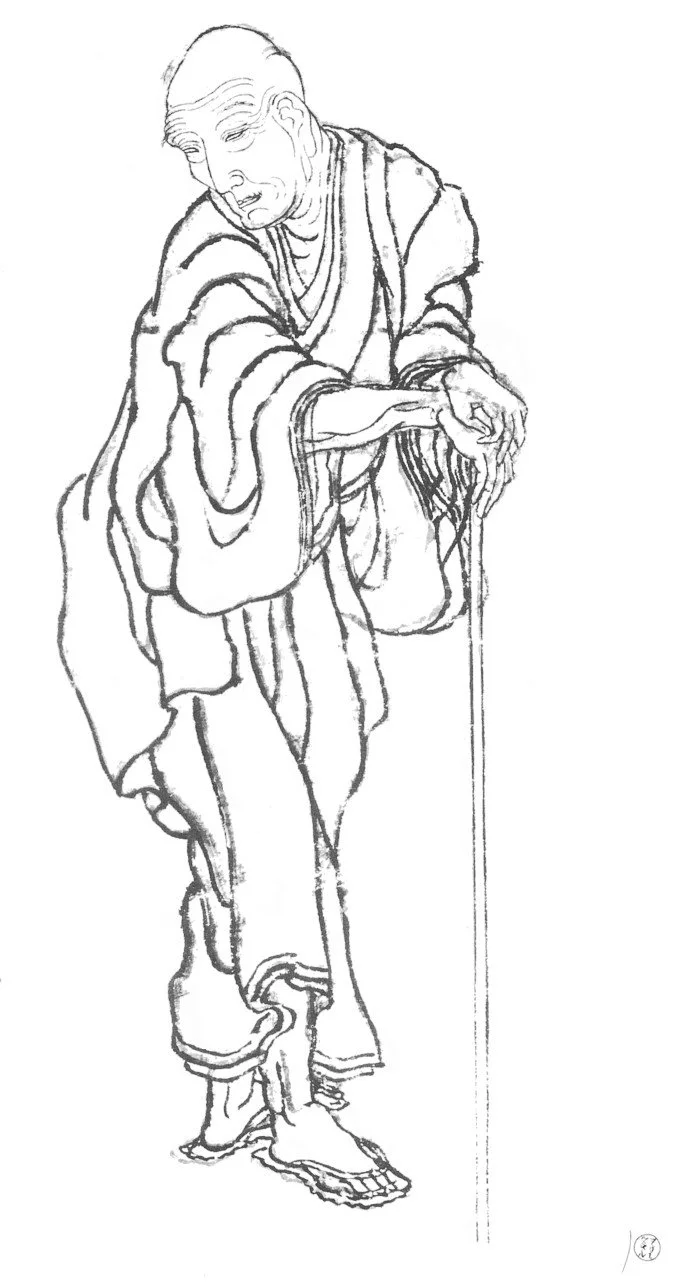
Katsushika Hokusai continued striving throughout his life to become a true painter, even envisioning growth beyond the age of 100.
In Dragon flying over Mount Fuji, created at the age of 90, a dragon rises powerfully toward the heavens, winding its way upward through turbulent clouds. Struggling yet steadily advancing toward its ultimate destination, the dragon is often seen as a reflection of Hokusai himself—an artist in constant pursuit of mastery.
Just three months after completing this work, Hokusai passed away, still describing himself as an “immature painter.” He left behind the poignant words: “If only I could have lived another 10, or even 5, years, I could have become a true painter…”
This remarkable hand-painted piece from his final years stands as a testament to his enduring passion and undiminished artistic power. With the cooperation of the Hokusai Museum, Pagong has reinterpreted this masterpiece through Yuzen dyeing, adding its own distinctive touch.
The image used for this reproduction is based on an ultra-high-resolution digital archive provided by the Hokusai Museum, created by NTT ArtTechnology and Alstecne as part of the Digital Hokusai Project—bringing new life to this timeless work while preserving its extraordinary detail.