
Dragon God
龍神 - Ryujin
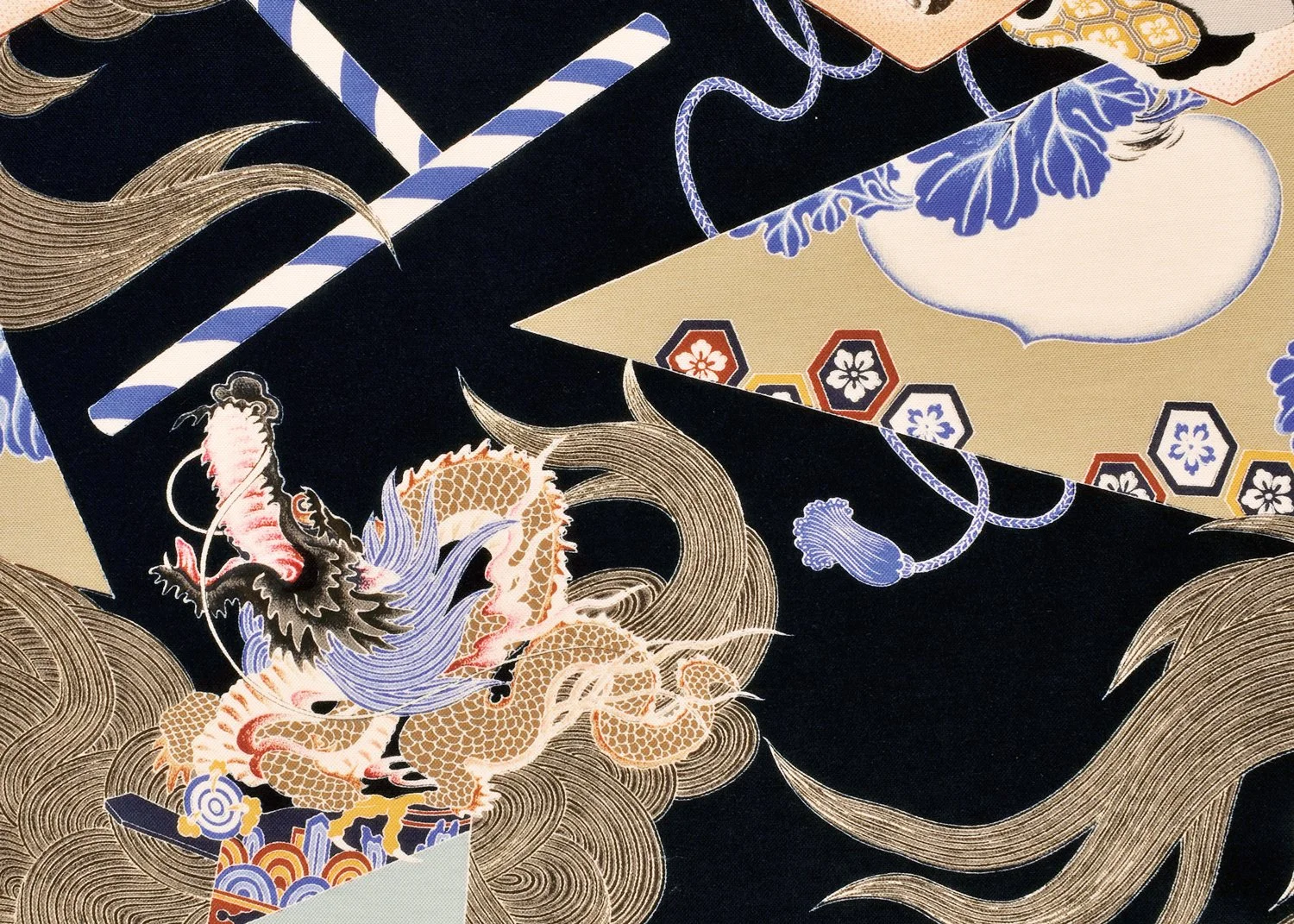
The Story of the Dragon God Pattern
This design is inspired by the Noh chant piece Chikubushima and is believed to date from the Meiji period.
From the Meiji through the Taisho period, Noh chanting became a popular cultural pursuit among wealthy merchants and influential figures. Designs based on these classical performances were often used in men’s garments, such as under-kimono or jacket linings, reflecting both refinement and education.
Chikubushima is a small island floating on Lake Biwa. It has long been a sacred site, known for its enshrined deity, a goddess associated with water, music, and protection. Even today, it remains an important place of pilgrimage.
The story unfolds in the early Heian era. On a peaceful spring day, court nobles traveling from the capital visit Lake Biwa to pay their respects at Chikubushima, already renowned for its sacred presence.
While searching for a boat, they encounter a couple who offer to guide them to the island. After showing them the shrine, the couple reveals their true identities—the husband as the Dragon King of the lake, and the wife as a celestial being. They further disclose that they are manifestations of the island’s deity. After presenting a sacred jewel symbolizing blessings and protection, they vanish, leaving the travelers in awe.
This pattern brings together many elements from that story.
The Dragon King appears with distinctive features—an ornate headpiece, a staff, and a sacred jewel. The Noh mask shown in a box represents a character associated with the dragon deity. The staff symbolizes supernatural power.
Other motifs carry playful, intellectual meanings. A turnip and a millstone appear as visual wordplay: the idea of a “strong root” echoes a “strong voice,” while the act of grinding or playing suggests musical performance.
A mallet is also depicted, hinting at pounding rice cakes, which in turn evokes the image of the moon—an association drawn from folklore of a rabbit preparing an elixir upon its surface.
The scene described in the chant evokes a dreamlike landscape:
“Chikubushima comes into view—
green trees reflected in still waters,
fish seeming to climb among the branches,
and the moon rising over the sea,
as if even a rabbit runs upon the waves.”
Bamboo, representing the island itself, and the moon, symbolizing the celestial realm, are essential motifs woven into the design.
Seen in this light, the pattern reveals layers of meaning—story, symbolism, and wit intertwined. It reflects a time when artistry, knowledge, and subtle humor were seamlessly expressed through design, leaving us with a deep sense of admiration for the creativity of the past.