
Dragonfly
とんぼ - Donbo
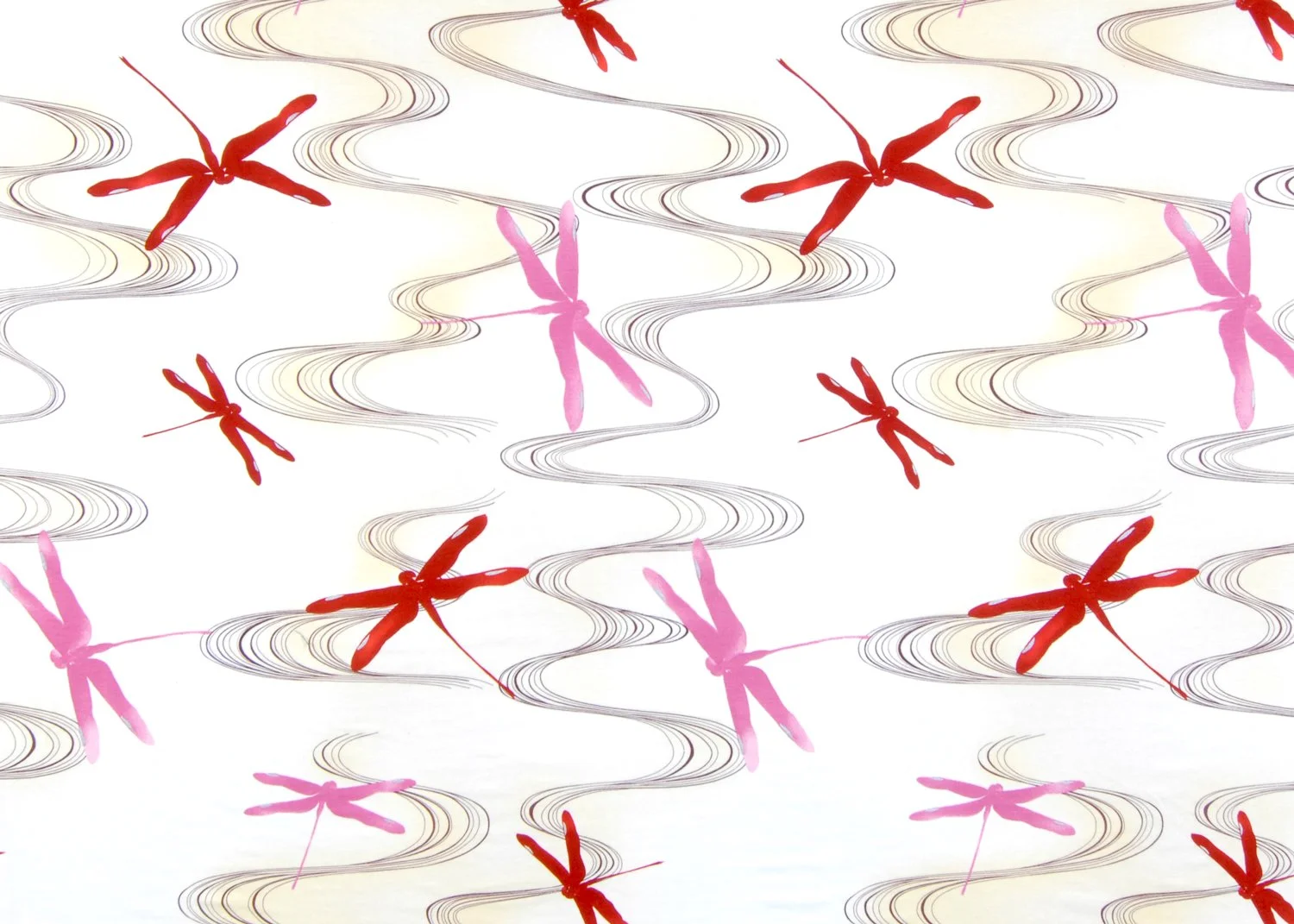
The Story of the Dragonfly Pattern
Japan was formerly called "Yutaka no Akitsukuni," where "Akitsu" means dragonfly.
The Nihon Shoki (Chronicles of Japan) states that this name means "a rich and good country where dragonflies fly." Dragonfly motifs can also be seen on bronze bells from the Yayoi period.
Thus, dragonflies have been a familiar motif to the Japanese people since ancient times.
During the Kamakura period, dragonflies were favored by samurai because of their swift flight, their ability to prey on small insects, their constant forward movement and never retreat, and their aggressive nature.
They were called "Kachimushi" (victory insect) or "Kachiikusamushi" (victory military insect). They were used as motifs on samurai clothing and armor. Dragonfly motifs can be seen in patterns such as "dragonfly and iris," which combines the word "victory" (shobu) with the flower "iris" (shobu), and "dragonfly on a wind vane," which combines a dragonfly with the weapon "arrow" (ya), reflecting the superstitions of samurai warriors.
In the Edo period, dragonfly patterns could be seen on Noh costumes and kosode (short-sleeved kimono). Because dragonflies only perch on the head (tip) of things, they were also favored as a pattern for baby boys' kimonos, with the wish that they would grow up to be the head (kashira). In modern times, they are often used as a cool-looking pattern that evokes images of watersides, and are frequently used on summer ro kimonos and yukata.