
Fan and Pine
扇面と松 - Senmen to Matsu
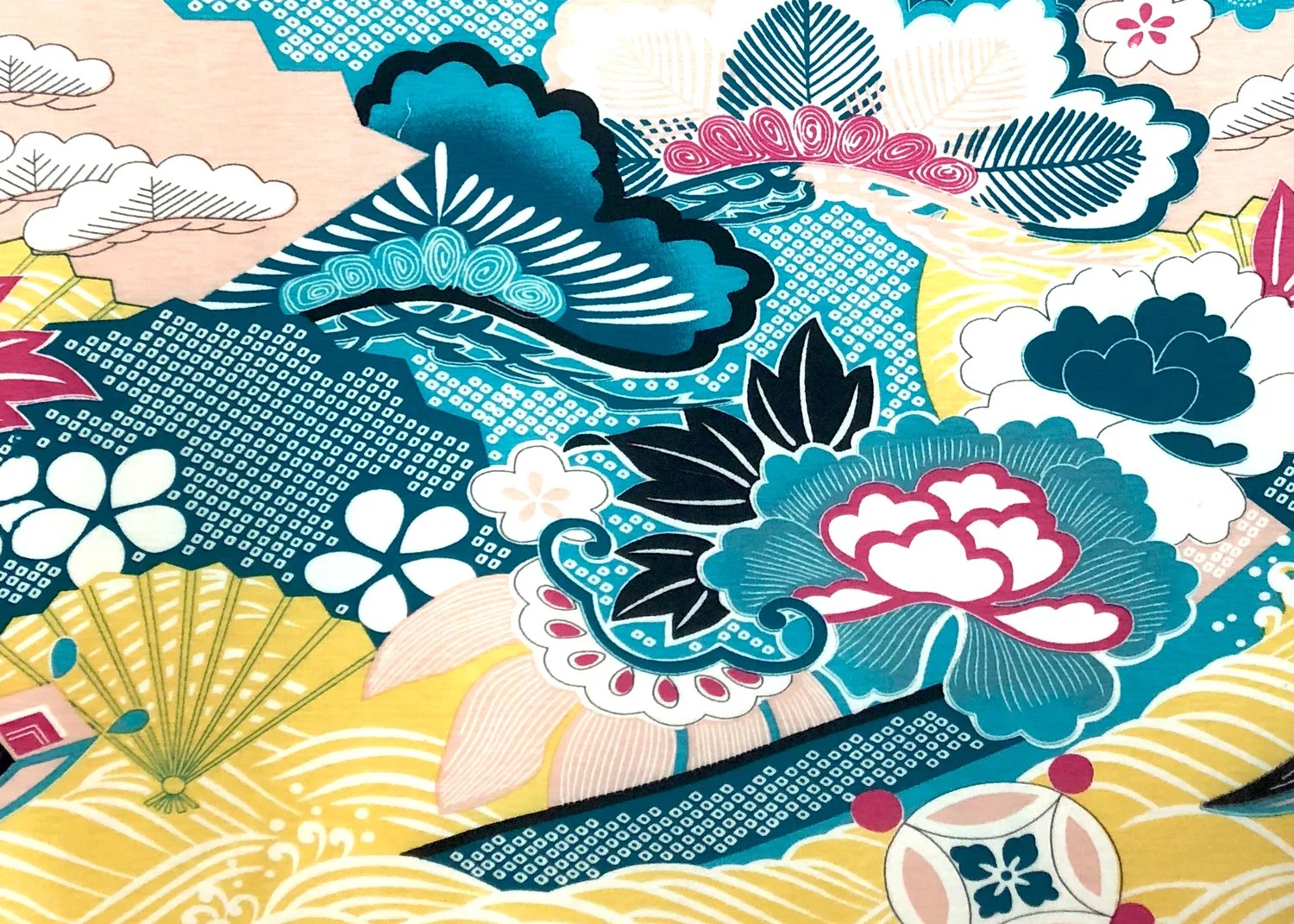
The Story of the Fan and Pine Pattern
Patterns such as these, featuring auspicious motifs, were traditionally used on children’s kimonos and on the linings of women’s haori jackets. “Auspiciousness” refers to joyful signs, fortunate omens, and expressions of happiness. Motifs that embody these meanings in visible form are known as auspicious designs, and they have long been cherished in everyday life.
Auspiciousness was valued not only as a wish for good fortune, but also as a way to live in harmony with nature, as a guiding principle for human relationships, and as a symbolic form used in rituals and ceremonies.
Let us begin with the motif of the fan. Known as suehirogari—meaning “spreading out toward the end”—the fan’s shape, which widens gracefully, has been regarded as a symbol of expanding prosperity since ancient times. Fans have been especially loved for their versatility: they can appear fully open, half-open, or closed, and can be beautifully combined with flowers and other motifs, evoking the refined elegance of the Heian period.
Pine trees are another deeply auspicious motif. Said to live for a thousand years and remaining evergreen even through the harshness of winter, they are also known as tokiwagi, or “eternal trees.” For this reason, they symbolize longevity, resilience, and enduring vitality.
Various forms of pine motifs carry distinct meanings. The young pine (wakamatsumon) grows straight upward, expressing youthful energy and growth. The old pine (oimatsumon) features layered branches forming a gentle, mountain-like silhouette, evoking dignity and calm strength. Other variations include the pine needle motif (matsubamon), the rooted pine (nebikimatsumon), symbolizing longevity through its extended roots, and the coastal pine (sonarenomatsumon), which withstands sea winds while growing low along the ground.
Originally, the old pine motif depicted the entire tree, admired for the powerful trunk and the graceful spread of its branches. A well-known example can be seen on the mirror panel (kagamiita) of a Noh stage, where a majestic pine is painted. This tradition stems from the origins of Noh as a sacred performance offered to the gods, once held beneath the Yōgō no Matsu—a revered pine believed to serve as a dwelling place for deities. As Noh evolved into an art form patronized by the samurai class, painted pine trees became a symbolic element of the stage itself.
During the Edo period, pine motifs—often rendered in the style of the Kanō school favored by feudal lords—were widely used in the possessions of daimyo, as well as in high-quality furnishings and garments. Over time, the distinctive shapes of pine branches and foliage became stylized and used independently as decorative motifs.
Even today, pine designs remain prominent in formal attire such as bridal uchikake and obi. As auspicious plant motifs, they symbolize longevity and the eternal, otherworldly paradise of Hōrai.