
Flowers and Peacock
花と孔雀 - Hana to Kujaku
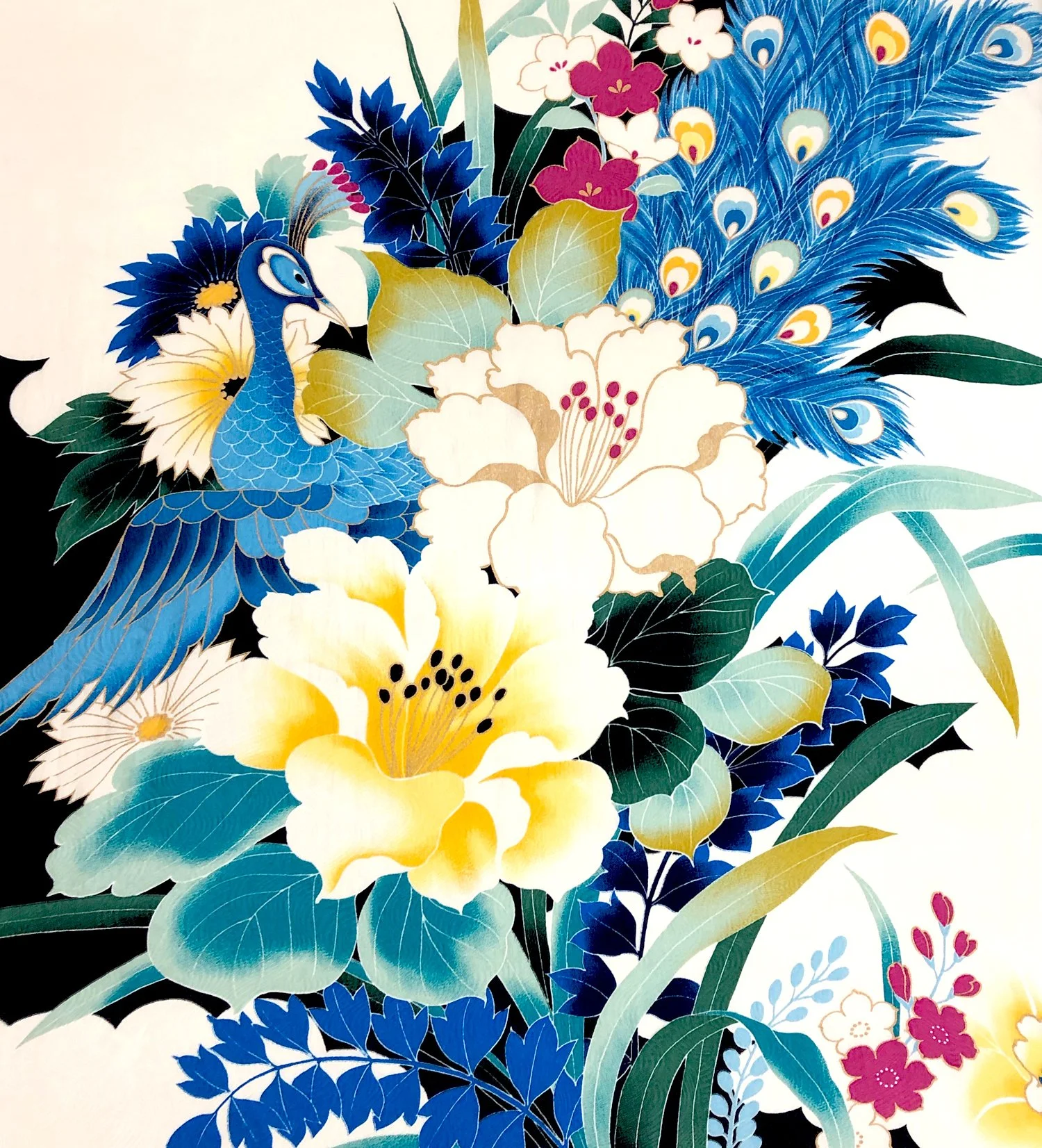
The Story of the Flowers and Peacock Pattern
A peacock with magnificent tail feathers stands quietly, surrounded by radiant blossoms. The large flowers may be inspired by the sāla tree.
The sāla tree, native to India, is one of the three sacred trees of Buddhism. It is said that Gautama Buddha lay between two sāla trees at the time of his passing into nirvana, which is why they are known as the Twin Sāla Trees (sāla sōju).
This image is famously evoked in the opening lines of the The Tale of the Heike:
“The sound of the bells of Gion Shōja echoes the impermanence of all things;
the color of the sāla flowers reveals the truth that all who flourish must fall…”
However, the sāla tree does not naturally grow in Japan. Trees planted in temple grounds under this name are often substitutes—most commonly the summer camellia (natsutsubaki). A well-known example can be found at Tōrin-in, a sub-temple of Myōshin-ji in Kyoto.
The peacock, native to tropical regions, has long been admired across many cultures for its beauty. Because it feeds on poisonous insects and snakes, it has been regarded as a creature that removes misfortune and suffering, becoming an object of reverence.
In Japan, texts such as the Konjaku Monogatarishū recount how En no Gyōja invoked the power of the Peacock King (Kujaku Myōō) to gain supernatural abilities—commanding spirits and even flying through the air.
The Peacock King is said to consume the “three poisons” of human desire—greed, anger, and ignorance—thereby transforming and eliminating them. The peacock is also believed to possess the ability to foresee rain and has been associated with rituals for invoking rainfall.
While both the sāla tree and the peacock are deeply connected to Buddhist symbolism, this pattern—created by a Shōwa-era designer—presents a serene and beautiful world through the combination of birds and flowers. Beneath its elegant surface, however, lies a rich layer of meaning.
The peacock, said to dispel misfortune, together with the sacred tree, offers a quiet wish for protection and peace to the wearer.