
Flowers of the Four Seasons
流水四季草花図 - Ryusuishikisoukazu
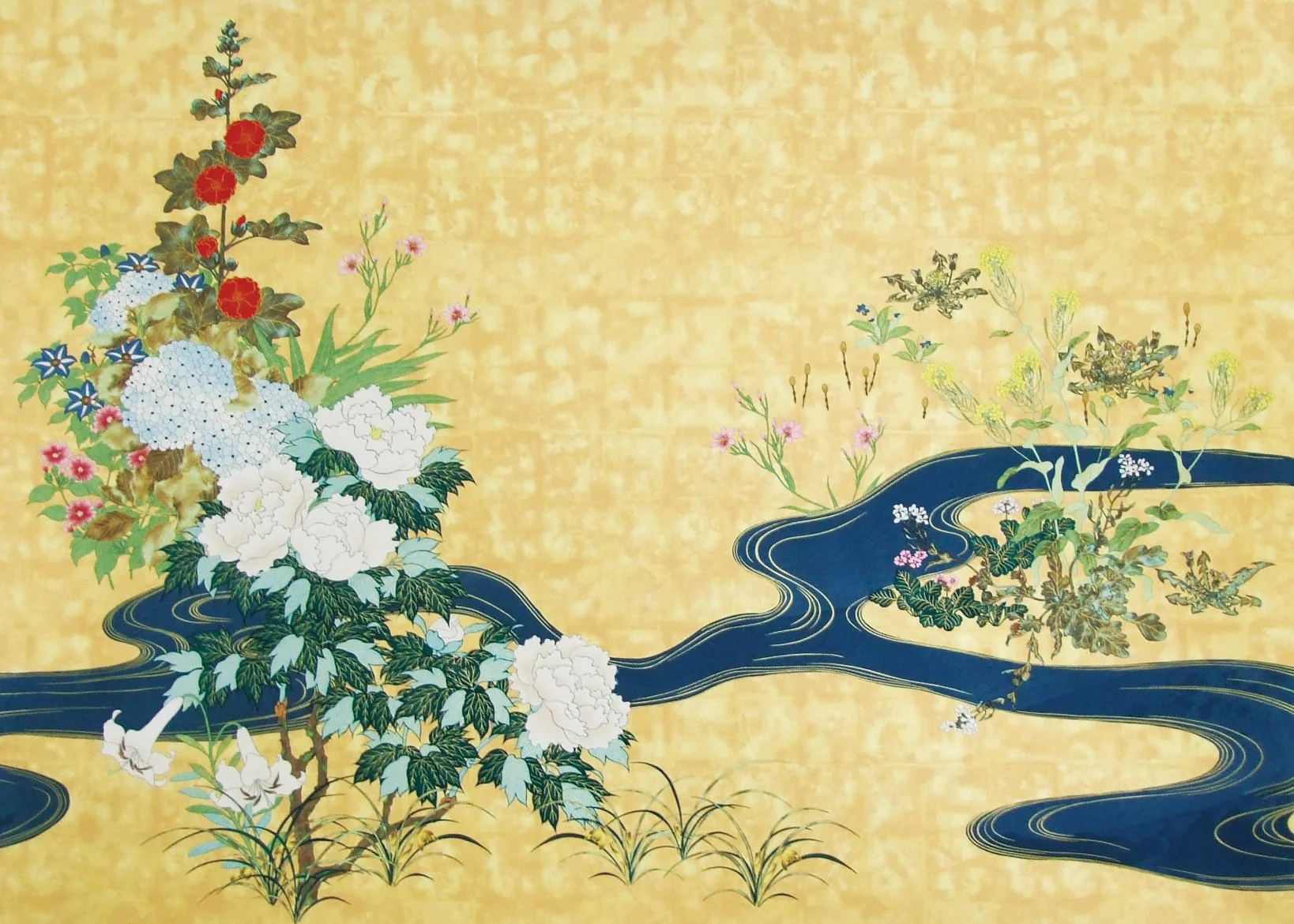
The Story of the Flowers of the Four Seasons Pattern
This design, featuring a rich array of colorful flowers and plants, is a reproduction of the right panel of Flowing Water and Four Seasons Flowers Screen by Sakai Hoitsu, housed in the Tokyo National Museum. Recreated using Yuzen dyeing with official permission, Pagong’s version carefully preserves the elegant gold-leaf seams characteristic of Rinpa-style folding screens.
The original work consists of a pair of two-panel screens: the right panel depicts spring and summer flowers, while the left panel portrays autumn and winter. Pagong has chosen to reinterpret the right panel, capturing the vibrant transition from spring to summer.
Sakai Hoitsu is regarded as the founder of the Edo Rinpa school. Born as the second son of the Sakai family, lords of the Himeji domain, he grew up surrounded by art and literature. From an early age, he studied haikai poetry, the tea ceremony, the Kano school, and ukiyo-e. At 37, he became a monk, leaving behind his samurai status to fully devote himself to artistic pursuits. Deeply inspired by Ogata Korin—whose works he studied and copied—Hoitsu later commemorated Korin’s 100th death anniversary in 1815 by publishing Kōrin Hyakuzu (One Hundred Pictures of Kōrin), helping to spread the Rinpa style throughout Edo.
During Hoitsu’s time, the Edo period saw remarkable developments in horticulture. Cultivation of wildflowers, variegated plants, and even unusual morning glories became widespread, enjoyed by people of all social classes. This cultural fascination is reflected in the screen, which depicts plants once popular but now rarely seen.
The composition vividly portrays spring grasses bursting from the earth after winter, gradually transitioning into the lush atmosphere of summer. The flowing water running through the center symbolizes the life force of nature and is believed to purify impurities. Each plant carries its own meaning: horsetails and dandelions represent prosperity and vitality; clematis symbolizes strong bonds and harmonious relationships; peonies, known as the “king of flowers,” signify wealth and prosperity; and spring orchids—one of the “Four Gentlemen”—embody elegance and noble character.
This work invites you to experience the essence of the Rinpa school, where nature, design, and symbolism merge into a timeless expression of beauty. Originating with Honami Koetsu and Tawaraya Sotatsu in the late Momoyama period, and later developed by masters such as Ogata Kōrin and Sakai Hōitsu, the Rinpa tradition extends beyond painting into everyday crafts—textiles, lacquerware, ceramics, folding screens, and fans.
Rather than a lineage bound by blood, the Rinpa school represents a continuous thread of artistic admiration and reinterpretation, passed down through generations—an enduring celebration of beauty, craftsmanship, and cultural memory.