
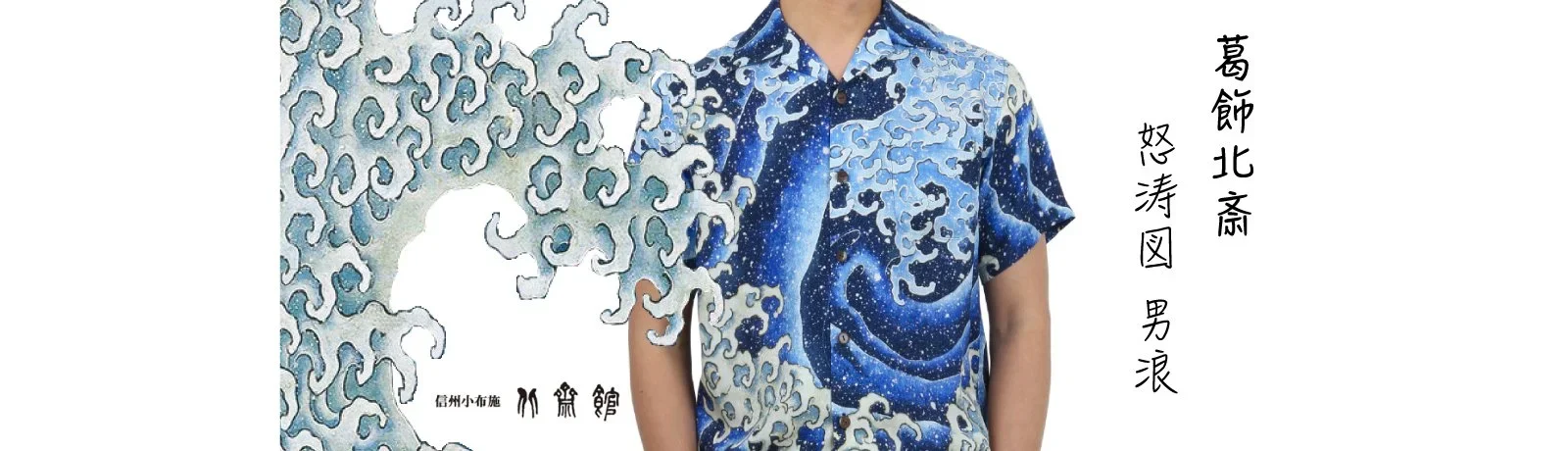
Hokusai Aloha Shirts
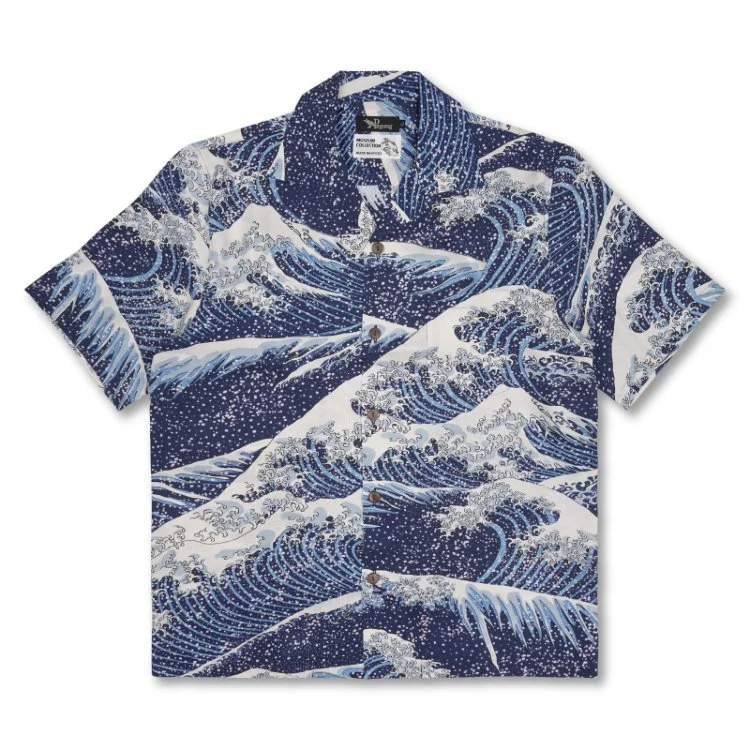
Color / Blue Size Chart Care Instruction
Japanese name / 大波 (Oonami)
-About-
Katsushika Hokusai (1760-1849) was a master artist and printmaker of ukiyo-e, “pictures of the floating world” school.
Hokusai was well over 70 years old when The Great Wave was made. It would be the very first print he would publish of his monumental series, “The Thirty-Six Views ofMount Fuji”, a series which would firmly secure Hokusai’s fame in Japan, as well as overseas.
The Great Wave is Hokusai’s mostcelebrated work and with no doubt considered the most recognizable work of Japanese art in the world. This extraordinary pattern was dyed using the kimono technique “Kyoto-Yuzen”.
A collaboration with the Hokusai Museum, Obuse, Nagano.
・Currency : US Dollar (USD)
・100% Silk (Custom-woven Jacquard )
・Made in Japan
・Classic-fit Aloha shirt
・Coconut buttons
・Dry-clean
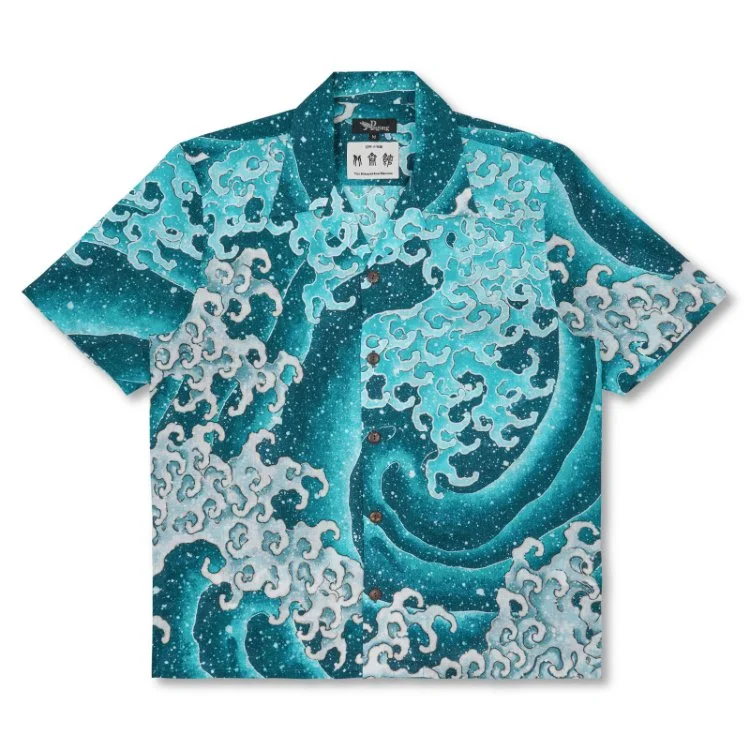
Color / Blue-Green Size Chart Care Instruction
Japanese name/ 怒涛図 男浪 (Dotouzu Onami)
-About-
Master ukiyo-e artist and painter of theEdo-era, Katsushika Hokusai (1760-1849), was invited to Obuse, Nagano by a wealthy farmer, merchant, and patron of the arts, Takai Kozan.
During his 3-year stay, 86 year-old Hokusai was asked to paint several masterpieces for the ceilings of festival floats. “Masculine Wave“ (Onami), and “Feminine Wave“ (Menami) were painted for the ceiling of the “Kanmachi” festival float.
In our Aloha shirt “Masculine Wave“, the surging crest of a huge wave and the power of the ocean are expressed with hand-drawn lines, evoking Hokusai’s joyful spirit, and dynamic strength of character.
A collaboration with the Hokusai Museum, Obuse, Nagano.
・Currency : US Dollar (USD)
・70% Cotton / 30% Linen
・Premium Fabric / Made in Japan
・Classic-style Aloha shirt
・Coconut buttons
・Gently wash by hand.
・Made in Japan
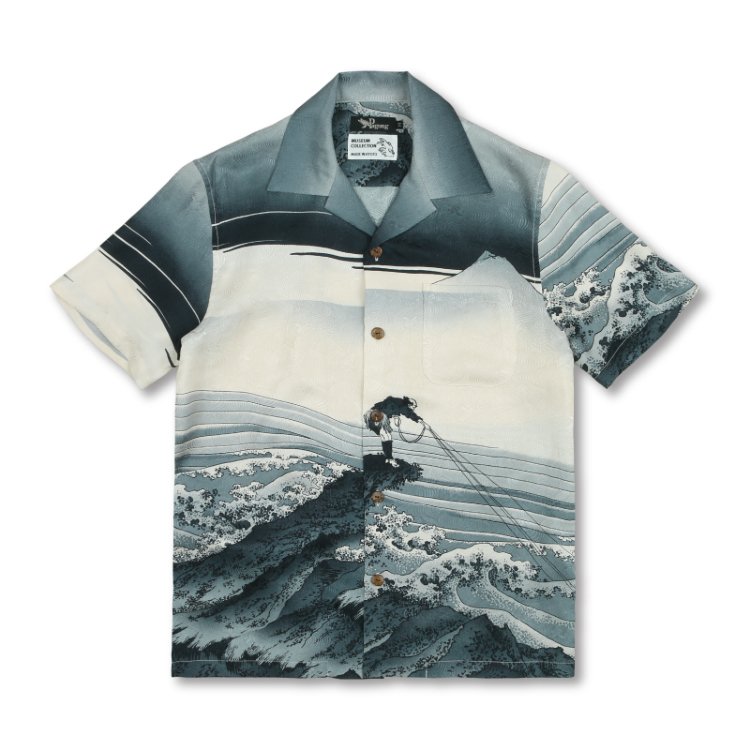
Color / Black and White
Japanese name/ 甲州石班澤 (Koshu Kajikazawa)
-About-
At the age of seventy, with a career of over 50 years experience making traditional woodblock prints, Katsushika Hokusai (1760-1849),undertook making his now-famous series “Thirty Six Views of Mount Fuji”, honoring the most spiritual and sacred mountain in all Japan. The traditional technique he used was most common at the time, ukiyo-e, literally meaning “pictures of the floating world”.
“Koshu Kajikazawa”, is the name of a place between Tokyo and Kyoto where two rivers meet, the 14th print of the series, which we the viewer have the pleasure of seeing through Hokusai’s eyes.
In this masterpiece, the fisherman’s pose intentionally reflects the shape of Mount Fuji in the background, an example of Hokusai’s “signature” compositional genius, no doubt contributing to Hokusai becoming the most renown and respected Japanese artist of all time.
We have been been given official permission to use this extraordinary woodblock print from the Metropolitan Museum of Art in New York , to which Pagong has implemented the dye technique of Kyoto Yuzen.
・Currency : US Dollar (USD)
・100% Silk (Custom-woven Jacquard )
・Made in Japan
・Classic-fit Aloha shirt
・Coconut buttons
・Dry-clean

Color / Blue Size Chart Care Instruction
Japanese name/ 怒涛図 男浪 (Dotouzu Onami)
-About-
Katsushika Hokusai (1760-1849), an ukiyo-e wood-block print artist and master painter of the Edo era, was invited to Obuse by Takai Kozan, a wealthy farmer and merchant.
During his 3-year stay, 86 year-old Hokusai was asked to paint several masterpieces for the ceilings of festival floats. “Masculine Wave“ (Onami), and “Feminine Wave“ (Menami) were painted for the ceiling of the “Kanmachi”, festival float.
In “Masculine Wave“, the surging crest of a huge wave and the power of the ocean are delightfully expressed with hand-drawn lines, evoking Hokusai’s spirited character and inner strength.
A collaboration with the Hokusai Museum (Obuse, Nagano).
・Currency : US Dollar (USD)
・100% Silk (Custom-woven Jacquard )
・Made in Japan
・Classic-fit Aloha shirt
・Coconut buttons
・Dry-clean
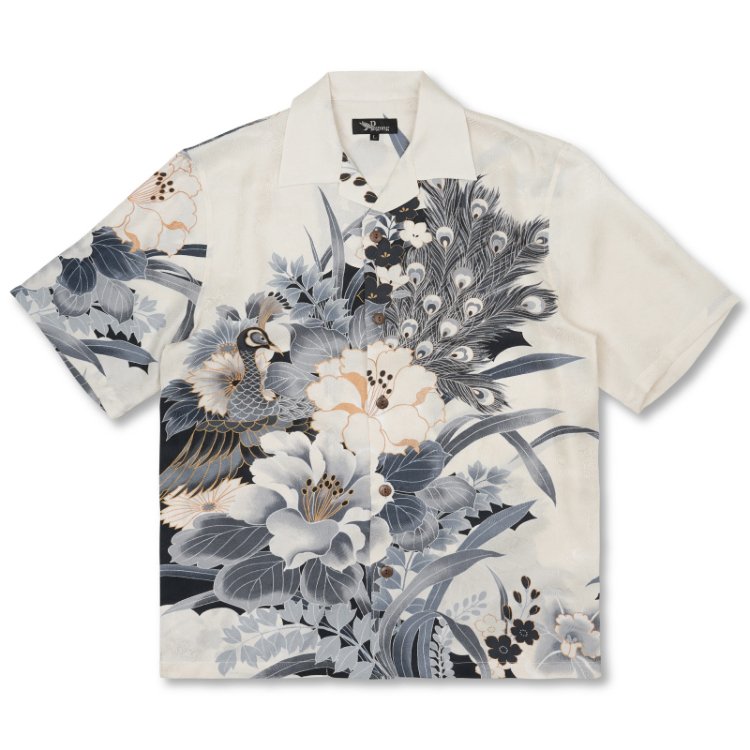
Color / White, Black, and Gray Size Chart
Japanese name/ 花と孔雀 (Hana To Kujaku)
-About-
For its handsome beauty and graceful appearance, the peacock has been beloved in all world cultures since ancient times.
The peacock was introduced to Japan during the Nara period (710-794), however, became popular as a kimono pattern motif during the Edo period (1600-1868).
Its meaning is that of “protection”, which hasn’t changed in hundreds of years. The pattern is worn to protect the wearer from all misfortune and harm, therefore it is often seen used on ceremonial kimono.
・Currency : US Dollar (USD)
・100% Silk (Custom-woven Jacquard )
・Made in Japan
・Classic-fit Aloha shirt
・Coconut buttons
・Dry-clean
・Model (6 feet)

Color / Royal Blue Size Chart Care Instruction
Japanese name/ 怒涛図 男浪 (Dotouzu Onami)
-About-
Katsushika Hokusai (1760-1849), an ukiyo-e wood-block print artist and master painter of the Edo era, was invited to Obuse by Takai Kozan, a wealthy farmer and merchant.
During his 3-year stay, 86 year-old Hokusai was asked to paint several masterpieces for the ceilings of festival floats. “Masculine Wave“ (Onami), and “Feminine Wave“ (Menami) were painted for the ceiling of the “Kanmachi”, festival float.
In “Masculine Wave“, the surging crest of a huge wave and the power of the ocean are delightfully expressed with hand-drawn lines, evoking Hokusai’s spirited character and inner strength.
A collaboration with the Hokusai Museum (Obuse, Nagano).
・Currency : US Dollar (USD)
・100% Silk (Custom-woven Jacquard )
・Made in Japan
・Classic-fit Aloha shirt
・Coconut buttons
・Dry-clean

Color / White and Black
Japanese Name / 富士越龍 (Fuji Koshi Ryu)
-About-
Katsushika Hokusai (1760-1849) was to spend his final years passionately making a rare collection of “free-hand” paintings, quite unlike any of his previous ukiyo-e print-works which he is most world-renowned.
Hokusai’s enduring passion to portray Mount Fuji, Japan’s sacred mountain, is a challenge he continued to pursue for his entire lifetime. The many ephocal events of his long prolific career seem to culminate in his final masterpiece, “Dragon Flying Over Mount Fuji” where we the viewer are given the rare opportunity to look deeply into the stillness and peace within the artist’s final year.
・Currency : US Dollar (USD)
・70% Cotton / 30% Linen
・Premium Fabric / Made in Japan
・Classic-style Aloha shirt
・Coconut buttons
・Gently wash by hand.
・Made in Japan
Accessories

Color / Off-White, and Light-Blue Size chart is below Care Instruction
Japanese name/ (DOTOUZU ONAMI)
-About-
Katsushika Hokusai (1760-1849), an ukiyo-e wood-block print artist and master painter of the Edo era, was invited to Obuse by Takai Kozan, a wealthy farmer and merchant.
During his 3-year stay, 86 year-old Hokusai was asked to paint several masterpieces for the ceilings of festival floats. “Masculine Wave“ (Onami), and “Feminine Wave“ (Menami) were painted for the ceiling of the “Kanmachi”, festival float.
In “Masculine Wave“, the surging crest of a huge wave and the power of the ocean are delightfully expressed with hand-drawn lines, evoking Hokusai’s spirited character and inner strength.
A collaboration with the Hokusai Museum (Obuse, Nagano).
・93% Rayon 7% Polyurethane
・Made in Japan
・Heat-retention knit fabric
・Hand-wash
・Hang to dry
・Use pressing cloth to iron
・Currency : US Dollar (USD)

Color / Blue and White Care Instruction
Japanese name/ 怒涛図 男浪 (Dotouzu Onami)
-About-
Katsushika Hokusai (1760-1849), an ukiyo-e wood-block print artist and master painter of the Edo era, was invited to Obuse by Takai Kozan, a wealthy farmer, merchant, and patron of the arts.
During his 3-year stay, 86 year-old Hokusai was asked to paint several masterpieces for the ceilings of festival floats. “Masculine Wave“ (Onami), and “Feminine Wave“ (Menami) were painted for the ceiling of the “Kanmachi”, festival float.
In “Masculine Wave“, the surging crest of a huge wave and the power of the ocean are delightfully expressed with hand-drawn lines, evoking Hokusai’s spirited character and inner strength.A collaboration with the Hokusai Museum (Obuse, Nagano).
・100% Premium Cotton
・Made in Japan
・Hand-wash
・Line-dry
・Currency : US Dollar (USD)
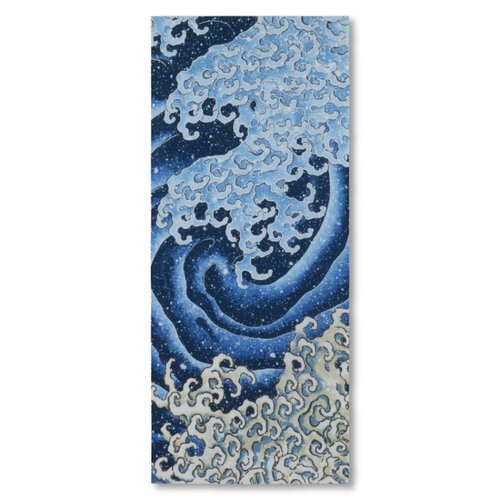
Japanese name/ Dotouzu Onami
-About-
Katsushika Hokusai (1760-1849), an ukiyo-e wood-block print artist and master painter of the Edo era, was invited to Obuse by Takai Kozan, a wealthy farmer and merchant.
During his 3-year stay, 86 year-old Hokusai was asked to paint several masterpieces for the ceilings of festival floats. “Masculine Wave“ (Onami), and “Feminine Wave“ (Menami) were painted for the ceiling of the “Kanmachi”, festival float.
In “Masculine Wave“, the surging crest of a huge wave and the power of the ocean are delightfully expressed with hand-drawn lines, evoking Hokusai’s spirited character and inner strength.
A collaboration with the Hokusai Museum (Obuse, Nagano).
A tenugui (手拭い) is a traditional Japanese decorative towel made from thin and light cotton. It dates back to the Heian period or earlier. By the Edo period, tenugui became what they are today; about 35 by 90 centimeters (14 by 35 in) in size, plain woven, and almost always dyed with plain color or some pattern. The long sides are finished with a selvage, while the short sides are left unfinished to allow fraying.
Tenugui is traditionally used, tied in a specific manner, as a sling to wrap and carry bento boxes. Similarly, they're used to wrap items such as bottles. They are also used as hand towels, and often as headbands, such as for Kendo. They are widely used simply as souvenirs or decorations. Although tenugui were once used as dishcloths, today Western-style thick or terry cloth dishcloths have generally replaced tenugui for dishcloth use.
・Cotton 100%
・35 x 14 inches
・Dyeing method-Kyo-Yuzen
・Wash separately
・Do not soak, line-dry.
・Made in Japan
・Currency : US Dollar (USD)

-About-
Katsushika Hokusai (1760-1849) was a master artist and printmaker of ukiyo-e, “pictures of the floating world” school.
Hokusai was well over 70 years old when The Great Wave was made. It would be the very first print he would publish of his monumental series, “The Thirty-Six Views of Mount Fuji”, a series which would firmly secure Hokusai’s fame in Japan, as well as overseas.
The Great Wave is Hokusai’s most celebrated work and with no doubt considered the most recognizable work of Japanese art in the world.
A collaboration with the Hokusai Museum, Obuse, Nagano.
・Size:2.8 × 2.8 × 7.9 (inches)/ Mass : 0.51 lbs / Caliber : 1.9 (inches)
・Made in Japan
・Currency : US Dollar (USD)

Japanese name / 大波 (Oonami)
-About-
The Great Wave is Hokusai’s mostcelebrated work and with no doubt considered the most recognizable work of Japanese art in the world. This extraordinary pattern was dyed using the kimono technique “Kyoto-Yuzen”.
A collaboration with the Hokusai Museum, Obuse, Nagano.
Actual items may look slightly different than their photo depending on cutting.
・Size:7.8 x 5 x 0.6 inch
・Belt :47 inch
・Made in Japan
・Currency : US Dollar (USD)
Color / (Blue) Size Chart
Japanese name/ 甲州石班澤 (Koshu Kajikazawa)
-About-
At the age of seventy, with a career of over 50 years experience making traditional woodblock prints, Katsushika Hokusai (1760-1849), undertook making his now-famous series “Thirty Six Views of Mount Fuji”, honoring the most spiritual and sacred mountain in all Japan. The traditional technique he used was most common at the time, ukiyo-e, literally meaning “pictures of the floating world”.
“Koshu Kajikazawa”, is the name of a place between Tokyo and Kyoto where two rivers meet, the 14th print of the series, which we the viewer have the pleasure of seeing through Hokusai’s eyes.
In this masterpiece, the fisherman’s pose intentionally reflects the shape of Mount Fuji in the background, an example of Hokusai’s “signature” compositional genius, no doubt contributing to Hokusai becoming the most renown and respected Japanese artist of all time.
We have been been given official permission to use this extraordinary woodblock print from the Metropolitan Museum of Art in New York , to which Pagong has implemented the dye technique of Kyoto Yuzen.
・Currency : US Dollar (USD)
・100% Silk (Custom-woven Jacquard )
・Made in Japan
・Classic-fit Aloha shirt
・Coconut buttons
・Dry-clean
・Model (6 feet)