
Ikyu’s Dragon
意休の龍 - Ikyu no Ryu
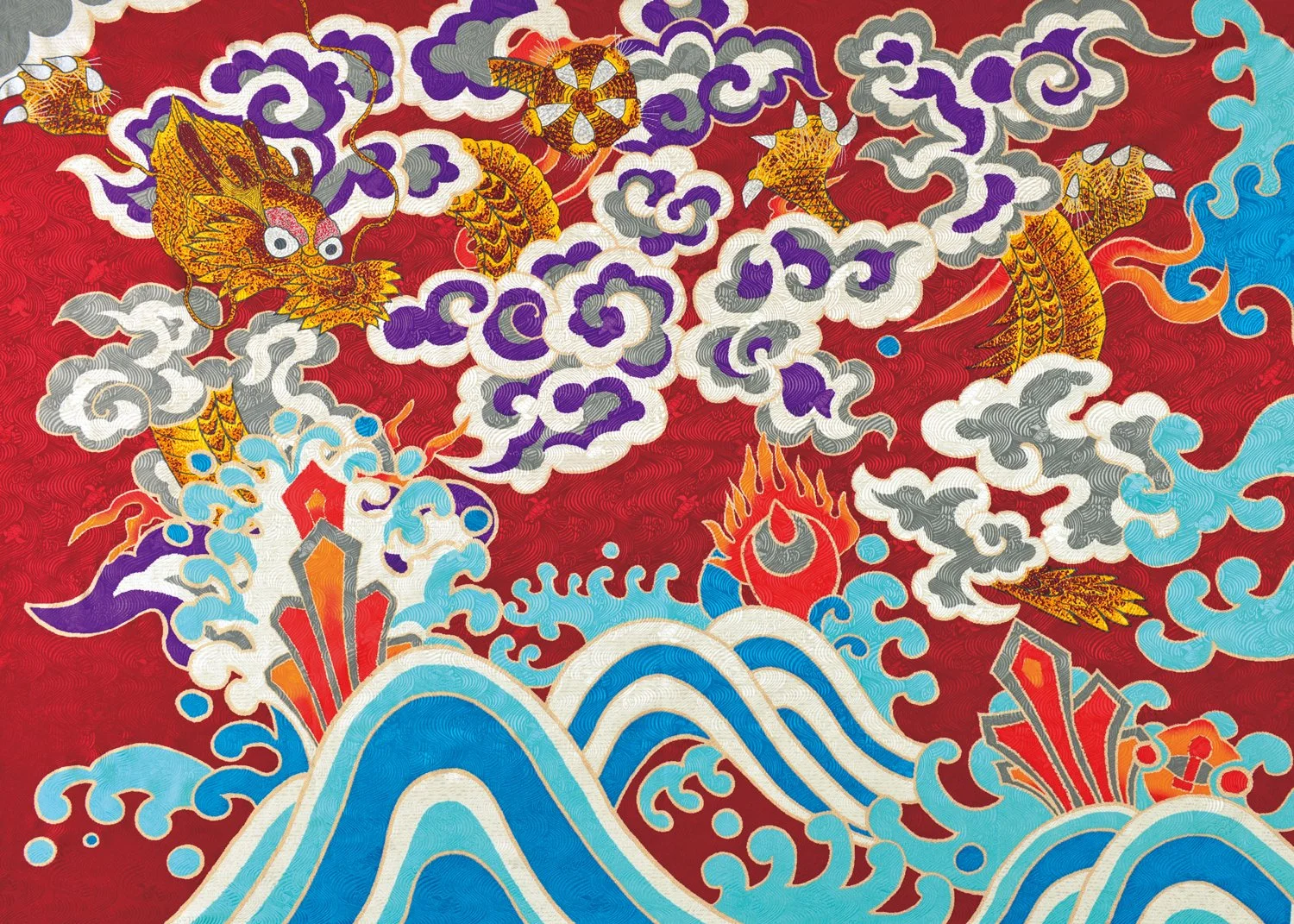
The Story of the Ikyu’s Dragon Pattern
This design is a reproduction, created using Yuzen dyeing techniques, of the costume worn by “Ikyū with the Beard,” the antagonist in Sukeroku Yukari no Edo Zakura, one of the famous plays in the Kabuki repertoire.
Set against the vibrant backdrop of the pleasure quarters, the story follows the hero Hanakawado Sukeroku, who provokes passing samurai into drawing their swords in order to search for the stolen Genji heirloom blade, Tomokirimaru. Eventually, he identifies Ikyū as the one in possession of the sword and challenges him, forcing him to draw it. The moment Ikyū unsheathes his sword, he is dressed in this striking costume known as Ikyū no Ryū (Ikyū’s Dragon).
The costume design reflects strong external influences, characterized by bold and dramatic motifs. Similar decorative styles can also be seen in traditional theatrical costumes from neighboring cultures, highlighting a shared appreciation for dynamic and expressive visual elements.
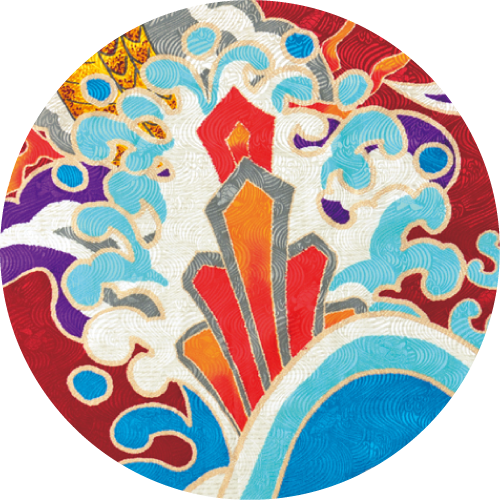
“Mount Kunlun”
Rising sharply from the waves, the jagged peak depicted in this design represents Mount Kunlun, a legendary mountain from ancient mythology. It is said to stand at the far western edge of the world, reaching up toward the heavens. Revered as a sacred realm, it was believed to be the dwelling place of celestial beings and immortals, and a source of the elixir of eternal life.In contrast, while Kunlun lies in the distant west, another mythical paradise is said to exist far to the east across the sea—an island of immortality known as Mount Hōrai.Together, these imagined landscapes evoke a world beyond the ordinary, symbolizing a timeless longing for eternity, transcendence, and the mysteries of the unknown.
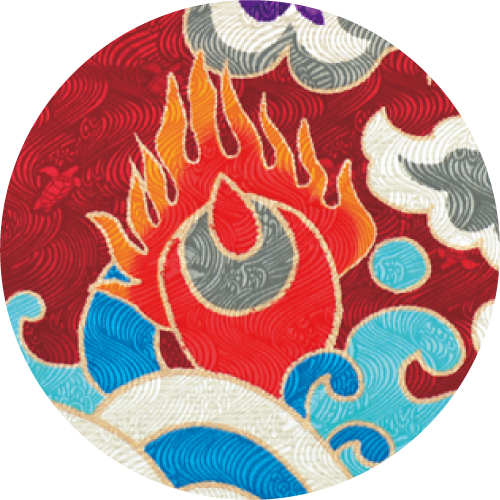
“Hōju (Sacred Jewel)”
Floating among the waves is a mystical jewel known as the hōju.This sacred gem is believed to ward off misfortune and purify even the murkiest waters. It is often described as a wish-fulfilling jewel—one that grants desires and brings forth treasures such as gold, silver, and anything one seeks.As a motif, the hōju symbolizes protection, purity, and the fulfillment of wishes, embodying both spiritual power and the promise of abundance.
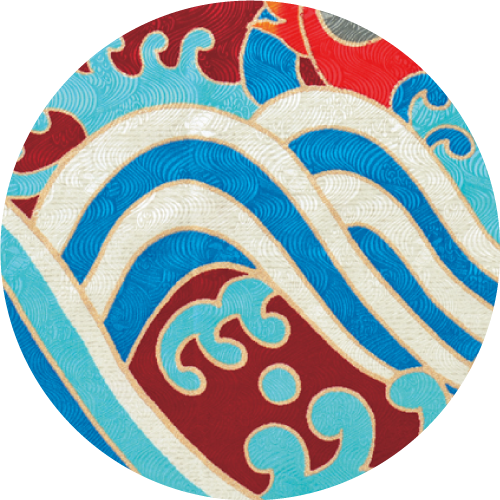
“Sea”
The sea has long been regarded as a source of treasures and abundance.
The waves, endlessly rolling in and receding, symbolize continuity and eternity. For this reason, wave patterns have been considered auspicious motifs, representing enduring prosperity and the unbroken flow of life.
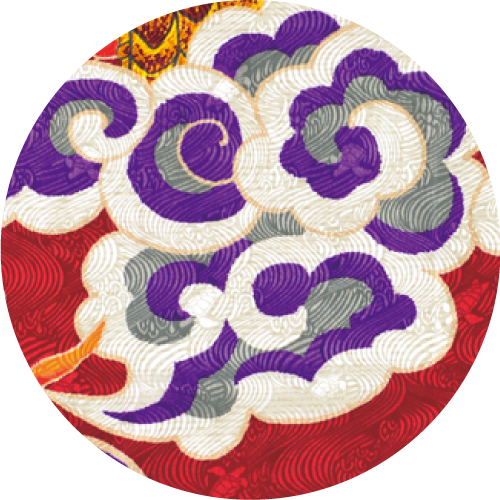
“Beaded Cloud Pattern”
The beaded cloud pattern is one of many stylized ways to depict clouds, characterized by rounded, pearl-like forms rising into the sky.In traditional imagery, dragons ascend to the heavens by riding on clouds. The proverb “like a dragon obtaining clouds” describes a moment when a person of great ability seizes the right opportunity, allowing them to rise and achieve remarkable success.This motif expresses elevation, momentum, and the power of timing—capturing the instant when potential transforms into greatness.
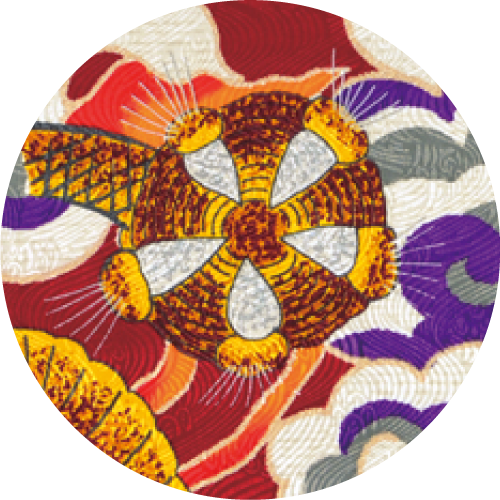
“Five-Clawed Dragon”
The motif of the five-clawed dragon in Japan originates from traditions that developed on the Asian continent. The dragon itself is a mythical creature said to possess the power to transform freely, symbolizing immense strength and authority.In these traditions, a fully realized dragon came to represent the highest rank of power. The five-clawed dragon in particular was reserved for the supreme ruler, while dragons with fewer claws were associated with those of lower rank within the ruling class.For this reason, the depiction of a dragon on Ikyū’s costume signifies his elevated status and commanding presence.
It is often said that Ikyū was modeled after Guan Yu from the classic Chinese tale Romance of the Three Kingdoms. However, within the actual narrative, Sukeroku is revealed to be Soga no Gorō, a man seeking revenge for his parents’ death. Meanwhile, Ikyū’s true identity is Iga Heinai Zaemon, a warrior of the Taira clan who is secretly plotting to assassinate Minamoto no Yoritomo.
The Kabuki Eighteen Best Plays were selected by Ichikawa Danjūrō VII as the signature works of his family. These plays were carefully preserved in a box and handed down through generations as treasured heirlooms. Even today, the expressions “eighteen best plays” and “the box” are used to refer to one’s specialties, and their origin can be traced back to this tradition.