
Jakuchu Ito
鶏図押絵貼屏風 - Niwatorizu Oshiebari Byoubu
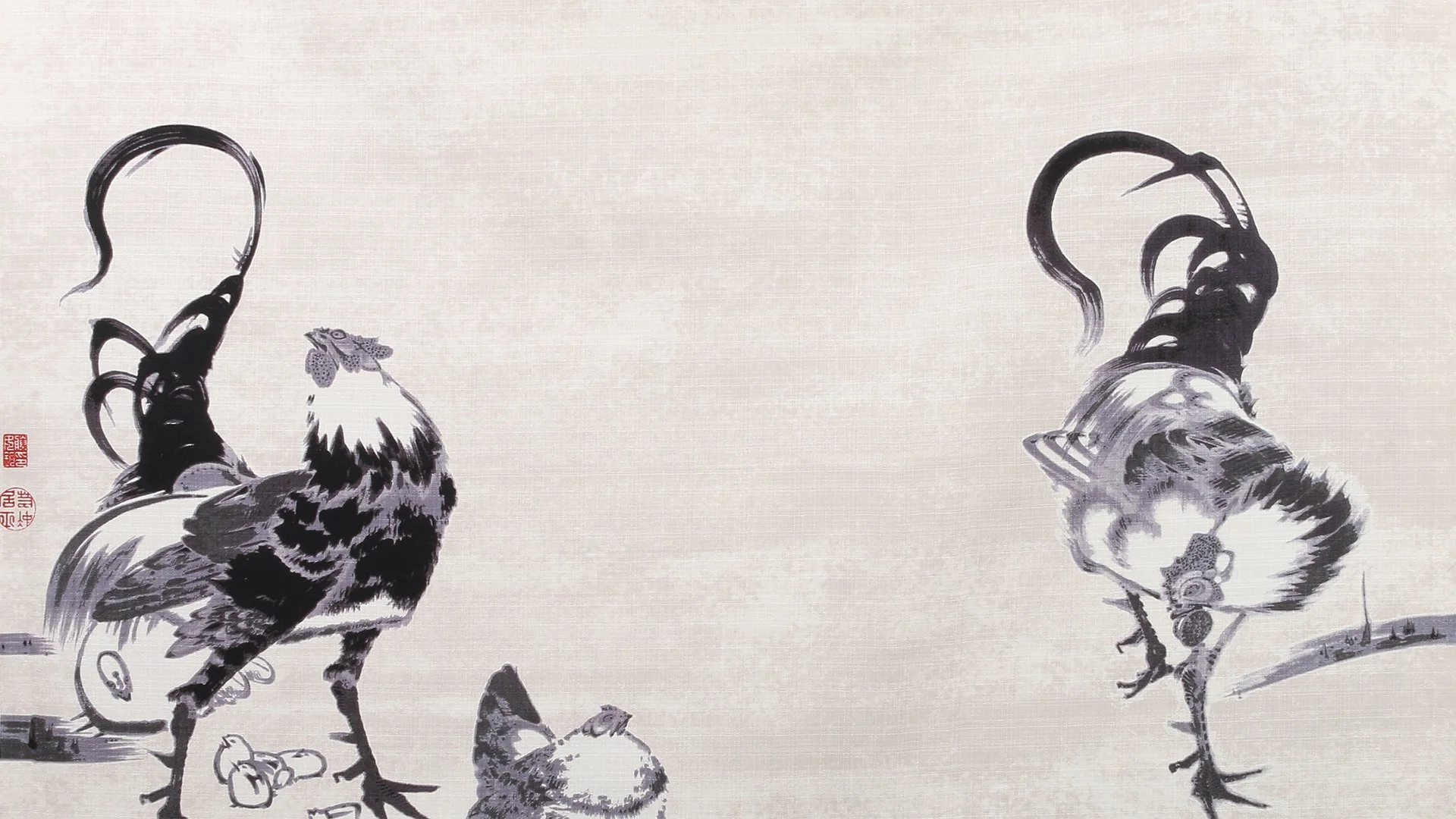
The Story of the Jakuchu Ito Rooster Pattern
Ito Jakuchu (1716–1800) was a painter active in Kyoto during the mid-Edo period.
Born as the eldest son of the Masuya greengrocer on Nishikikoji Street in Kyoto, he inherited the family business at the age of 23 and took the name Ito Genzaemon IV. At 40, he handed the business over to his younger brother and retired, devoting the rest of his life entirely to painting.
Jakuchu first studied under Kano school painters and later copied classical ink paintings, but eventually became deeply committed to direct observation from life. It is said that he kept dozens of chickens in his garden and spent years carefully observing and sketching their forms. Through this dedication, he came to be known as the “painter of chickens.”
The “Chicken Picture Appliqué Screen,” housed in the Hosomi Museum of Art in Kyoto, is composed of twelve individual panels arranged like appliqué works, each depicting chickens in different poses and moments. With the cooperation of the Hosomi Museum of Art, part of this work has been recreated using Kyoto Yuzen dyeing techniques.
The flowing tail feathers, rendered in deep ink tones, form rhythmic arcs as if cutting through the air, with each feather expressed through swift, energetic brushwork. The chickens appear in a variety of poses—looking upward, facing forward, and captured in both stillness and motion. Subtle gradations of ink and expressive details give the composition a sense of humor, vitality, and movement.
In 1788, Jakuchu lost much of his property in the Great Tenmei Fire and later built a hermitage in front of Sekiho-ji Temple in Fushimi, where he began painting professionally for the first time to support himself. Until then, he had been financially supported by his family. However, rather than being burdened by poverty, it is said that he found freedom in it, allowing his artistic expression to deepen further.
Remaining unmarried throughout his life and wholly devoted to painting, Jakuchu continued to pursue art with unwavering dedication until his death at the age of 85.