
Japanese Irises
燕子花 - Kakitsubata
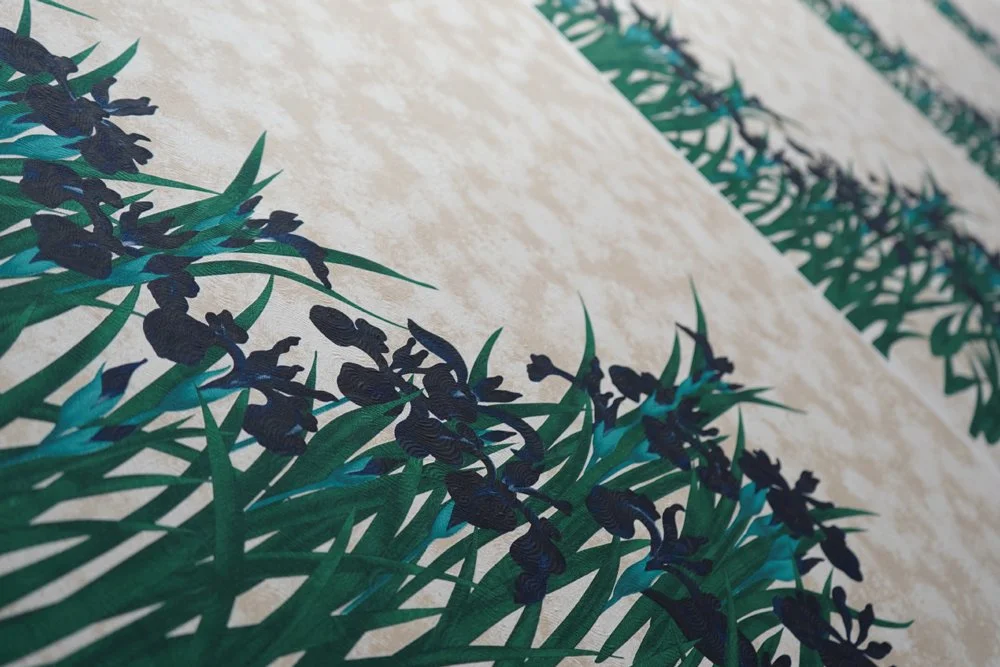
The Story of the Japanese Irises Pattern
This eye-catching pattern, featuring irises boldly arranged within a beaded cloud motif, is inspired by Eight Bridges Screen by Ogata Kōrin, now housed in the Metropolitan Museum of Art.
Ogata Kōrin, "Eight Bridges Screen," Metropolitan Museum of Art
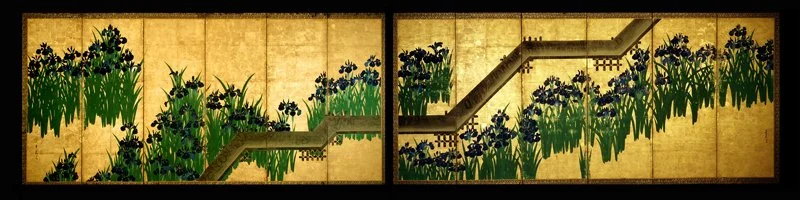
Eight Bridges Screen was created approximately ten years after the National Treasure Irises Screen, during the later period of Ogata Kōrin’s career, when he was in his early fifties.
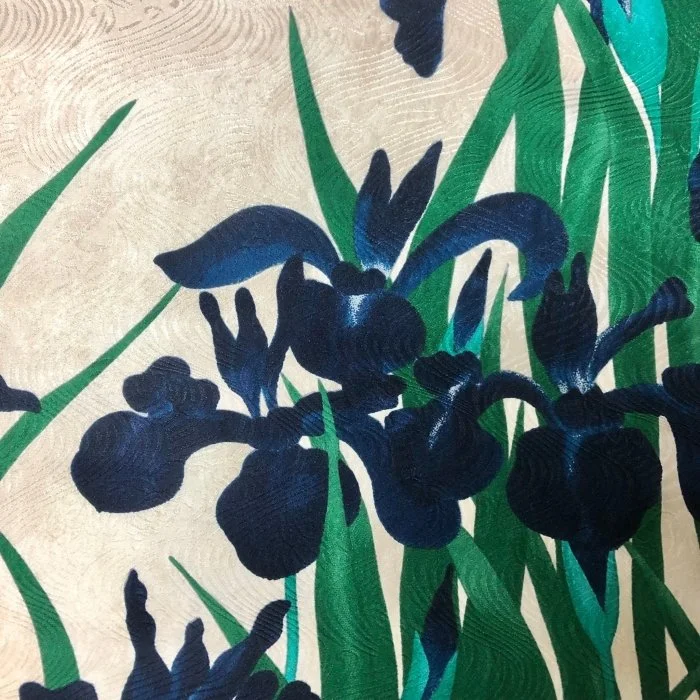
While the distinctive bridge naturally draws the eye, a closer comparison of the flowers reveals that Yatsuhashi-zu Byōbu presents the irises in a more naturalistic and realistic manner compared to the more rounded and stylized depiction seen in the Kakitsubata-zu Byōbu. In particular, the subtle white markings at the base of the petals—an essential characteristic of irises—are rendered with greater accuracy.
In early summer, irises bloom gracefully along the water’s edge in shades of purple and white. As evidenced by their frequent appearance in the Manyōshū, one of Japan’s oldest poetry anthologies, irises have long been cherished in Japanese culture. Their traditional flower meanings include “nobility,” “yearning,” and “certainty that happiness will come.”
From ancient times, purple has been regarded as a color of aristocracy, reserved for those of high status. The dignified, upright姿 of the purple iris therefore naturally conveys an impression of refinement and nobility.