
Koshu Kajikazawa
甲州石班澤
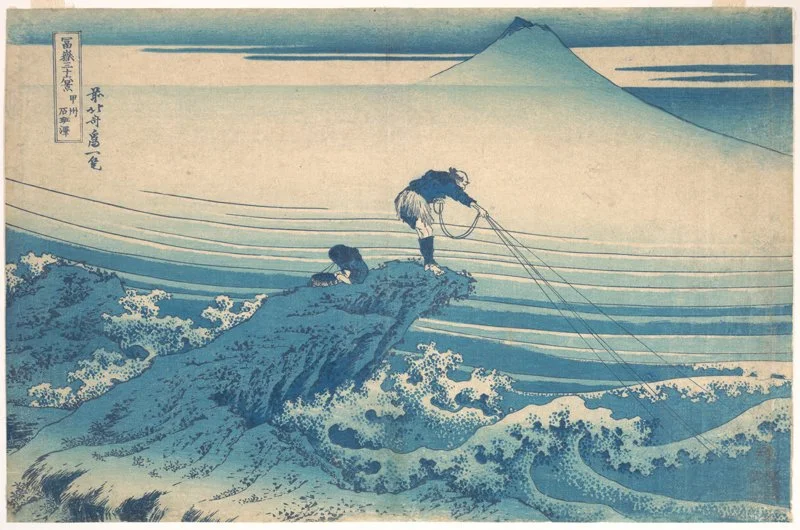
Katsushika Hokusai, "Thirty-Six Views of Mount Fuji: Ishibazawa, Koshu," Metropolitan Museum of Art
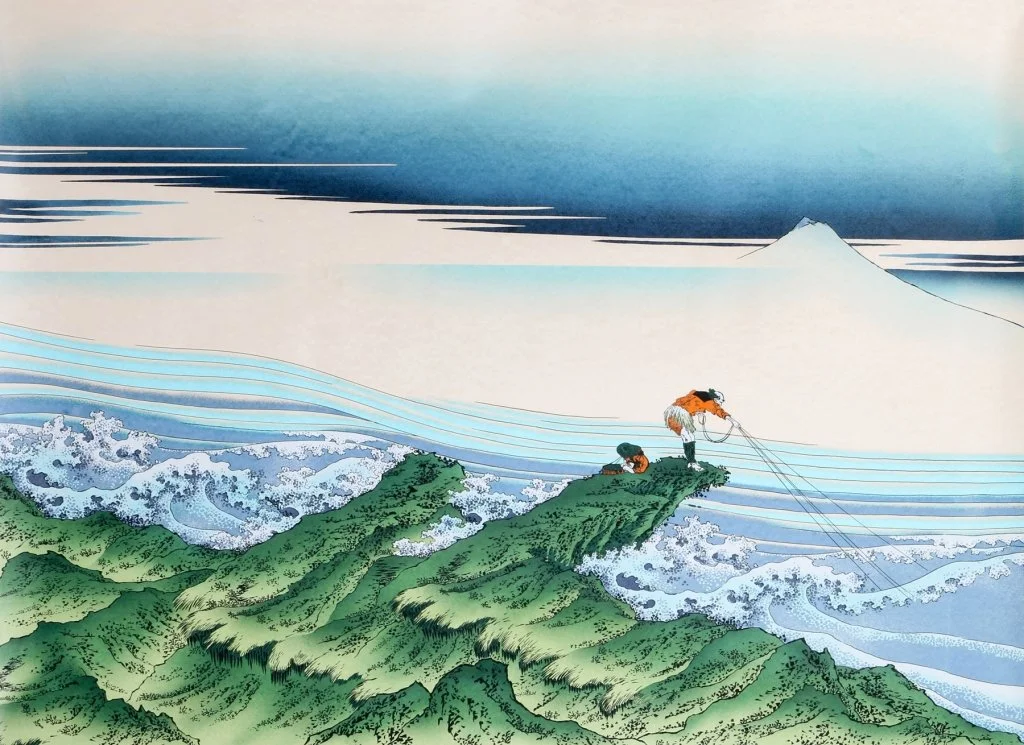
This is an adaptation of a woodblock print from the Metropolitan Museum of Art (New York), expressing Katsushika Hokusai's work using Kyo-Yuzen dyeing techniques.
It depicts a scene from Katsushika Hokusai's masterpiece, "Thirty-Six Views of Mount Fuji."
The Story of the Koshu Kajikazawa Pattern
Ishizawa refers to the area around former Kajikazawa Town in Yamanashi Prefecture (now part of Fujikawa Town), a strategic transport point known for its rapid currents where two rivers converge to form the main flow of the Fuji River.
What immediately draws the eye in this work is the figure of a fisherman casting a net from a steep, rocky cliff, along with the powerful waves crashing against the rocks below. The depiction of the river, rendered with such dynamic intensity that it almost feels like a raging sea, introduces a sense of movement within an otherwise tranquil composition, capturing the viewer’s attention.
Beside the fisherman, a child peering into a fish basket adds a touch of warmth and tenderness, gently softening the tense and dramatic atmosphere of the scene.
Although Mount Fuji is the nominal subject, it recedes into the distant haze, almost dissolving into the background—creating a composition that feels as though the fisherman has been captured through a focused, photographic perspective.
Furthermore, when connecting the fisherman, the cast net, and the protruding rocks, a triangular composition emerges that aligns with the silhouette of Mount Fuji in the background. In Thirty-Six Views of Mount Fuji, such triangular structures subtly suggesting the presence of Mount Fuji appear repeatedly. This use of recurring geometric forms—avoiding monotony while instead creating rhythm and resonance—is one of the defining qualities of Hokusai’s work.