
Landscape
風景画 - Fukeiga
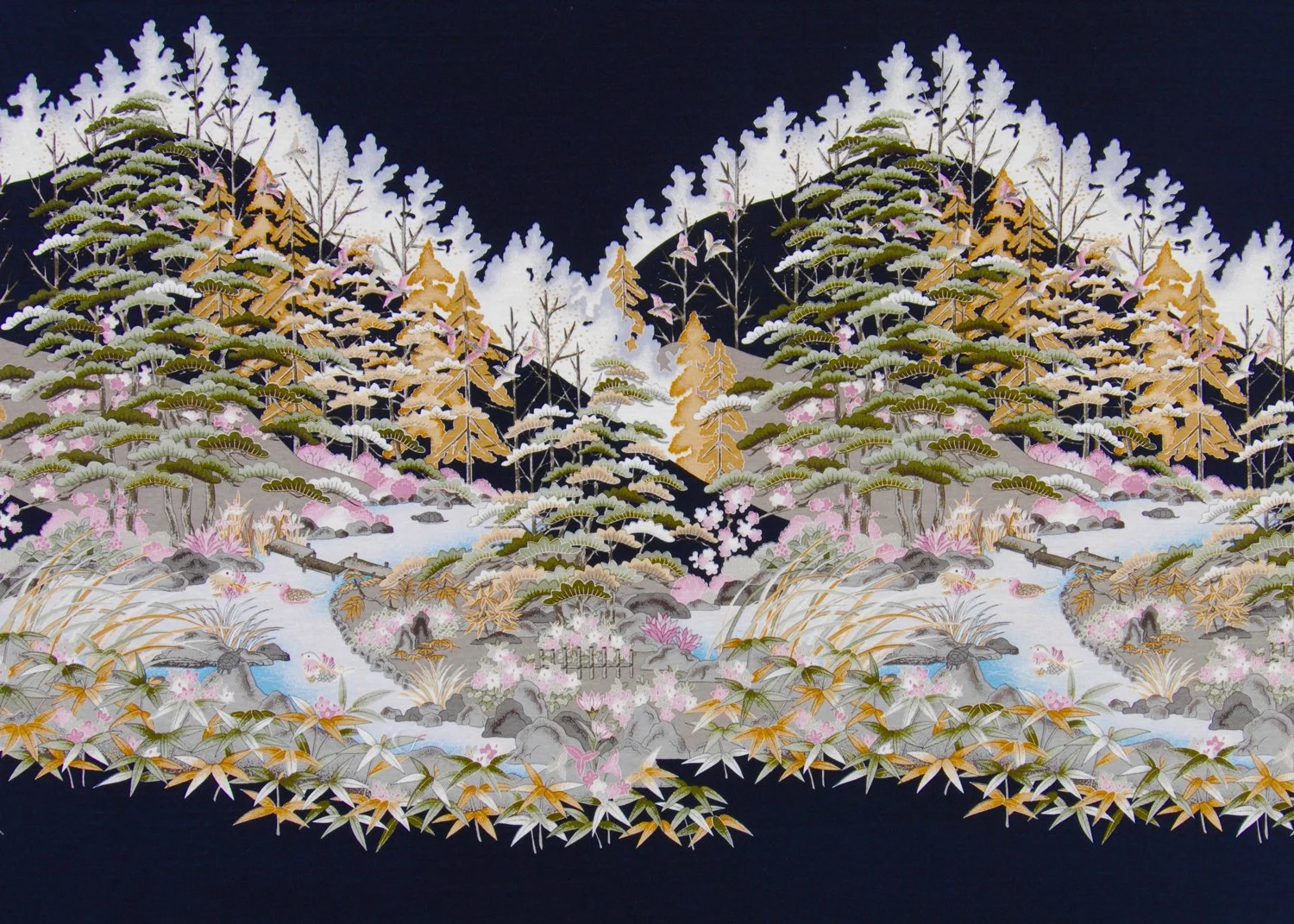
The Story of the Landscape Pattern
Depicting natural scenery as decorative patterns has a long history in Japan. In earlier periods, many designs were influenced by continental landscape painting traditions. From the mid-Heian period onward, as Japanese aesthetics developed, these designs gradually evolved into distinctly Japanese-style landscapes.
In the Kamakura and Muromachi periods, motifs began to incorporate themes from poetry and classical literature, giving rise to uta-e—designs in which imagery and poetic sensibility blend harmoniously. By the Edo period, landscape patterns often carried literary meaning; by recognizing the scene depicted on a kimono, one could sense the story or poetic reference behind it. Such designs also served as an expression of cultural refinement.
From the mid-Edo period, with the development of Yuzen dyeing and the rise of travel culture, landscapes of famous places became especially popular motifs. Scenic views such as Ōmi Hakkei, the famous sites of Kyoto, and the Tatsuta River were frequently depicted.
This particular landscape design was created in the 1960s. Evergreen trees and seasonal flowers are thoughtfully arranged, while the flowing water adds a refreshing sense of movement. The composition evokes the feeling of gazing upon a beautifully designed garden, with distant mountains forming a borrowed backdrop (shakkei), inviting a quiet appreciation of nature’s harmony.