
Lily
百合ちらし - Yuri Chirashi
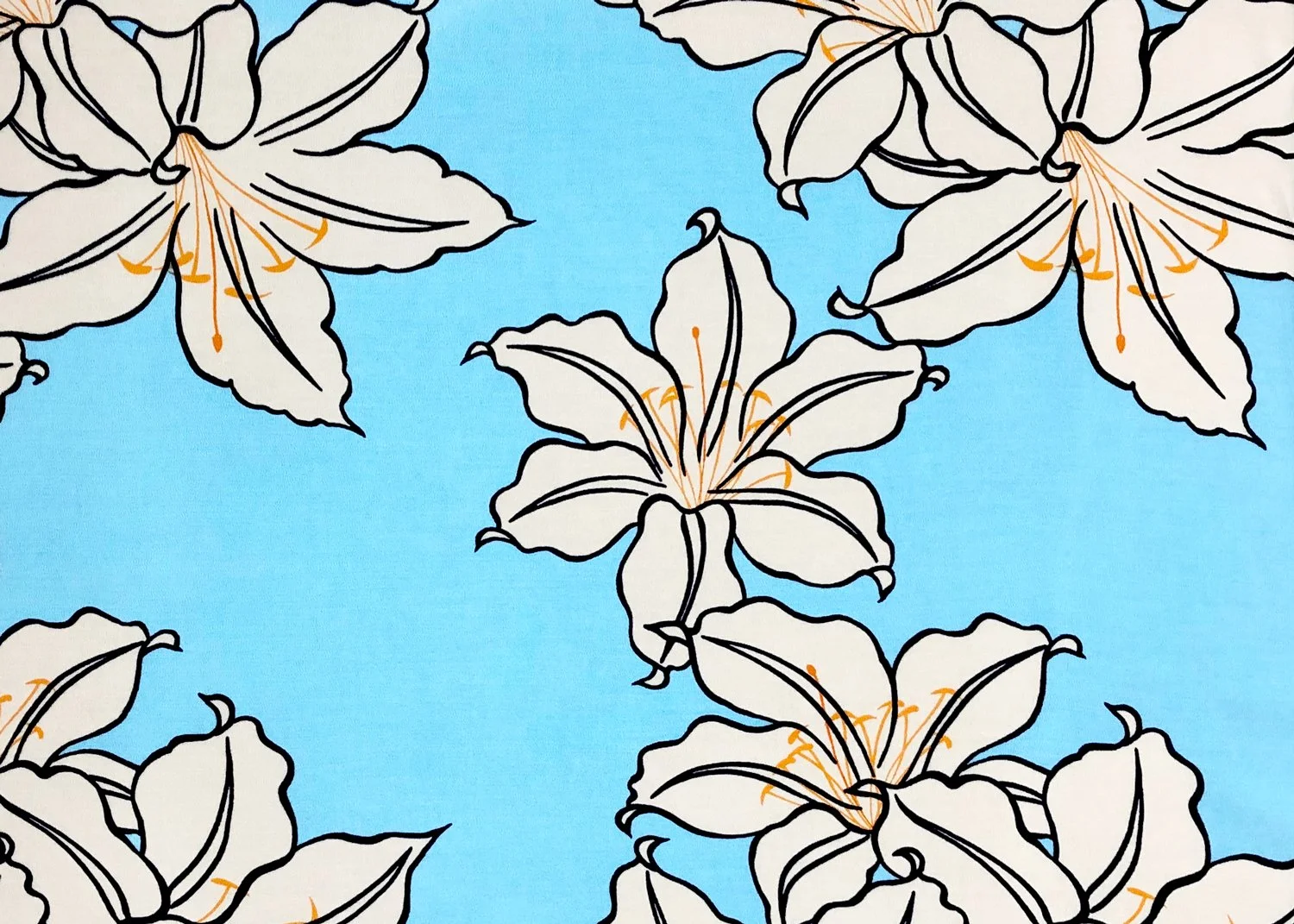
The Story of the Lily Pattern
Lilies have long been admired for their beauty, yet they have appeared surprisingly rarely as decorative motifs. One of the earliest examples can be found in the realistic depictions seen in Noh costumes from the Momoyama period.
There are many varieties of lilies—such as himeyuri, sasayuri, yamayuri, oniyuri, and teppoyuri—each with its own distinct charm. Toward the end of the Meiji era, as Western flowers and aesthetics gained popularity, more naturalistic, sketch-like designs began to emerge. From the Taisho period onward, lilies gradually became a motif in kimono design. Their graceful, somewhat Western elegance was favored, and they were often depicted in a realistic style rather than being heavily stylized.
In Christian tradition, the white lily is a symbol of purity and is offered as a sacred flower to Virgin Mary. It is often regarded as her flower, representing innocence and spiritual beauty.
In Japan as well, lilies appear in ancient texts such as the Kojiki and the Nihon Shoki. One notable story tells of the romance between Emperor Jimmu and Isukeyorihime.
At Isagawa Shrine in Nara, a festival inspired by this story is still held today. The shrine enshrines Isukeyorihime—also known as Himetatara Isuzuhime—and her parents. According to legend, she grew up near a pure spring surrounded by blooming mountain lilies. It was there that Emperor Jimmu first saw her and fell in love, and their meeting became the origin of this tale.
Even today, lilies are offered during the festival in her honor, continuing the connection between the flower and themes of purity, beauty, and devotion.
The lily’s symbolic meanings—purity, grace, and elegance—are reflected across cultures. In Japan, it has also been associated with feminine beauty, as seen in the expression likening a graceful woman’s walk to the gentle sway of a lily.
The “scattered lily” pattern, in which blossoms flow across the entire surface, captures this beauty through soft, flowing lines. Wearing such a design evokes a sense of refinement and quiet elegance, allowing the timeless charm of the lily to live on in everyday life.