

Lookbook Items List

Japanese name/ 蔦と菊牡丹 (Tsuta to Kikubotan)
-About-
Ivy is loved for its beautiful palm-shaped leaves and tendrils that form stems. It is also used as a family crest, as it is considered a strong and auspicious plant, as it grows by climbing other trees and buildings. Geisha also liked the way it tangles and multiplies, as it represents a lifetime of staying with regular customers. Chrysanthemums are depicted as a motif representing longevity and are beloved as a flower that represents autumn in Japan. The peony is also known as the "flower of wealth" and symbolizes people's yearning for abundance.
・Currency : US Dollar (USD)
・100% Silk (Custom-woven Jacquard )
・Made in Japan
・Classic-fit Aloha shirt
・Coconut buttons
・Dry-clean
Color / Black and White
Japanese name/ 甲州石班澤 (Koshu Kajikazawa)
-About-
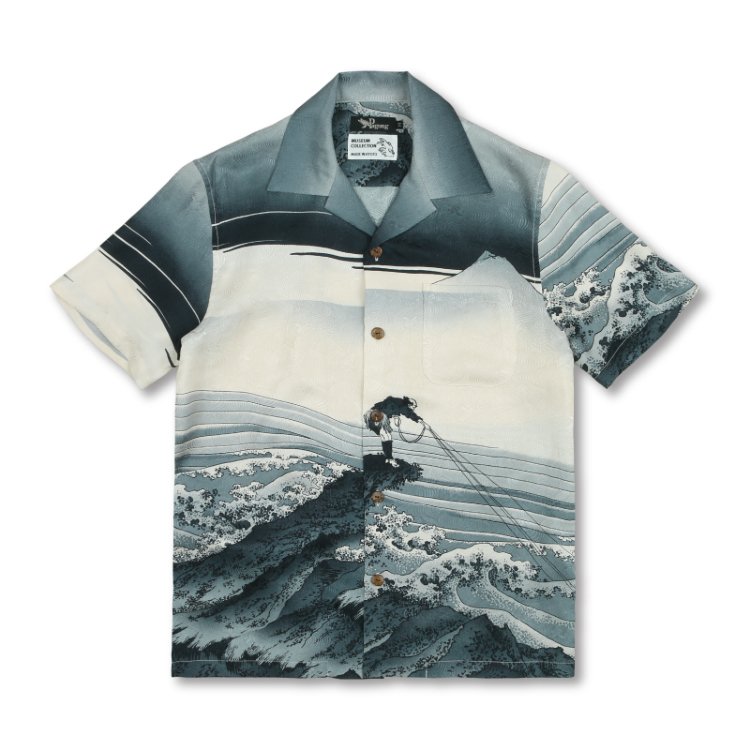
At the age of seventy, with a career of over 50 years experience making traditional woodblock prints, Katsushika Hokusai (1760-1849),undertook making his now-famous series “Thirty Six Views of Mount Fuji”, honoring the most spiritual and sacred mountain in all Japan. The traditional technique he used was most common at the time, ukiyo-e, literally meaning “pictures of the floating world”.
“Koshu Kajikazawa”, is the name of a place between Tokyo and Kyoto where two rivers meet, the 14th print of the series, which we the viewer have the pleasure of seeing through Hokusai’s eyes.
In this masterpiece, the fisherman’s pose intentionally reflects the shape of Mount Fuji in the background, an example of Hokusai’s “signature” compositional genius, no doubt contributing to Hokusai becoming the most renown and respected Japanese artist of all time.
We have been been given official permission to use this extraordinary woodblock print from the Metropolitan Museum of Art in New York , to which Pagong has implemented the dye technique of Kyoto Yuzen.
・Currency : US Dollar (USD)
・100% Silk (Custom-woven Jacquard )
・Made in Japan
・Classic-fit Aloha shirt
・Coconut buttons
・Dry-clean

Color / White and Black Size Chart Care Instruction
Japanese Name / 富士越龍 (Fuji Koshi Ryu)
-About-
Katsushika Hokusai (1760-1849) was to spend his final years passionately making a rare collection of “free-hand” paintings, quite unlike any of his previous ukiyo-e print-works which he is most world-renowned.
Hokusai’s enduring passion to portray Mount Fuji, Japan’s sacred mountain, is a challenge he continued to pursue for his entire lifetime. The many ephocal events of his long prolific career seem to culminate in his final masterpiece, “Dragon Flying Over Mount Fuji” where we the viewer are given the rare opportunity to look deeply into the stillness and peace within the artist’s final year.
・Currency: US Dollar (USD)
・100% Silk (Custom-woven Jacquard )
・Made in Japan
・Classic-fit Aloha shirt
・Coconut buttons
・Dry-clean

Color / Black and Multi-color Size Chart
Japanese name/ 梅竹に菊籬 (Umetake ni kikumagaki)
-About-
The kabuki costume featuring the "Plum, Bamboo, and Chrysanthemum Fence Motif " showcases a design brought to life through the traditional Yuzen dyeing technique. This exquisite pattern originates from the kimono worn by the character Yugiri in the kabuki play "Kuruwa Bunsho."
Yugiri was a real historical figure—so beloved for her beauty and grace that even after her passing, numerous artistic works known as "Yugirimono" were created in her honor. By wearing this captivating motif, you can experience a connection to her timeless elegance and the rich cultural heritage of classical Japanese theatre.
Musuem Collection
・Currency : US Dollar (USD)
・100% Silk (Custom-woven Jacquard )
・Made in Japan
・Classic-fit Aloha shirt
・Coconut buttons
・Dry-clean

Color / Purple and Multi-color Size Chart
Japanese name/ むじな菊 (Mujinagiku)
-About-
This pattern features small petals of chrysanthemums arranged to resemble double-petaled chrysanthemum flowers. It is named for the way the petals mimic the fur of a badger. While typically used as a small pattern for kimonos, in this design, each badger chrysanthemum is distinct, with varied petals. Chrysanthemums have been a beloved flower in Japan since ancient times, frequently appearing in kimono designs and crafts as a symbol of immortality.
・Currency : US Dollar (USD)
・100% Silk (Custom-woven Jacquard )
・Made in Japan
・Classic-fit Aloha shirt
・Coconut buttons
・Dry-clean

Color / Black and Multi-color Size Chart
Japanese name/ 御所解 (Goshodoki)
-About-
This palace-style pattern was popular among the ladies of the Kyoto Imperial Palace for their kosode short-sleeved kimonos during the mid to late Edo period. It is a type of landscape pattern that portrays stories from the imperial era, featuring elegant elements such as flowing water, flowers, and imperial carriages. This pattern eventually became known as the "Gosho-kai pattern" in the early Meiji period. It is said that the ladies-in-waiting to nobles and women working at the Imperial Palace would unpick and wear short-sleeved kimonos given to them by the ladies-in-waiting.
・Currency : US Dollar (USD)
・100% Silk (Custom-woven Jacquard )
・Made in Japan
・Classic-fit Aloha shirt
・Coconut buttons
・Dry-clean

Color / Iceberg Blue and Multi-color Size Chart
Japanese name/ 龍神 (Ryujin)
-About-
A deity of the sea in Japanese mythology, RYUJIN or “Dragon God”, has the powerful capability to transform into a human shape, and is the master of serpents. With his magic jewels he is responsible for the tides, and represents both the perils as well as the bounty of thesea.
Ryujin is one of the eight dragon gods which were originally imported from Indian mythology via China and Korea. His residence is in a palace beneath the sea or in a lake of an extinct volcano. The depths of Lake Biwa, north-east of Kyoto, are often cited as the home of Ryujin.
・Currency : US Dollar (USD)
・100% Silk (Custom-woven Jacquard )
・Made in Japan
・Classic-fit Aloha shirt
・Coconut buttons
・Dry-clean

Color / Red Size Chart Care Instruction
Japanese name/ 意休の龍 (Ikyu no Ryu)
(Featured in the Edo-era Kabuki drama “Sukeroku Yukari No Edo Zakura”.
-About-
On the gorgeous Kabuki stage, the setting from which this pattern was taken, we are transported to feudal Japan, when samurai and bushi still had important roles in the land.
Ikkyu, the main character of this kabuki drama, is wearing the boldly elegant, lavishly embroidered dragon kimono, which “explodes” on stage. Worn with confidence, Ikkyu’s full intention is to distinguish his importance as well as his high ranking.
The origin of the exquisite symbols within this costume can be traced all the way back to ancient Chinese mythology. The five-clawed dragon, considered god-like, is said to have been worn only by nobles. Mythological mountains, clouds, waves and flames, are all freshly represented to signify great wealth, strength, and abundance.
We have been been given official permission to use this extraordinary pattern from the ShochikuCostume Company in Tokyo, to which Pagong has implemented the dye technique of Kyoto Yuzen.
・Currency : US Dollar (USD)
・100% Silk (Custom-woven Jacquard )
・Made in Japan
・Classic-fit Aloha shirt
・Coconut buttons
・Dry-clean
Japanese name/ 曜変天目 (Yohen Tenmoku)
-ABOUT-
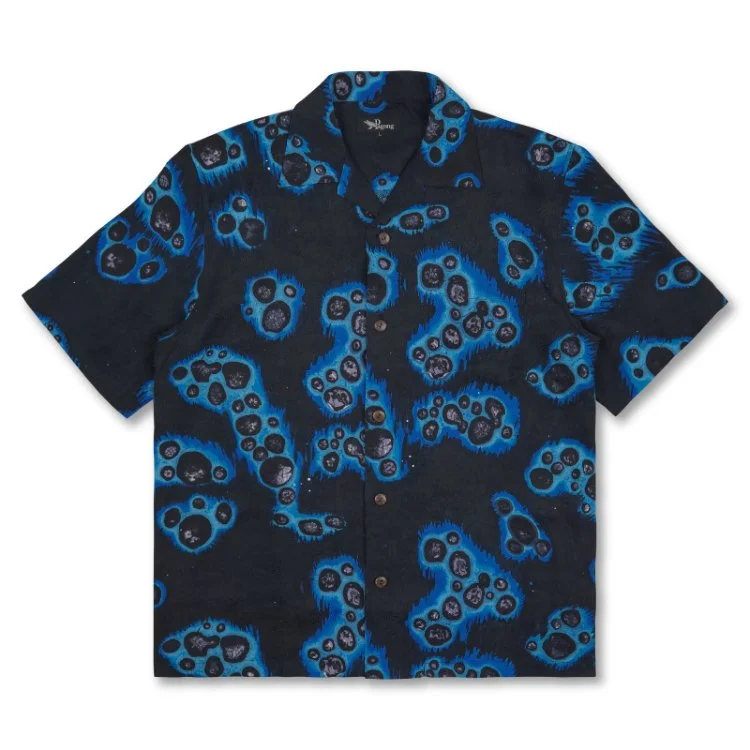
Each is only 12 centimeters, less than 5 inches across, but inside is what seems to be “a galaxy aglow with stars”…
There are only three intact centuries-old Yohen Tenmoku tea bowls known to still exist in the world. The bowls are believed to have been produced at Jian-yao kiln in China’s Fujian province during the Song dynasty (1127-1279).
Although it wasn’t until the Muromachi era (1338-1573) when the custom of tea began to take root, they were brought back to Japan as a gift by a Japanese Zen monk who was receiving training at Tianmoku mountain, pronounced “Tenmoku” in Japanese, in China’s coastal Zhejiang province.
The Tenmoku type are black glazed bowls with the inside surface covered with iridescent patterns and lapis lazuli colored areas surrounded by lighter colors ranging from blue to bluish purple.
The meaning of “Yohen” describes the glistening pattern which transforms with light, and created while the bowls were being fired, the method in which this was done remains unknown, but it is thought to not be reproducible. The Yohen Tenmoku bowls are known as the highest grade of Tenmoku-ware, and considered to be the most precious pieces among black tea bowls produced at Jian kiln.
In recent years, fragments of Yohen Tenmoku were excavated in China from the site of the imperial guesthouse in Lin’an (Hangzhou) which used to be the southern capitol during the Song Dynasty; this discovery getting much attention world-wide.
At this time, one bowl is owned by Ryoko-in, a sub-temple of Daitokuji Temple in Kyoto, a second is owned by the FujitaMuseum of Art in Osaka, and a third is owned by SeikadoBunko Art Museum in Tokyo; all three being designated by the Japanese government as Important National Treasures.
It is a great honor and brings us much joy for Pagong Kyoto to have been selected to replicate these ancient patterns of the Yohen Tenmoku by the Seikado Bunka Art Museum in Tokyo, to be admired and appreciated by art enthusiasts once more!
・Currency : US Dollar (USD)
・100% Silk (Custom-woven Jacquard )
・Made in Japan
・Classic-fit Aloha shirt
・Coconut buttons
・Dry-clean

Japanese name/ 地獄の鬼 (Jigoku no Oni)
-About-
This pattern was originally used during the Showa era (1926-1989), for the lining of a men’s coat or “haori“ which was worn over the kimono.
”Little Demons In Hell”, playfully depicts the everyday way of life of the lord “oni“ with his little demons. One might wonder why this pattern would have only been used for the inner lining…perhaps it was meant to make an impression or impact when removing the coat, a “surprise“ lining being exposed.
Often was such the case in the past in Japan, when playing games with geisha, or maiko san in the lively entertainment districts. This fun-loving pattern would have surely been the center of attention at a party, winning the delight and admiration of everyone.
・Currency : US Dollar (USD)
・100% Silk (Custom-woven Jacquard )
・Made in Japan
・Classic-fit Aloha shirt
・Coconut buttons
・Dry-clean

Color / Black Size Chart Care Instruction
Japanese name/ 意休の龍 (Ikyu no Ryu)
(Featured in the Edo-era Kabuki drama “Sukeroku Yukari No Edo Zakura”.
-About-
On the gorgeous Kabuki stage, the setting from which this pattern was taken, we are transported to feudal Japan, when samurai and bushi still had important roles in the land.
Ikyu, the main character of this kabuki drama, is wearing the boldly elegant, lavishly embroidered dragon kimono, which “explodes” on stage. Worn with confidence, Ikkyu’s full intention is to distinguish his importance as well as his high ranking.
The origin of the exquisite symbols within this costume can be traced all the way back to ancient Chinese mythology. The five-clawed dragon, considered god-like, is said to have been worn only by nobles. Mythological mountains, clouds, waves and flames, are all freshly represented to signify great wealth, strength, and abundance.
We have been been given official permission to use this extraordinary pattern from the ShochikuCostume Company in Tokyo, to which Pagong has implemented the dye technique of Kyoto Yuzen.
Currency : US Dollar (USD)
・70% Cotton / 30% Linen
・Premium Fabric / Made in Japan
・Classic-style Aloha shirt
・Coconut buttons
・Gently wash by hand.
・Made in Japan

Japanese name / 狛犬と源氏車 - Komainu to genjiguruma
-About-
This pattern called komainu depicting shishi, "lion-dogs," stand at either side of the entrance to the shrine or the hall of worship. These fierce guardians are meant to protect the shrine from evil.These fierce guardians are meant to protect the shrine from evil.
The ultimate origins of these lionlike figures probably extend back to ancient India or even Egypt, but the more immediate source would appear to be Chinese.
Most komainu closely resemble the so-called (Divene Beasts). Typically, one of the creatures is depicted with its mouth open and the other with its mouth closed.
・Currency: US Dollar (USD)
・100% Silk (Custom-woven Jacquard )
・Made in Japan
・Classic-fit Aloha shirt
・Coconut buttons
・Dry-clean
Color / Black and White Size Chart Care Instruction
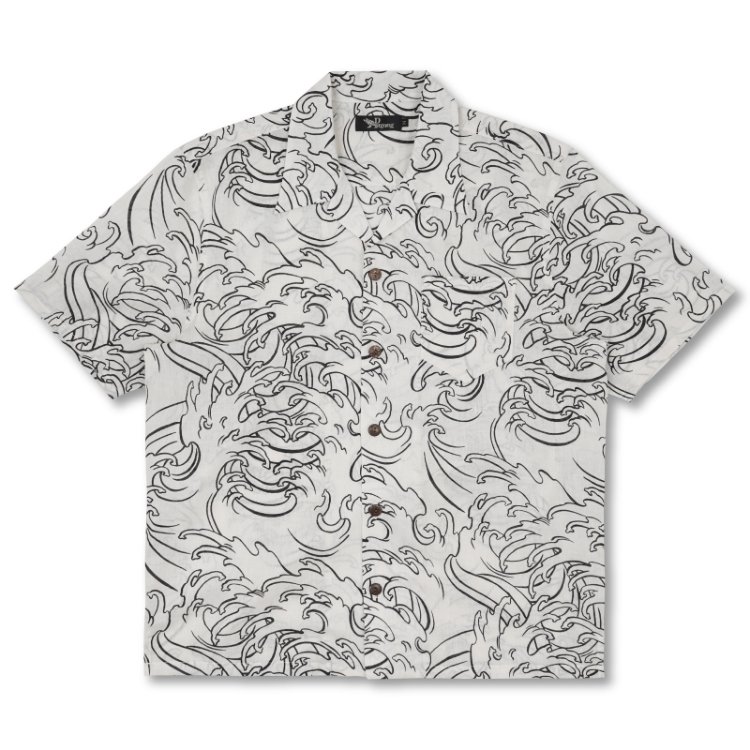
Japanese name/ 額波 Gakunami
-About-
This is a collaborative design with the tattoo studio "Gion Daruma." Tattoos have been used in ceremonies, as talismans, and as customs around the world since ancient times, and have expanded into a sophisticated culture over time. The powerful wave patterns unique to Japanese tattooists are expressed using Yuzen dyeing.
・Currency : US Dollar (USD)
・70% Cotton / 30% Linen
・Premium Fabric
・Classic-style Aloha shirt
・Coconut buttons
・Wash by hand
・Made in Japan

Color / Blue Size Chart Care Instruction
Japanese name/ 桜ぼかし (Sakurabokashi)
-About-
Sakura, or cherry blossoms, are Japan’s national flower in the hearts of the people. Every spring, throngs of Japanese people and visitors make efforts to see this well-loved flower, a tradition known as “hanami”, a flower-viewing and picnic event to enjoy the blossoms.
Widely celebrated in Japanese literature, poetry, and art, sakura carry layered meanings. For example, because they bloom briefly, the blossoms are often seen as a metaphor for the ephemeral beauty of living. The brilliant blooming season is powerful, glorious, and intoxicating, but short-lived, a visual reminder that our lives, too, are fleeting.
The joyful tradition of hanami is an old and ongoing tradition, and can be traced back centuries in Japanese culture. The eighth century chronicle Nihon Shoki records hanami festivals being held as early as the third century AD.
・Currency : US Dollar (USD)
・100% Polyester (Quick Dry)
・Made in Japan
・Classic-style Aloha shirt
・Coconut buttons
・Hand-wash
Color / Violet Size Chart Care Instruction
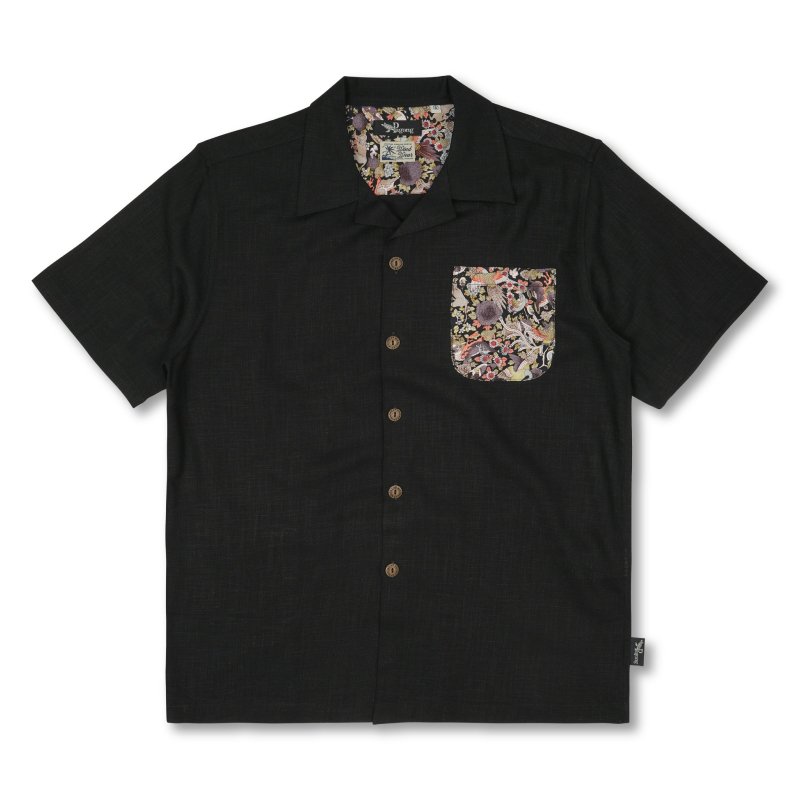
Pagong X WindWear Second Collabortaion
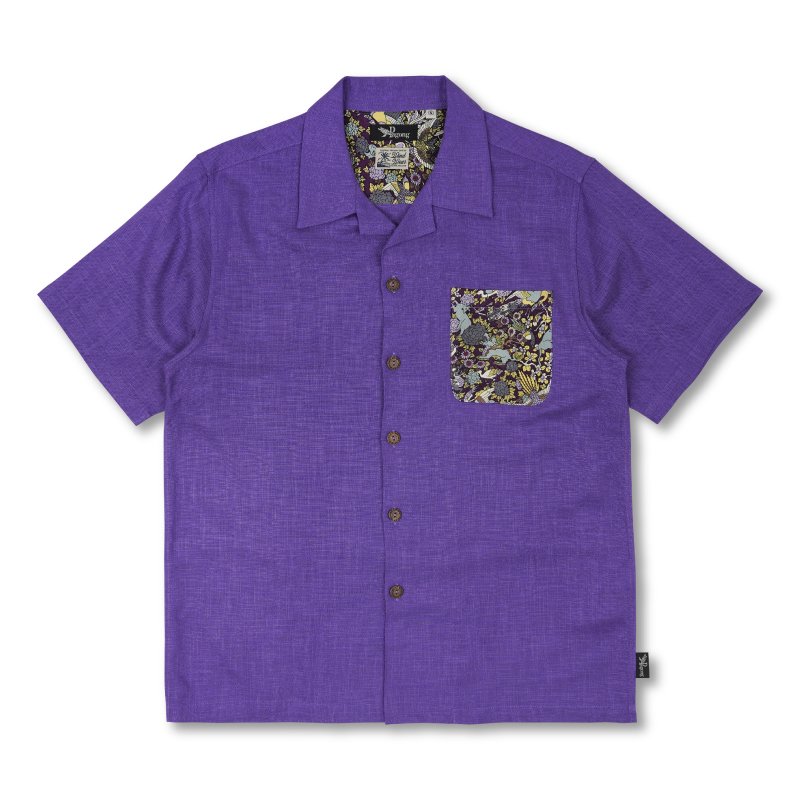
This is the second collaboration with Thai Aloha shirt brand "WindWear". The body of this Aloha shirt is made of natural rayon linen material, and the patterned parts such as the pockets are made of silk fabric dyed by artisans at Pagong.
Our second collaboration features an aloha shirt with black and violet color combination where the inner shoulders and pockets have been silk fabric fitted with animal chintz pattern.
The “Animal chintz” patterns were chosen as a reflection of Thai and Japanese nature and culture.
*Regarding sizing please note:
The sizes for this collaboration shirt are cut larger than Pagong’s silk Aloha shirts.
For example: The chest-size for Pagong’sMEDIUM silk Aloha shirt is 42 inches. WindWear’s rayon Aloha shirt chest-size for MEDIUM is 44 inches.
・Currency : US Dollar (USD)
・85% Rayon 15% linen
・Classic-fit Aloha shirt
・Coconut buttons
・Wash by hand
Color / Black
Pagong X Windwear Second Collabortaion
This is the second collaboration with Thai Aloha shirt brand "Windwear". The body of this Aloha shirt is made of cool rayon linen material, and the patterned parts such as the pockets are made of silk fabric dyed by artisans in Pagong.
Our second collaboration features an aloha shirt with black and violet colour combination where the inner shoulders and pockets have been silk fabric fitted with animal chintz.
The animal chintz patterns were chosen as a reflection of Thai and Japanese nature and culture.
*Regarding sizing please note:
The sizes for this collaboration shirt are cut larger than Pagong’s silk Aloha shirts.
For example: The chest-size for Pagong’sMEDIUM silk Aloha shirt is 42 inches. Windwear’s rayon Aloha shirt chest-size for MEDIUM is 44 inches.
・Currency : US Dollar (USD)
・85% Rayon 15% linen
・Classic-fit Aloha shirt
・Coconut buttons
・Wash by hand

Color/ Black and Multi-color Size Chart Care Instruction
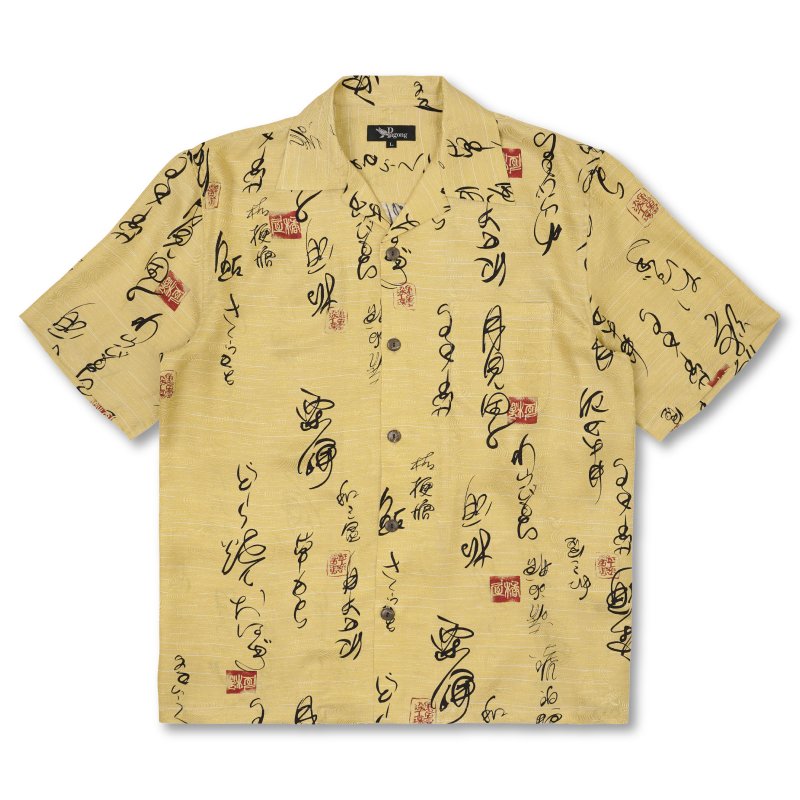
Japanese name/ 荒磯丸文 Arasomarumon
-About-
The name "Araiso" can be pronounced as "Ariso" or "Araiso." Its origin stems from "Araiso Junko," depicting carp-like fish rhythmically leaping on the waves in opposite directions. This mesmerizing pattern of carp gracefully bouncing on the waves is commonly referred to as Araiso-bun.
In this pattern, the Araiso pattern arranged in a round pattern placed between the waves along with the Hanamaru pattern. Combining the wild and heroic image of Araiso with the Hanamaru pattern adds softness, creating a pattern that combines strength and gentleness. The carp symbolizes bravery and strong faith in the face of adversity and hardship, and the flowers, which evoke kindness, encourage us as we strive toward the future.
Currency: US Dollar (USD)
・100% Polyester (Quick Dry)
・Made in Japan
・Classic-style Aloha shirt
・Coconut buttons
・Hand-wash
Japanese name/ 有楽斎好み
-About-
Sakura mochi in spring, refreshing warabi mochi in summer, kuri mochi in autumn, and strawberry daifuku in winter - wagashi, which allows you to feel the four seasons, is one of Japan's world-famous cultures. In the past, they were a treat associated with imperial ceremonies, but in modern times, they have come to signal the change of seasons, and you can see wagashi all over town. Wagashi seem to have a noble character, as they quickly retire once the season has passed, and can only be found in that season. This time, we have collaborated with Kyoto's long-established wagashi shop "Tachibanaya'' and "Pagong'', and produced textiles named after wagashi. While machine-made products are becoming mainstream, this pattern was created with the feelings of wagashi shop and dye shop that have been cherished for a long time.
・Currency: US Dollar (USD)
・100% Silk (Custom-woven Jacquard )
・Made in Japan
・Classic-fit Aloha shirt
・Coconut buttons
・Dry-clean

Color / Navy adn Multi-color Size Chart Care Instruction
Japanese name/ 荒磯丸文 Arasomarumon
-About-
The name "Araiso" can be pronounced as "Ariso" or "Araiso." Its origin stems from "Araiso Junko," depicting carp-like fish rhythmically leaping on the waves in opposite directions. This mesmerizing pattern of carp gracefully bouncing on the waves is commonly referred to as Araiso-bun.
In this pattern, the Araiso pattern arranged in a round pattern placed between the waves along with the Hanamaru pattern. Combining the wild and heroic image of Araiso with the Hanamaru pattern adds softness, creating a pattern that combines strength and gentleness. The carp symbolizes bravery and strong faith in the face of adversity and hardship, and the flowers, which evoke kindness, encourage us as we strive toward the future.
・Currency : US Dollar (USD)
・100% Silk (Custom-woven Jacquard )
・Made in Japan
・Classic-fit Aloha shirt
・Coconut buttons
・Dry-clean

Color / Red and Multi-color Size Chart Care Instruction
Japanese name/ 鞍馬天狗のうちわ
Tengu, a class of supernatural creatures found in Japanese folklore, art, theater, and literature.
The normal feather fan of a Tengu has 7 or 8 (yatsude) feathers. Some have nine feathers.Many tales feature this fan, which has the ability to grow or shrink the nose of its owner. They can also produce a strong gust of wind.
This is the fan of the great Tengu from Kurama mountain, used to ward off all evil during the goma fire rituals.
・Currency : US Dollar (USD)
・70% Cotton / 30% Linen
・Premium Fabric
・Classic-style Aloha shirt
・Coconut buttons
・Wash by hand
・Made in Japan
Size Chart Care Instruction
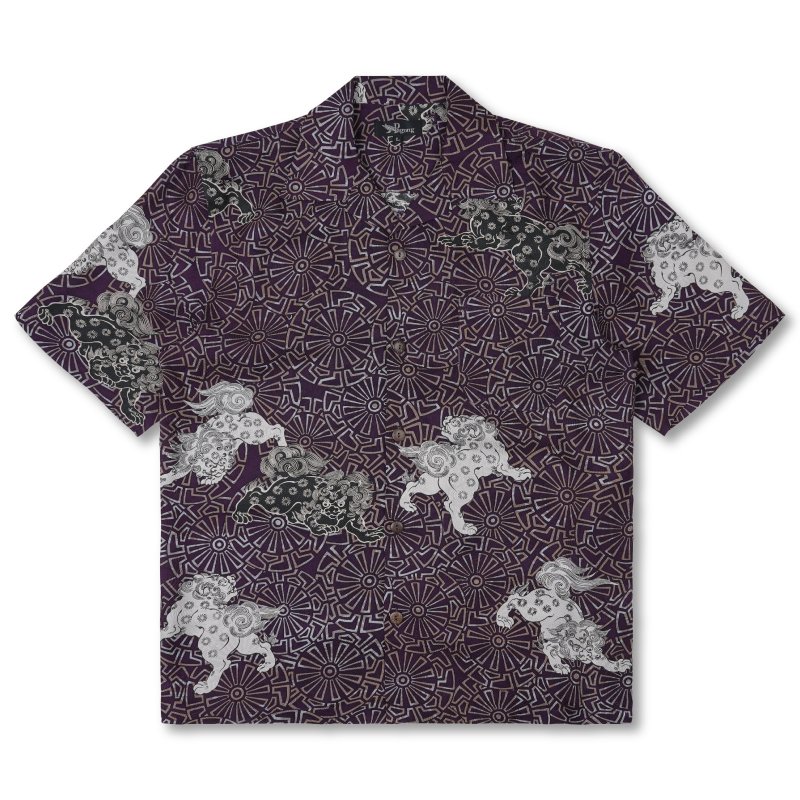
Japanese name / 狛犬と源氏車 - Komainu to genjiguruma
-About-
This pattern called komainu depicting shishi, "lion-dogs," stand at either side of the entrance to the shrine or the hall of worship. These fierce guardians are meant to protect the shrine from evil.These fierce guardians are meant to protect the shrine from evil.
The ultimate origins of these lionlike figures probably extend back to ancient India or even Egypt, but the more immediate source would appear to be Chinese.
Most komainu closely resemble the so-called (Divine Beasts). Typically, one of the creatures is depicted with its mouth open and the other with its mouth closed.
・Currency: US Dollar (USD)
・100% Silk (Custom-woven Jacquard )
・Made in Japan
・Classic-fit Aloha shirt
・Coconut buttons
・Dry-clean

Color / Violet and Multi-color Size Chart
Japanese name / 秋桜 (Cosmos)
-About-
The word "cosmos" has its roots in the Greek language, specifically in the word "Kosmos" or "Cosmos." This word initially meant "order" and "harmony." Since the Greeks believed that order and harmony were synonymous with beauty, the word "Kosmos" or "Cosmos" also came to represent "decoration" and "beauty." As a result, the universe, which is arranged beautifully and orderly, was named "Cosmos."
Cosmos are generally associated with a pink color, but some varieties bloom in orange or yellow. Although it is an autumn flower, it is a pattern often used on yukata as a stylish way to get ahead of the season.
・Currency: US Dollar (USD)
・100% Silk (Custom-woven Jacquard )
・Made in Japan
・Classic-fit Aloha shirt
・Coconut buttons
・Dry-clean

Japanese name/ 有楽斎好み
-About-
Sakura mochi in spring, refreshing warabi mochi in summer, kuri mochi in autumn, and strawberry daifuku in winter - wagashi, which allows you to feel the four seasons, is one of Japan's world-famous cultures. In the past, they were a treat associated with imperial ceremonies, but in modern times, they have come to signal the change of seasons, and you can see wagashi all over town. Wagashi seem to have a noble character, as they quickly retire once the season has passed, and can only be found in that season. This time, we have collaborated with Kyoto's long-established wagashi shop "Tachibanaya'' and "Pagong'', and produced textiles named after wagashi. While machine-made products are becoming mainstream, this pattern was created with the feelings of wagashi shop and dye shop that have been cherished for a long time.
・Currency: US Dollar (USD)
・100% Silk (Custom-woven Jacquard )
・Made in Japan
・Classic-fit Aloha shirt
・Coconut buttons
・Dry-clean

Japanese name/ 矢羽根 (Yabane)
-About-
Yabane is an auspicious design based on hawk, eagle, and other bird feathers which were used in arrows. Its pattern is associated with the Japanese saying that “an arrow fired, never returns”… A symbol for moving forward.
Especially in the Edo-era (1603-1868) the Yabane pattern was worn at wedding ceremonies as a symbol of a bright future and at graduations to represent unwavering determination.
Kiku, or chrysanthemums, were introduced to Japan via China in the Nara-era (710-794) and when combined with Yabane, traditionally symbolize the wish fora life blessed with everlasting happiness.
・Currency : US Dollar (USD)
・100% Silk (Custom-woven Jacquard )
・Made in Japan
・Classic-fit Aloha shirt
・Coconut buttons
・Dry-clean

Color / Light Blue and Black Size Chart Care Instruction
Japanese name/ 雪中雄鶏図
-About-
Jakuchū Ito (March 2, 1716 to October 27, 1800) was raised in the Nishiki area of Kyoto during the “golden age of art” of the Edo era, before Japan opened its doors to the outside world.
The eldest son of a wholesale vegetable merchant, Jakuchu was self-taught, and passionate about painting from childhood. A student of Buddhism at the Shokokuji Zen monastery, he devoted himself to the art of painting, taking inspiration from the temple’s collection of Chinese Yuan and Ming dynasty paintings.
He made thorough sketches of all natural phenomena, especially chickens and roosters, which he used to keep at his home as pets, in order to closely observe and study their nature.
This is Jakuchu’s earliest known painting, created in his thirties when he was still actively working in his family’s business. In a playful style which he would become known for, Jakuchu depicts a lone rooster pausing for a moment, aloof from the world, searching for food among the thickly-piled snow.
The rooster is considered a creature of virtue, and in this outstanding rendering, Jakuchu’s meticulous attention to precision and detail bring the subject to life.
At Pagong, in celebration of the 300th anniversary of the birth of Jakuchu Ito, we wish to breathe new freshness into this masterpiece with the use of a kimono dyeing technique called Kyo-Yuzen.
~A collaboration with the Hosomi Museum, Kyoto.
・Currency : US Dollar (USD)
・100% Silk (Custom-woven Jacquard )
・Made in Japan
・Classic-fit Aloha shirt
・Coconut buttons
・Dry-clean
Color / Water Blue Care Instruction
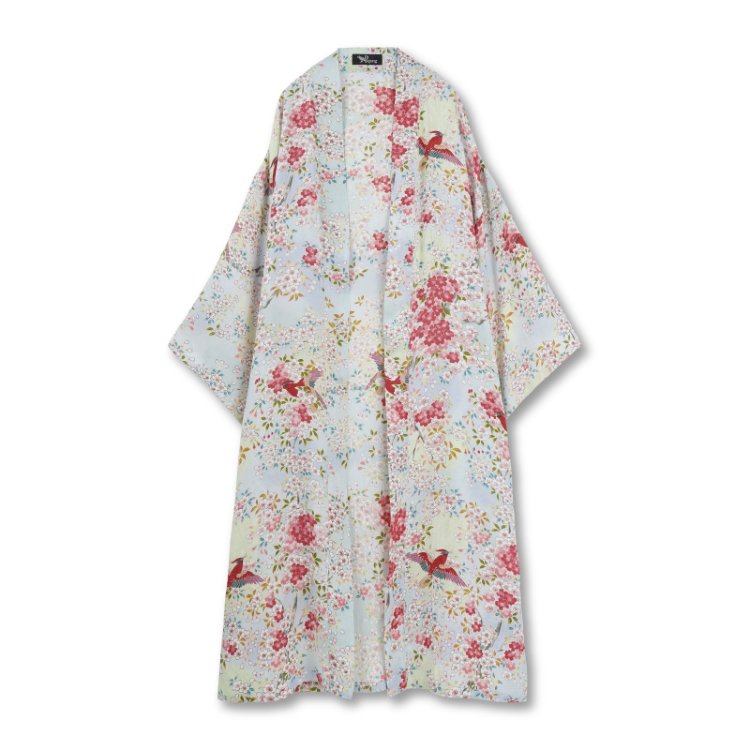
Japanese name/さくら (Sakura)
-About-
Sakura, or cherry blossoms, are Japan’s national flower in the hearts of the people. Every spring, throngs of Japanese people and visitors make efforts to see this well-loved flower, a tradition known as “hanami”, a flower-viewing and picnic event to enjoy the blossoms.
Widely celebrated in Japanese literature, poetry, and art, sakura carry layered meanings. For example, because they bloom briefly, the blossoms are often seen as a metaphor for the ephemeral beauty of living. The brilliant blooming season is powerful, glorious, and intoxicating, but short-lived, a visual reminder that our lives, too, are fleeting.
The joyful tradition of hanami is an old and ongoing tradition, and can be traced back centuries in Japanese culture. The eighth century chronicle Nihon Shoki records hanami festivals being held as early as the third century AD.
The style of this painting is from the Maruyama school of the Edo era (1603-1868).
・ 100% Silk
・One-Size-Fits-All
・Made in Japan
・Dry-wash
・Currency : US Dollar (USD)

Color / Purple and Multi-color Care Instruction
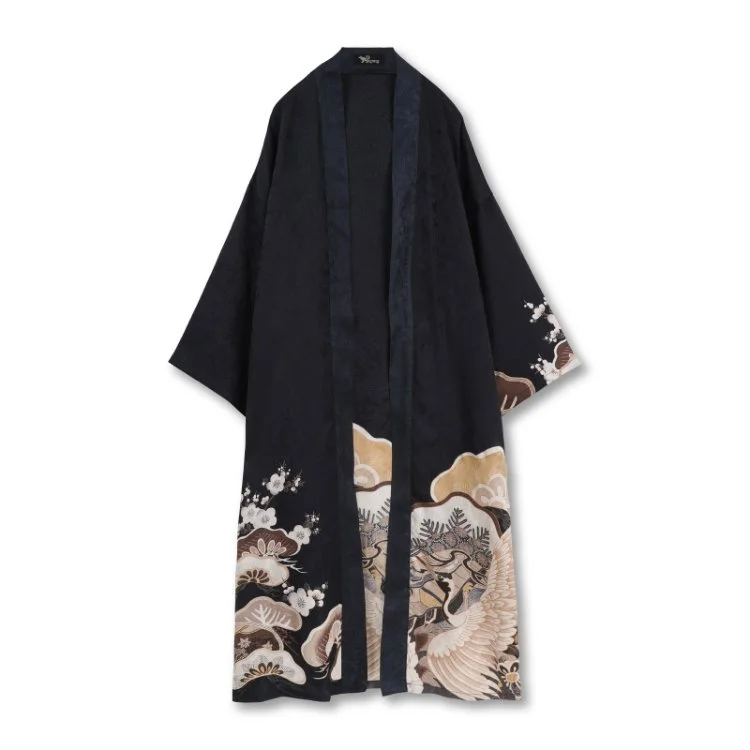
Japanese name/ 百年の鶴 (Momotose No Tsuru)
-About-
In Japanese mythology, the tsuru, or crane, comes from Mount Horai in heaven, and carries happiness and good fortune to earth. Since the crane was believed to live 1,000 years, in Japan it is revered as a symbol for resilience, strength and long life.
The matsu, or pine, in reality, CAN live for up to 1,000 years; therefore it is also a symbol for long life, as well as strength.
The ume, or plum, always blooms during the harsh, cold winter; signifying vitality, and life-force.
In 2019, in order to celebrate the 100th Anniversary of our founding company Kamedatomi LTD, this exquisite pattern was especially chosen to represent our sincere wish for everyone:
“One Hundred Years of Happiness, Continued Good Health, and a Long Prosperous Life“.
・ 100% Silk
・One-Size-Fits-All
・Made in Japan
・Dry-wash
・Currency : US Dollar (USD)
Color / Black and Multi-color Care Instruction
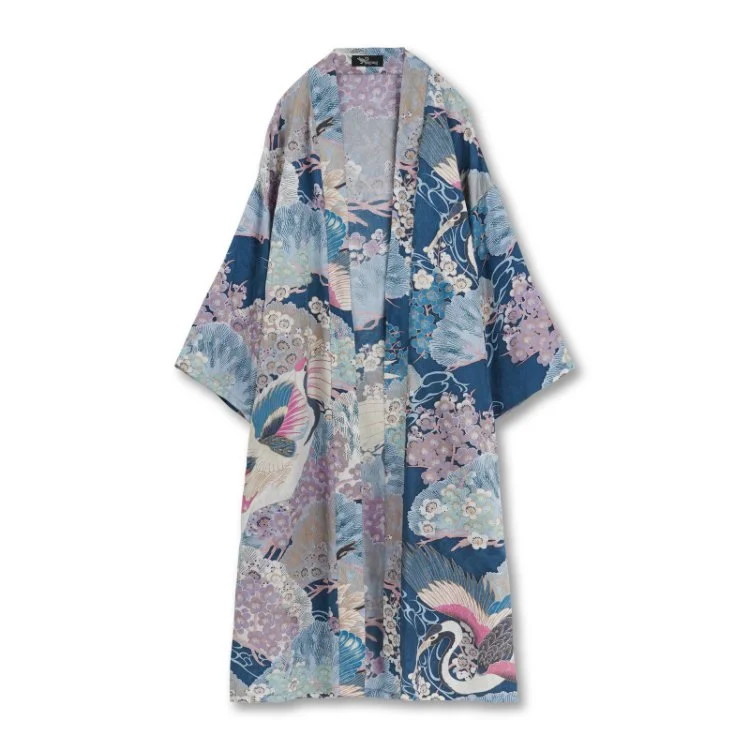
Japanese name/ 舟と鶴 ( Fune to Tsuru )
-About-
Classic Japanese design will often reflect an artisan’s delicate sensibility, and their deeply felt connection to nature. This exquisitely rendered pattern of a boat with crane is no exception, which celebrates all which is good in life, and a fresh beginning.
In ancient Japanese mythology, the tsuru or crane, comes from Mount Horai in heaven, and carries divine happiness and good fortune to earth. According to myth, it can also live 1,000 years, therefore the tsuru is widely revered as a symbol for strength, and long life.
The boat depicted in this pattern is symbolically being rowed into the ocean of the heavens, which signifies a future destined to be blessed, and filled with much happiness.
The boat and crane when represented together, are symbols of protection, which is why they are often seen embellishing elegant wedding kimono.
Also presented are specific plant-life chosen for their special meanings such as matsu, ume, and kiku.
Matsu, or pine, can live in reality over 1,000 years, therefore represent longevity, and resilience. Ume, or plumblossoms, have the ability to bloom during harsh, cold winters, therefore they are symbolizing vitality and life-force. Kiku, or chrysanthemums, are also representative of longevity, as well as rejuvenation and nobility, since the chrysanthemum is a symbol for the emperor and appears on the Japanese imperial seal.
Traditionally dyed Japanese designs such as “Boat With Crane” contain an illustrious language of symbols, one which exemplifies the grace, elegance, and ultimate refinement of centuries of preserved textile heritage.
・ 100% Silk
・One-Size-Fits-All
・Made in Japan
・Dry-wash
・Currency : US Dollar (USD)
Color / Blue and Multi-color Care Instruction
Japanese name/ 百年の鶴 (Momotose No Tsuru)
-About-
In Japanese mythology, the tsuru, or crane, comes from Mount Horai in heaven, and carries happiness and good fortune to earth. Since the crane was believed to live 1,000 years, in Japan it is revered as a symbol for resilience, strength and long life.
The matsu, or pine, in reality, CAN live for up to 1,000 years; therefore it is also a symbol for long life, as well as strength.
The ume, or plum, always blooms during the harsh, cold winter; signifying vitality, and life-force.
In 2019, in order to celebrate the 100th Anniversary of our founding company Kamedatomi LTD, this exquisite pattern was especially chosen to represent our sincere wish for everyone:
“One Hundred Years of Happiness, Continued Good Health, and a Long Prosperous Life“.
・ 100% Silk
・One-Size-Fits-All
・Made in Japan
・Dry-wash
・Currency : US Dollar (USD)
Color / Blue and Multi-color
Size Chart Care Instruction
Japanese name/ CHOJUKABOKUZU / JAKUCHU ITO
-About-
Jakuchu Ito (1716 to 1800) was raised in the Nishiki area of Kyoto during the “golden age of art” of the Edo era, before Japan opened its doors to the outside world.
Jakuchu was self-taught, and passionate about painting from childhood. A student of Buddhism at the Shokoku-ji zen monastery, he devoted himself to the art of painting, taking inspiration from classic Chinese paintings from the Yuan and Ming dynasties.
With nature as his teacher, he also began making thorough sketches of all natural phenomena, eventually establishing his own richly colored style of painting, as portrayed here in his “Birds,Animals, and Flowering Plants in an Imaginary Scene”, originally a pair of six-panel folding screens.
This timeless expression of flora and fauna is a testament to Jakuchu Ito’s originality and genius. It is comprised of roughly 43,000 squares within each of the painting’s panels. Animal figures within the scene are alive and alert showing their true nature in a style characteristic of Jakuchu.
At Pagong, in celebration of the 300th anniversary of the birth of Jakuchu Ito, we wish to breathe new freshness into these extraordinarily detailed depictions of plants and animals with the use of a kimono dyeing technique called Kyo-Yuzen.
~A collaboration with Idemitsu Museum of Arts.
・Currency : US Dollar (USD)
・100% Silk (Custom-woven Jacquard )
・Made in Japan
・Classic-fit Aloha shirt
・Coconut buttons
・Dry-clean