
Morning Glory
朝顔 - Asagao
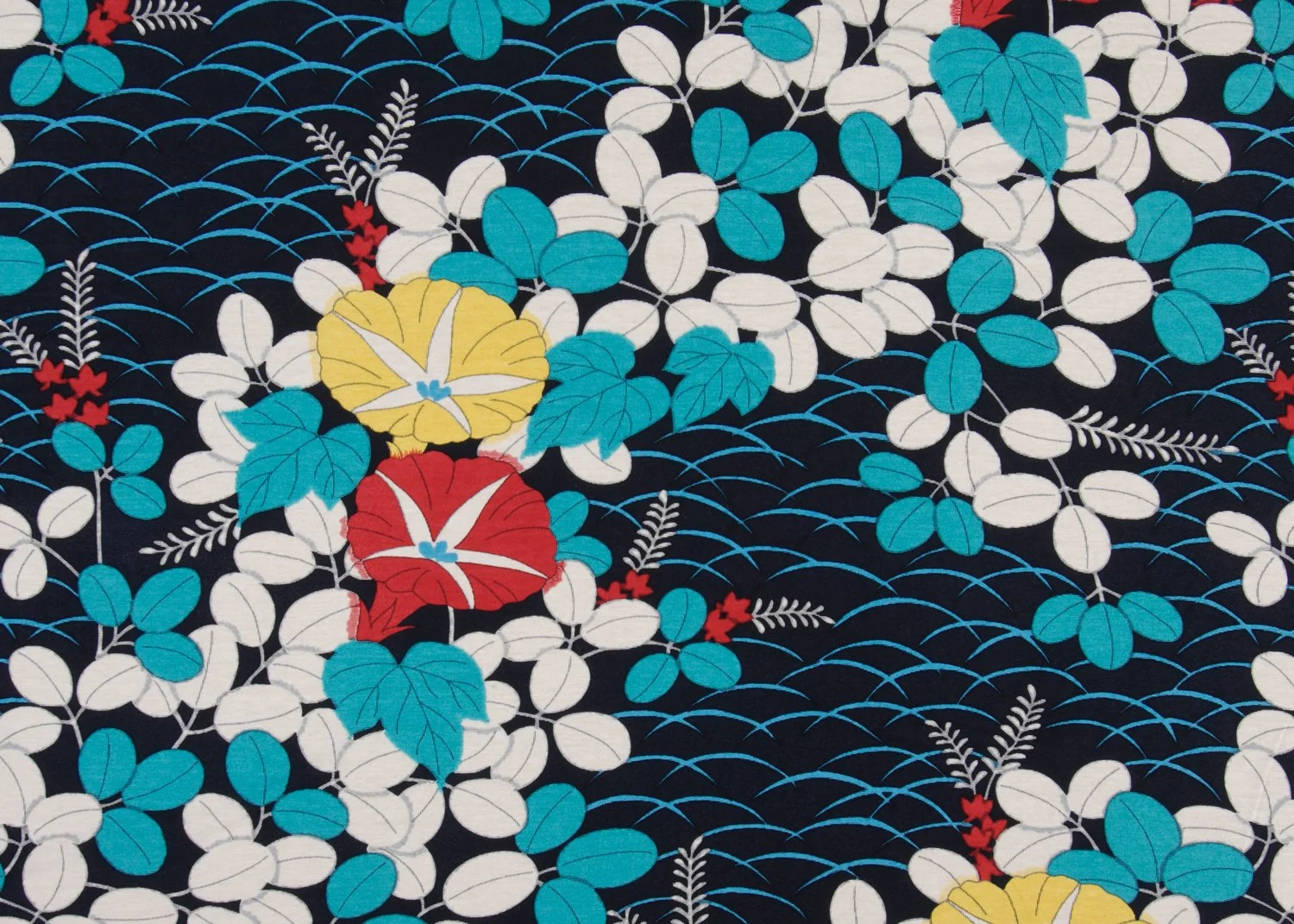
The Story of the Meisen Pattern
This design is a reproduction of a “Meisen” pattern from the early Showa period, created during the post–Art Deco era known as High Art Deco. At the time, Japanese design began embracing Western influences, especially bold American-style color palettes. Bright, strong contrasts became a defining feature, giving traditional motifs a fresh and modern expression.
In this pattern, vivid blue pampas grass stands out against a deep black background, accompanied by green leaves and accents of red, yellow, and white. While Western-style flowers were not yet widely accepted in Japan, this design keeps its roots in Japanese seasonal motifs, using color alone to express a new, modern sensibility.
Meisen is also known for its unique production technique. Instead of dyeing fabric after weaving, the threads themselves are dyed first using a method called kata-yuzen. Both warp and weft threads are printed with the pattern and then woven together. Because of this process, the design naturally develops slight misalignments and soft color bleeding, where hues gently extend beyond their outlines. This effect is not accidental—it is one of the most distinctive and appreciated characteristics of Meisen textiles.
This pattern recreates that original technique, carefully expressing the subtle blurring and depth that come from thread-based dyeing. When you look closely, the colors appear to flow softly from the flowers and leaves, giving the design a sense of movement and life.
The motif itself features the “Seven Autumn Flowers,” including pampas grass, bush clover, and morning glory. Although they are known as autumn flowers, many of them bloom in summer. Morning glories, in particular, bloom in the early morning, evoking a sense of freshness and seasonal transition.
These flowers have long been celebrated in Japanese culture. In the Manyoshu, one of Japan’s oldest poetry collections, the poet Yamanoe Okura wrote about the seven autumn flowers. Interestingly, it is believed that the “morning glory” mentioned in the poem may actually refer to the bellflower, adding a layer of poetic interpretation to the design.
The result is more than a pattern — it is a reflection of a moment in time, where tradition and modernity quietly meet.