
Rising Dragon
波に龍 - Nami ni ryu
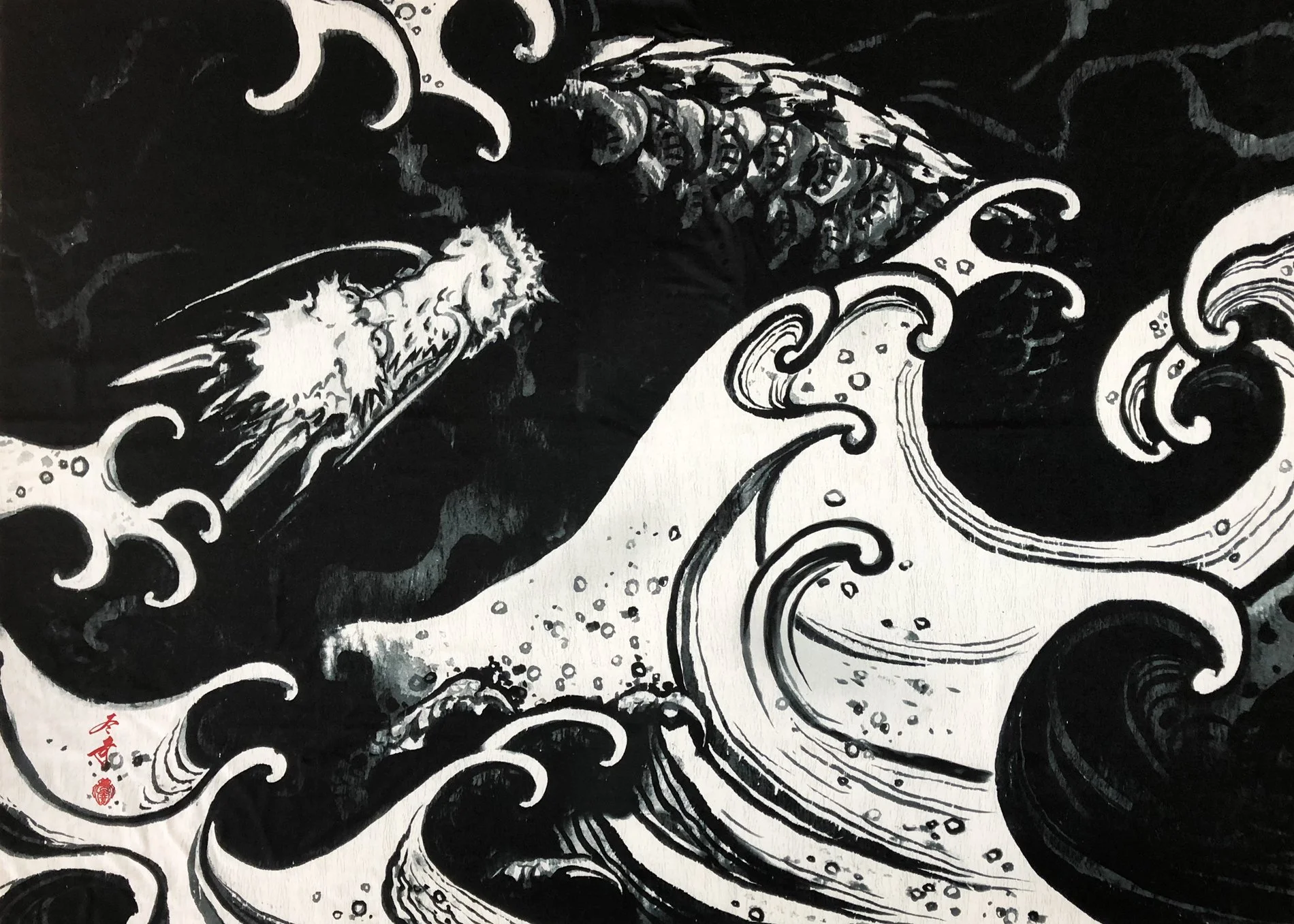
The Story of the Rising Dragon Pattern
This piece showcases the work of Kyoto town painter Fuyuki Fukaya, expressed through the world of Kyoto Yuzen dyeing at Pagong.
Fuyuki Fukaya is originally from Kanagawa Prefecture. After graduating from high school, he moved to Tokyo, and soon after relocated to Kyoto, the cultural heart of Japan, to pursue his artistic path. After studying Japanese painting, he spent 15 years working as a hand-painted Yuzen dye artisan at “Seisei.” During this time, he deeply explored traditional Japanese aesthetics, spirituality, and the universal values that should be preserved and passed on. Today, he continues to refine his craft daily, evolving his designs for contemporary life while aiming to contribute to global cultural expression. As a Kyoto-based town painter, he creates patterns across a wide range of themes connected to lifestyle, both in Japan and abroad.
The dragon is a mythical creature conceived in ancient Chinese imagination, believed to possess the ability to transform freely. It was thought to govern earth and water, control rainfall, ensure good harvests, and ward off epidemics.
Associated with the legend of the “Dragon Gate,” the dragon also became a symbol of success, transformation, and advancement in life.
It is said that the dragon was introduced to Japan from the Asian continent around the 4th to 5th century as a divine messenger. In Japan, where beliefs in serpentine deities symbolizing fertility, water control, and agricultural blessing already existed, the dragon was naturally accepted and came to be revered as a water deity capable of controlling clouds and rain.
The powerful imagery of waves—unceasing, shifting, and breaking—has long been stylized in Japanese decorative arts and textiles. Waves were also believed to be manifestations of water deities, and offerings such as swords, armor, and rituals were once dedicated to calm turbulent seas.
During the Sengoku period, wave motifs became especially popular among warlords who valued strength and strategy, appearing on family crests, battle standards, and armor. As such, waves also came to symbolize fortune in battle and protection in conflict.
In this composition, a dragon emerges from massive, surging waves, creating a fantastical and powerful scene. The image suggests the dragon commanding the waves and revealing itself from within them—an echo of ancient beliefs in the mysterious and sometimes feared power of water deities.
This “Dragon in Waves” design, combining symbols of prosperity, success, and victory, is a motif that embodies strength and confidence, especially at decisive moments in life.