
Round Chrysanthemum
丸菊 - Marugiku
The Story of the Round Chrysanthemum Pattern
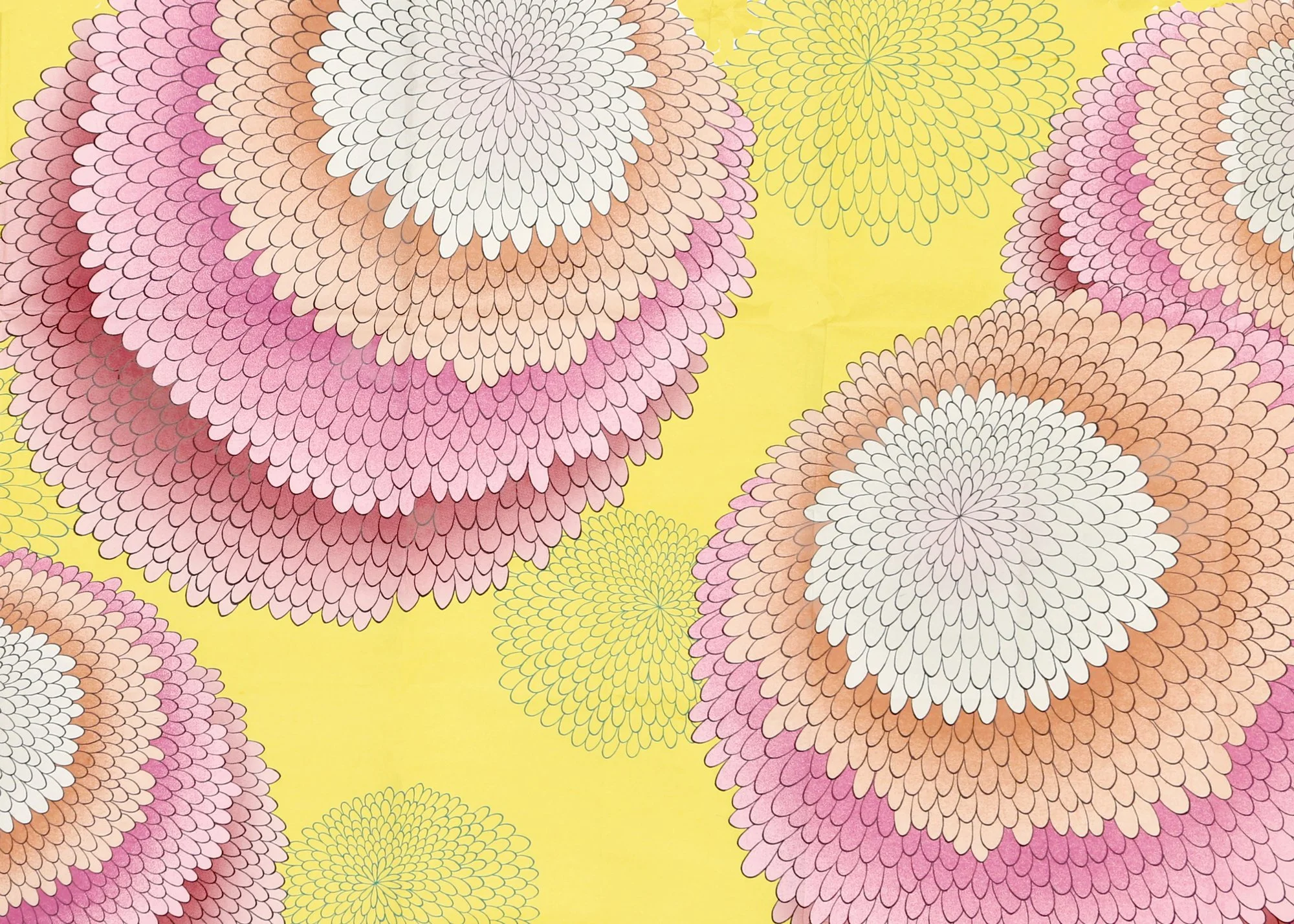
Patterns featuring scattered circular motifs—such as marumon (round crests) and decorative balls—have long been cherished as symbols of harmony and celebration. In this design, large, richly layered chrysanthemums are depicted with a striking boldness, their three-dimensional forms resembling fireworks blooming across the night sky. Their rounded, full shape is reminiscent of the “ping-pong chrysanthemum,” known for its perfectly spherical form.
In the world of traditional Japanese design, the circle—referred to as “maru”—has been regarded as a form that embodies the universe itself. Since ancient times, it has been used as a symbolic representation of the sun and moon, carrying deep spiritual significance. From the Heian period onward, circles came to be appreciated not only for their grandeur but also for their elegance and familiarity, leading to the creation of countless round motifs featuring plants and animals.
Design books from the Edo period, such as collections of Yuzen patterns, show an abundance of circular designs, reflecting their popularity at the time. The chrysanthemum, naturally circular in form, lends itself perfectly to such compositions and is used here as a bold marumon motif.
The voluminous, spherical chrysanthemums in this design express harmony and auspiciousness through their fullness and presence. By incorporating the rounded form of Western-style chrysanthemums and boldly stylizing them, the design gives a modern reinterpretation to a traditional motif.
The chrysanthemum’s association with longevity and vitality is further enhanced when combined with the symbolic power of the circle, creating a design imbued with even greater auspicious meaning.