
Snake gourds and Insects
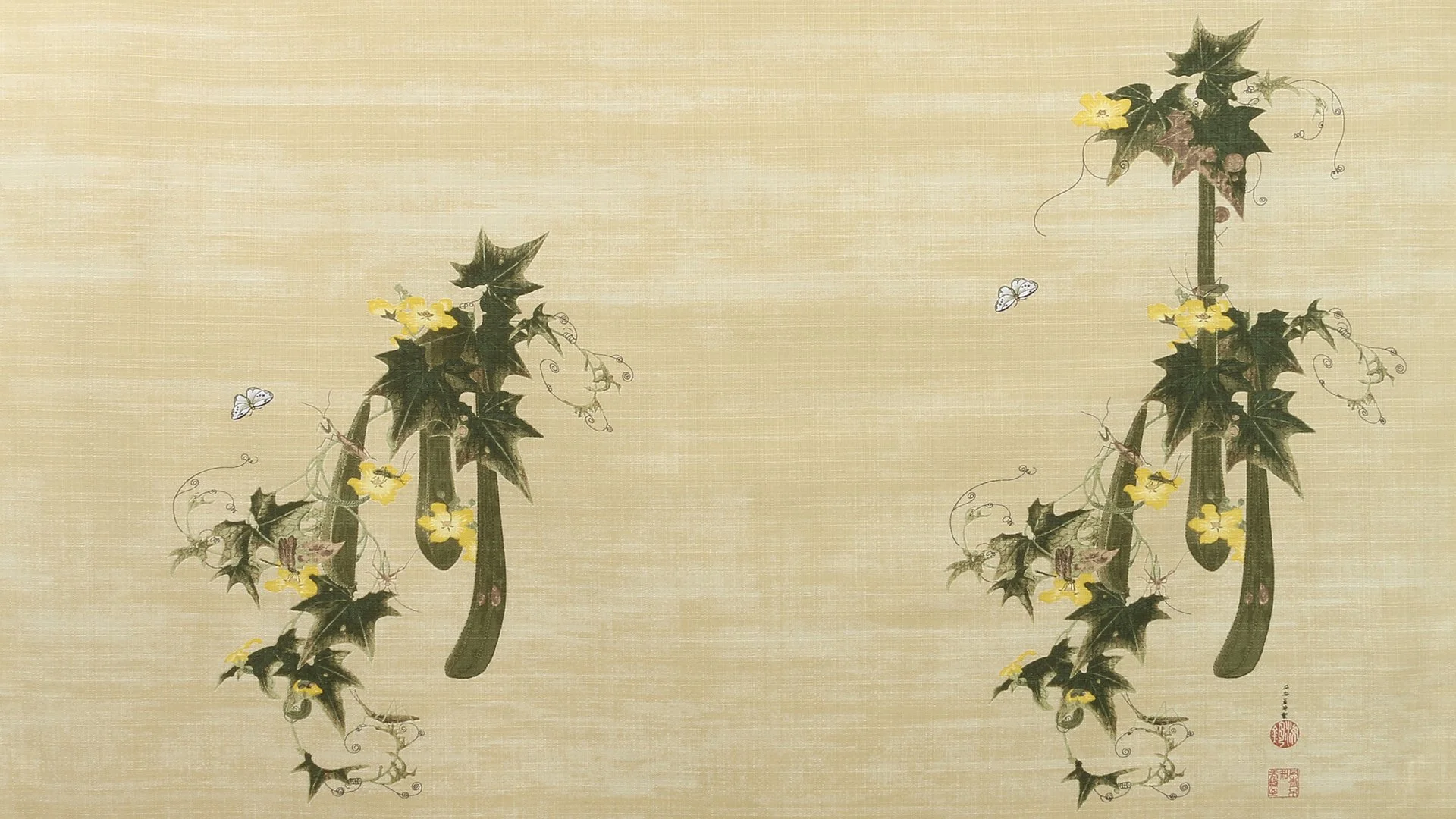
糸瓜群虫図 - Hechimagunchūzu
The Story of the Snake gourds and Insects Pattern
Ito Jakuchu (1716–1800) was a painter active in Kyoto during the mid-Edo period.
Born as the eldest son of the Masuya greengrocer in Kyoto’s Nishikikoji district, he inherited the family business at the age of 23 under the name Ito Genzaemon IV. At 40, he passed the business to his younger brother and devoted himself entirely to painting.
This work, depicting a gourd with swarming insects, is believed to have been created when Jakuchu was around 38 or 39 years old—just before he retired from the family trade. A variety of insects move freely across the long, slender gourd, portrayed with remarkable precision. From the large bite marks and delicate leaf veins to the curling tendrils and intricate insect forms, the painting reveals Jakuchu’s deep curiosity and affection for the natural world.
At first glance, the gourd and insects seem to merge into a single composition, but closer observation reveals a total of eleven distinct creatures. While the combination of gourds and insects is a traditional motif in Chinese insect painting, Jakuchu reinterpreted it through his own highly personal and expressive style.
This artwork was once treasured by Masuyama Sessai (1754–1819), the lord of the Ise Nagashima domain and a noted painter with a strong interest in natural history, who even kept his own illustrated insect records. It is also said that Tomioka Tessai later created a copy of this work and inscribed its storage box.
Today, the original piece is housed in the Hosomi Museum in Kyoto. With the museum’s cooperation, the design has been reproduced using Yuzen dyeing.
Marking the 300th anniversary of Jakuchu’s birth in 2016, Pagong selected this milestone as a theme, reimagining the dynamic beauty of Gourd and Insects through the refined and expressive medium of Yuzen dyeing.