
Tank
戦車 - Sensha
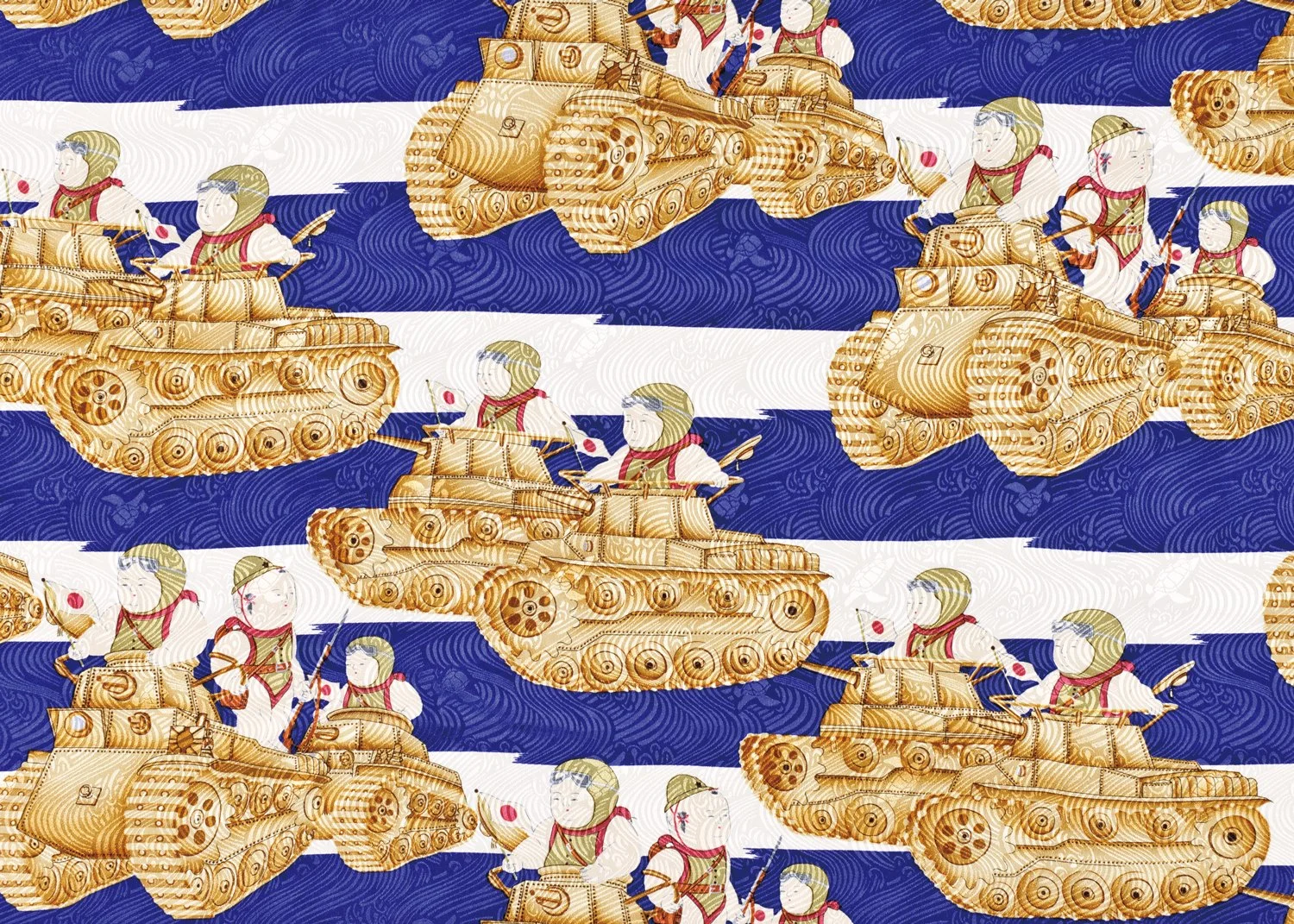
The Story of the Tank Pattern
From the Meiji era to the early Shōwa era, kimono designs evolved beyond traditional patterns to boldly reflect the social conditions of their time. Motifs began to include popular figures, exotic animals, scenes of war, and current events. This particular design, created for a boy’s kimono in the early Shōwa period, vividly captures Japan as it moved toward an era of conflict.
In the early Meiji era, children’s kimono often featured themes drawn from fairy tales and moral teachings, expressing ideas such as “good deeds bring good rewards” and “evil actions will be punished.” By the Taishō era, as children came to be seen as the future of the family and society, admiration for Western culture grew. Designs began to emphasize character development, incorporating motifs related to sports, literature, and nursery rhymes.
However, in the Shōwa era, these themes shifted dramatically. As Japan advanced toward war, kimono patterns began to reflect militarization, featuring tanks, fighter planes, and warships.
This early Shōwa design portrays a tank advancing forward with a child riding inside it. Alongside airplanes and naval vessels commonly seen in wartime motifs, tanks were depicted as exciting vehicles that captured children’s imaginations. The child is represented as a Gosho Ningyō—a doll symbolizing the ideal child. With its round form representing abundance and good fortune, the Gosho Ningyō traditionally embodies innocence and prosperity.
Yet here, that innocence is transformed. The doll wears a military uniform, waves a Japanese flag, and in some cases even holds a bayonet. Its expression is stern—far removed from the gentle, playful image typically associated with Gosho Ningyō. Designs like this, which stirred and encouraged a fighting spirit in children, were even used in formal wear, imprinting the atmosphere of war onto young, impressionable minds.
More than sixty years have passed since the end of the war, and for many in modern Japan, it may feel like a distant past. Yet across the world, conflict remains an ongoing reality. Even today, there are places where children are drawn into war, encouraged—or forced—to fight.
When you look at this design, or wear it, take a moment to reflect. It offers not only a glimpse into history, but also a chance to consider what “peace” truly means.