
Treasure with floral carriage
花車と宝尽し - Hanaguruma to Takarazukushi
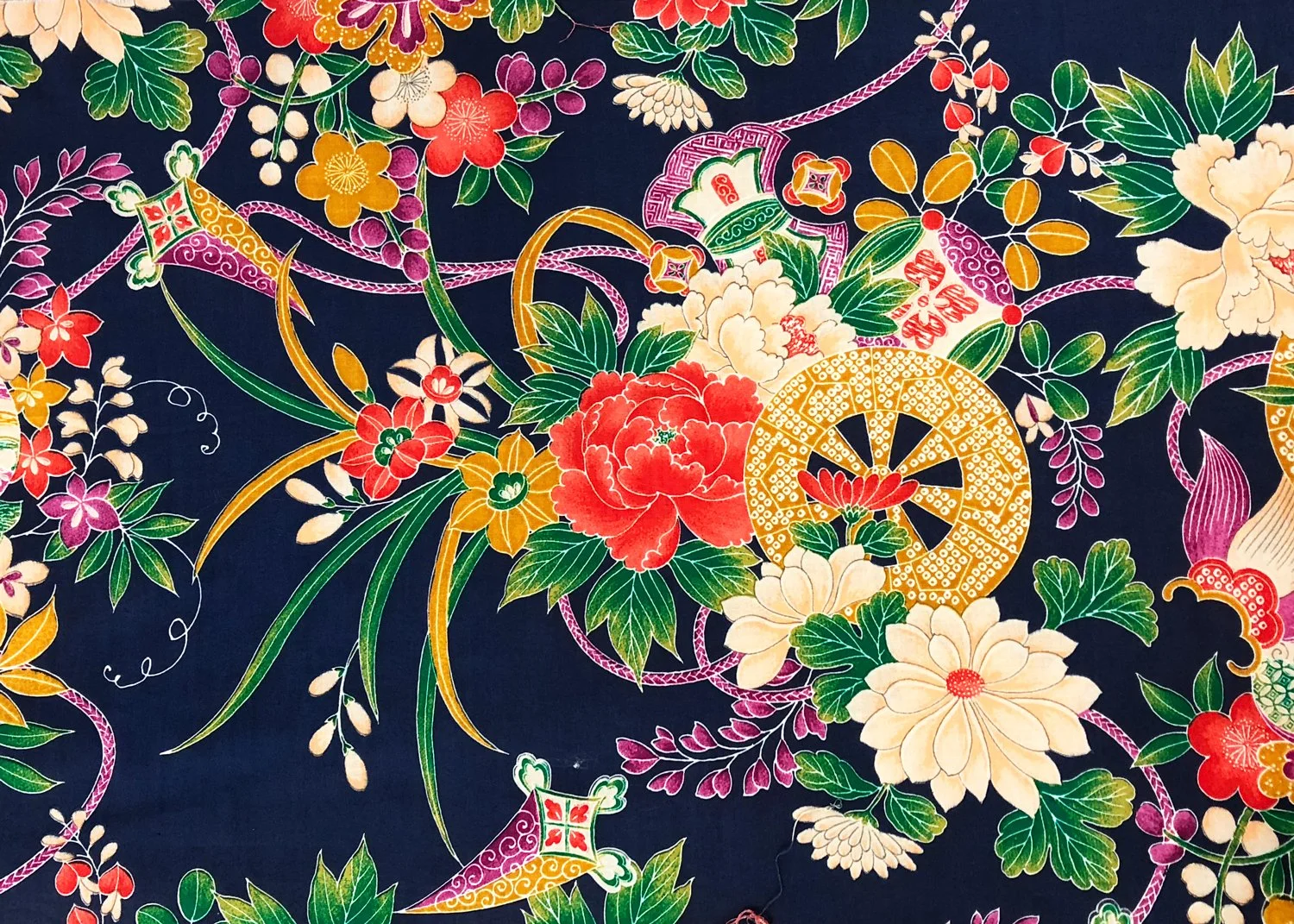
The Story of the Treasure with floral carriage Pattern
This pattern dates from the early Shōwa period and was used for a young girl’s formal kimono.
A flower cart overflowing with seasonal blossoms is adorned with various treasures. The design expresses a parent’s heartfelt wish that their daughter may live a life as beautiful as flowers and as prosperous as the treasures depicted.
Among the flowers, the peony is known as the “king of flowers” for its magnificent and opulent appearance, and is regarded as the ultimate symbol of wealth and nobility. It also carries the meaning of attaining prosperity and high status—perhaps even reflecting a wish for a fortunate and elevated future.
The chrysanthemum has long been associated with longevity. In an old tale, a youth is said to have lived for hundreds of years by drinking dew from chrysanthemum leaves, and the flower came to be regarded as a plant of immortality. In Japan, since the Heian period, the Double Ninth Festival (September 9) has been celebrated at court, where poems were composed and chrysanthemum sake was enjoyed in prayers for health and long life.
The plum blossom blooms early in the cold, ahead of other flowers, and releases a refined fragrance. For this reason, it symbolizes perseverance and noble character, and is also associated with cultural refinement through its frequent appearance in literature.
The narcissus, whose bulbs multiply readily, represents fertility and prosperity. The paulownia, a traditional crest motif for women in Japan, is also included. Together, the plum, peony, chrysanthemum, and other seasonal flowers create a vision of a heavenly, otherworldly realm.
The “treasure motif” (takara-zukushi) was introduced from the Asian continent and became widely used in decorative design from the Muromachi period onward. It includes symbolic items such as the wish-granting mallet (which brings anything one desires), a pouch filled with gold, the invisible cloak, weights representing wealth and balance, a rhinoceros horn symbolizing victory, and the shippo pattern, whose endlessly connected circles represent harmony and the prosperity of descendants.
Filled with beautiful flowers and auspicious symbols, this kimono for a young girl embodies heartfelt wishes for happiness, prosperity, and a blessed future.
Note: The paulownia is a familiar and traditional crest in Japan. It is also considered a noble tree said to be inhabited by the mythical phoenix only in times of peace and harmony.