
Tsujigahana
道長取りに辻が花 - Michinaga-tori ni tsujigahana
The Story of the Tsujigahana Pattern
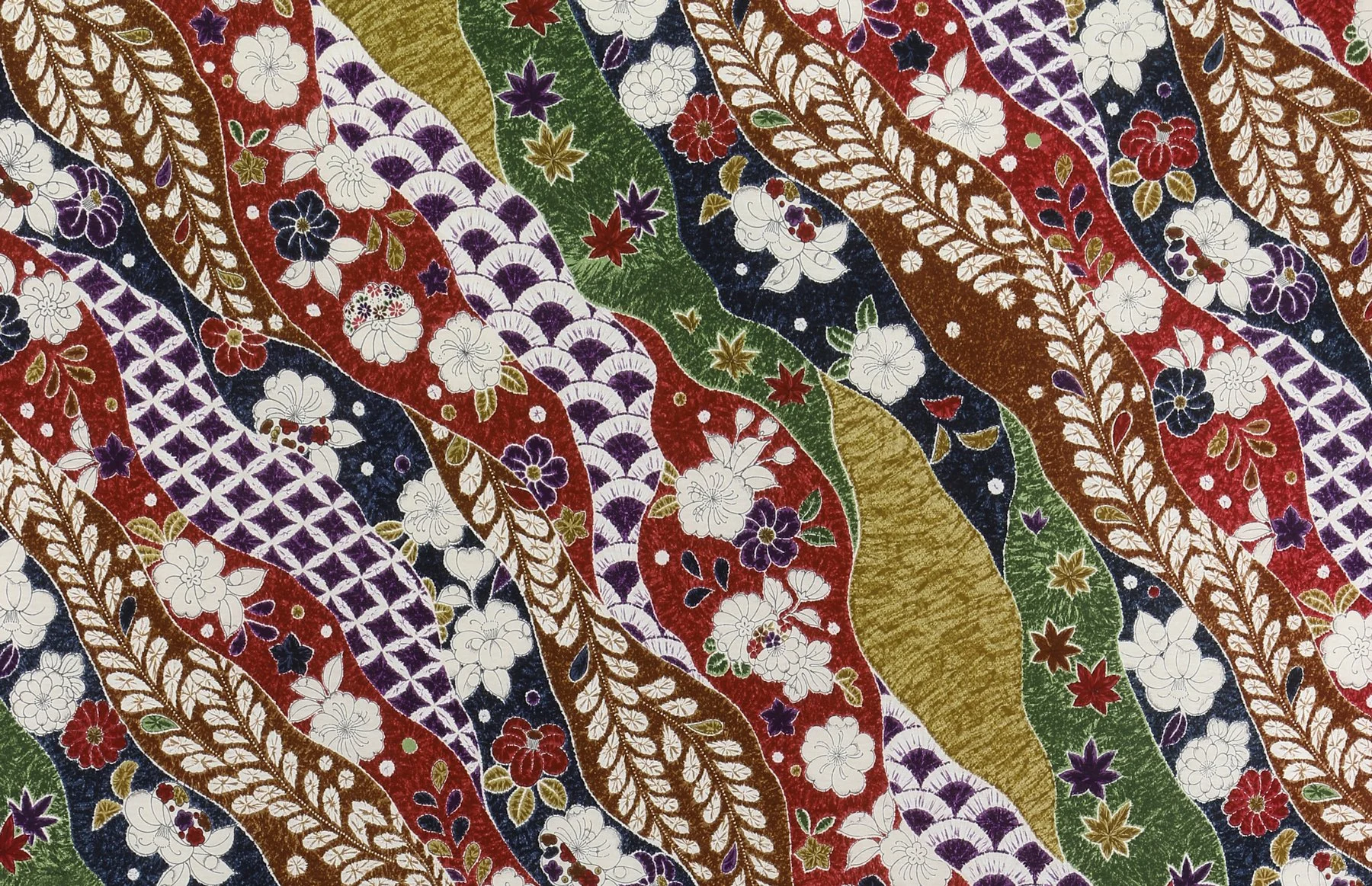
Michinaga-dori refers to a compositional style that resembles torn pieces of washi paper arranged diagonally across the design. It is said to be named after Fujiwara no Michinaga of the Heian period, who favored this aesthetic.
The term tsujigahana has several theories regarding its origin, but today it generally refers to a decorative dyeing style that flourished from the late Muromachi to the Momoyama period. It is characterized by a base of tie-dye techniques, combined with hand-painted details, metallic embellishments, and embroidery to create richly expressive patterns.
At its core, tsujigahana builds upon traditional tie-dye methods that date back to the Nara period. These range from simple techniques—where fabric is bound or tied before dyeing—to more elaborate methods in which stitched outlines are used to create multicolored, pictorial designs. Another key feature is kaki-e, a technique in which designs are directly painted onto the fabric.
One notable method within tie-dye is koketsu, in which stitched threads resist the dye, preventing it from penetrating certain areas of the fabric. In tsujigahana, outlines are often created using this resist technique, then enhanced with ink painting, giving the designs their distinctive character.
This pattern also incorporates auspicious motifs. Interlocking circles form the shippo-tsunagi pattern, symbolizing harmony and infinite connections. The seigaiha motif, with its overlapping semicircles, evokes waves and represents endless continuity. The kikkō pattern, resembling a turtle shell made of hexagons, is associated with longevity. All of these geometric designs share a common theme of continuity and eternity.
In this design, seasonal flowers—such as cherry blossoms of spring, wisteria of early summer, bellflowers of autumn, chrysanthemums of late autumn, and camellias of early spring—are arranged within the michinaga-dori composition. Rather than traditional tie-dye, the pattern is expressed using stencil-based Yuzen dyeing techniques.
Together, the flowing arrangement of seasonal flowers and the continuous geometric motifs celebrate the unending cycle of the seasons, expressing a wish for enduring beauty, harmony, and prosperity.