
Yohen Tenmoku
曜変天目
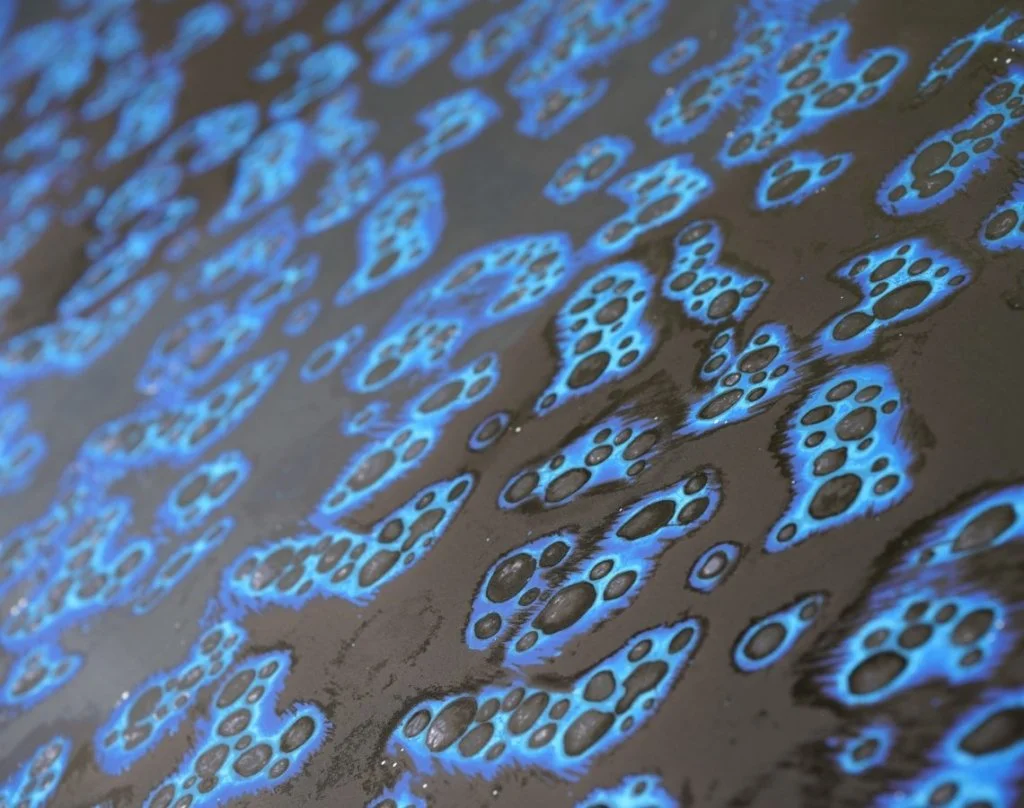
The Story of the Yohen Tenmoku Pattern
Each measuring only about 12 centimeters (less than 5 inches) across, these tea bowls contain what appears to be a “galaxy aglow with stars” within their depths.
There are only three intact Yohen Tenmoku tea bowls known to exist in the world. These extraordinary works are believed to have been produced at the Jian ware kilns in Fujian, China, during the Song dynasty.
Although tea culture flourished in Japan during the Muromachi period, these bowls were introduced earlier by a Japanese Zen monk who trained at Tianmu Mountain (Tenmoku) in Zhejiang, China—giving rise to their name in Japan.
Tenmoku tea bowls are characterized by their black glaze, with interiors displaying iridescent patterns and lapis lazuli-like hues that shift between deep blue and bluish-purple. The term “Yohen” refers to these luminous, ever-changing patterns formed naturally during the firing process. The exact method behind their creation remains unknown, and it is widely believed to be impossible to replicate. As such, Yohen Tenmoku represents the highest grade of Tenmoku ware and is regarded as the most precious among black-glazed tea bowls produced at Jian kilns.
In recent years, fragments of Yohen Tenmoku have been excavated from the site of an imperial guesthouse in Lin’an (modern Hangzhou), once the Southern Song capital. This discovery has drawn significant global attention.
Today, the three complete bowls are preserved in Japan: one at Ryoko-in in Kyoto, one at Fujita Museum in Osaka, and one at the Seikado Bunko Art Museum in Tokyo. All three have been designated as Important Cultural Properties by the Japanese government.
It is both an honor and a joy for Pagong Kyoto to have been selected by the Seikado Bunko Art Museum to reinterpret these ancient and mysterious patterns through Kyoto Yuzen dyeing—allowing their timeless beauty to be appreciated once again in a new artistic form.